At 6:27 on a weekday morning, a thermos appears beside a flower bed.
A woman walks across the square, nods to two people she knows, and takes a place near the back of a familiar formation. Nobody calls her name. Nobody assigns the position.
Three minutes later, the speaker comes on.
A woman at the front turns toward the group. The dancers arrange themselves in rows. The experienced members move into place almost automatically. Newcomers stay toward the outside or rear. Someone adjusts the speaker. Someone else checks a phone. A few people sitting on a bench watch without joining.
From a distance, it looks like a group of people exercising together.
Stand there for another ten minutes, however, and something else becomes visible.
You can begin to see who teaches, who controls the music, who remembers the choreography, who has seniority, who is new, who mediates disagreements, and who has enough social standing to move from the back toward the center.
This is one of the most interesting things about Guangchangwu (广场舞): its social organization is often visible in the choreography itself. This article is a field guide to reading that organization.
It is not a claim that every Guangchangwu group follows one universal hierarchy. A five-person riverside group, a neighborhood exercise team, and a 300-person competition troupe may operate very differently. But ethnographic research and observations of public-square dancing repeatedly show that formation, movement, spatial boundaries, and everyday interaction carry social meaning. Research on Guangchangwu has specifically examined how bodies influence interaction and social differentiation, while newer urban research shows how dance groups continually negotiate their boundaries with other users of public space.
If you know what to look for, the dance floor becomes a map.
1. The Front Rank Is the Interface
In many ordinary fitness-oriented Guangchangwu sessions, dancers face the same direction and arrange themselves in open rows.
The person at the front demonstrates the movements.
The people immediately behind her copy what they see.
Those behind them copy again.
The result is a human transmission system.
It is easy to mistake this for nothing more than choreography. But the formation also solves a practical organizational problem: how can dozens of people learn, remember, and perform the same sequence without a formal classroom?
The answer is distributed visual memory.
The front rank is therefore more than the first line of dancers. It is the interface between the person teaching and everyone else.
If a new song begins, watch the first few seconds.
Who looks directly toward the leader?
Who already knows the opening movement?
Who makes a correction without being corrected?
Who hesitates and then catches up?
Those observations often reveal experience more clearly than age or clothing does.
How to spot the lead
You usually do not need to ask.
Look for the person who:
- Faces the group rather than facing the same direction as everyone else.
- Demonstrates the movements.
- Controls or coordinates the beginning of a routine.
- Is repeatedly watched by dancers in the front rows.
- May use a microphone, although a microphone is not essential.
The lead and the person controlling the speaker may be the same person. They may also be completely different people.
That distinction becomes important later.
The geometry also helps distinguish Guangchangwu from Western forms that are sometimes translated as “square dance.” Western square dance traditionally organizes dancers into closed groups of four couples and relies heavily on a caller. Guangchangwu commonly uses an open-facing formation in which movement is visually transmitted through rows.
That difference is not merely aesthetic. It reflects a different way of organizing participation.
For more on why the English phrase “Chinese square dancing” can create confusion, see our guide to Guangchangwu vs. Square Dance.
2. The Speaker Is Another Center of Authority
The most visible person in a Guangchangwu session is usually the leader.
The most important person to the music may be standing several meters away.
Look for the speaker.
It may be sitting on a folding table, beside a tree, under a shelter, or on a small trolley. Around it you may find a phone, cables, batteries, a microphone, USB storage, or a second speaker.
The person operating this equipment has a different kind of authority.
They may not demonstrate a single movement.
But they can start the session.
They can stop it.
They can change the track.
They can adjust the volume.
They may also be the person who knows where the group’s music is stored.
This creates an important distinction:
The leader controls movement. The speaker operator can control the conditions under which movement happens.
Sometimes these are the same person. Sometimes they are not.
That distinction matters because Guangchangwu is not a centrally managed activity. Different groups distribute practical responsibilities in different ways.
A technically skilled speaker operator can become indispensable simply because somebody has to carry, charge, connect, and operate the equipment.
And equipment failure reveals this dependence immediately.
A dead battery or missing cable is not just a technical inconvenience. It interrupts the routine around which the group has organized its morning or evening.
The social importance of the speaker is therefore easy to underestimate when you are only watching the dancers.
The practical culture around speakers, playlists and volume has its own guide: Sounds of the Public Square, and the songs themselves live in the music section.
3. The Roles You Can Learn to Recognize
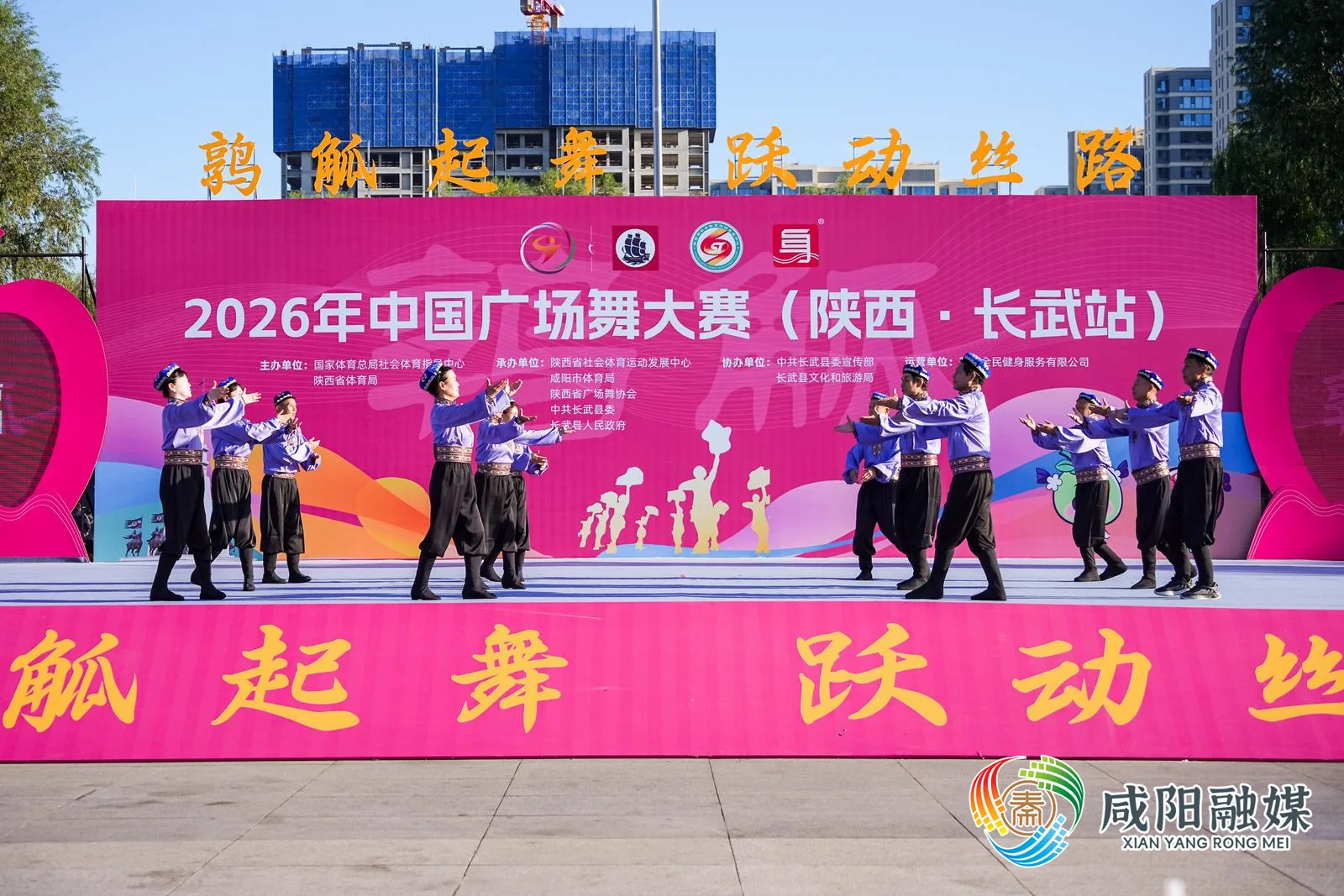
The lead stands at the front; everyone else follows the same counts.
There is no official national Guangchangwu organizational chart.
That is precisely why the recurring roles are interesting.
Think of the following as a rough map of the roles, not a universal hierarchy.
The Lead or Choreographer
The lead demonstrates routines, teaches counts, introduces new movements, and often decides which routines the group will practice.
Some leaders have formal dance or fitness backgrounds. Others are self-taught and have accumulated authority through years of participation.
Their legitimacy can come from several sources:
- dance ability;
- teaching ability;
- reliability;
- seniority;
- personality;
- social connections;
- organizational skill.
A person does not necessarily become a leader simply because she is the best dancer.
Teaching thirty people is a different skill from dancing beautifully in front of them.
The Speaker or Equipment Manager
This person maintains the practical infrastructure.
They may transport the equipment, charge batteries, organize cables, select or load music, and make sure the sound system works.
This role is often less visible than the lead, but it can be highly consequential.
If the leader is absent, another experienced dancer may demonstrate the routine.
If the speaker does not work, however, the entire session may have to change.
The Front Rank
The front rank contains people who know the routines well enough to provide a reliable visual reference.
They are not necessarily formal “captains.”
In some organized groups, however, experienced dancers may also coordinate smaller friend or neighborhood clusters.
The important point is that formation memory can become a form of social capital.
Someone who has attended hundreds of sessions knows where people stand, which routine comes next, how a particular transition works, and how the group normally responds when something goes wrong.
That knowledge cannot be learned from a single dance lesson.
Core Regulars
These are the people who appear again and again.
They know the routines.
They know the people.
They know the unwritten rules.
They know which songs the group likes, who has been absent, when a performance is coming up, and which part of the square is normally available at a particular time.
Their importance is easy to overlook because they may have no formal title.
But continuity creates authority.
The Middle Rank
Between experienced front-row dancers and complete beginners is a much less clearly defined group: people who know enough to participate confidently but are still learning new routines.
Their position can change.
They may move forward when they become more experienced, move backward to make room for beginners, or simply occupy whatever space is available.
This fluidity is important.
Guangchangwu is not necessarily a rigid ladder.
People can gain standing through repeated participation and demonstrated competence.
Newcomers
Newcomers are usually easiest to recognize because their movements are slightly delayed.
They watch.
They imitate.
They make mistakes.
They look around to see what everyone else is doing.
In a welcoming group, this is normal.
The important social distinction is not whether someone makes mistakes. Everyone was a beginner once.
It is whether the newcomer understands the difference between learning the group and reorganizing the group.
A first-time participant normally has little reason to choose the music, correct experienced dancers, or claim the most visible position.
That is less about exclusion than about learning the local operating system.
Men
Guangchangwu is strongly associated with older women, and that association has substantial support in the research literature. But men do participate. Academic studies describe Guangchangwu as predominantly female rather than exclusively female.
When men are present, their roles vary.
Some participate directly in the main formation.
Some appear more often around equipment or logistics.
Others participate in adjacent forms of social dancing, including partner dance.
The important point is not to treat male participation as an exception that proves a stereotype.
It is better understood as another example of how gender expectations shape participation in public leisure.
Observers
Finally, look outside the formation.
People sitting on benches.
Grandparents watching grandchildren.
Partners waiting.
Passersby stopping for a few minutes.
People who have not yet decided whether to join.
These people are part of the social environment too.
Research on Guangchangwu has emphasized that the practice is not simply physical exercise. Public dancing can create social connection, a sense of place, community interaction, and opportunities for older participants to construct identities in public space.
The audience therefore matters.
A dance group is performing for someone, even when nobody has bought a ticket.
For the demographic picture behind these roles, see Who Practices Guangchangwu?.
4. What You Cannot See From the Formation
The visible hierarchy is only part of the story.
Some of the people who influence a Guangchangwu group’s activities may never dance.
A neighborhood committee worker may help coordinate use of a community space.
A community-center employee may organize activities.
A cultural organization may provide opportunities to perform.
A sponsor may help with costumes or equipment.
A community sports instructor may have a formal role that sits above the informal relationships visible on the dance floor.
This creates two overlapping systems: the social organization inside the formation and the institutional environment around it.
They are not always aligned.
A group may be extremely informal internally while still depending on a community organization for access to a venue.
Conversely, a formally organized team may develop its own informal seniority system once people begin practicing together every day.
This is why it is dangerous to assume that a Guangchangwu group is either “official” or “spontaneous.”
Many exist somewhere between the two.
5. Why Formation Can Become a Governance System
This is where Guangchangwu becomes particularly interesting from a sociological perspective.
A public square does not normally come with a manager assigned to every group.
There may be no membership desk.
No employee checks attendance.
No written rule says who stands where.
Yet dozens of people can repeatedly assemble, practice, coordinate, and leave with relatively little formal administration.
How?
They develop routines.
Formation is one of those routines.
Research by Zhou Kehan and Huang Yingying is especially useful here. Their study followed three Guangchangwu teams for a year and included 28 in-depth interviews. Their argument was not simply that dancing creates hierarchy; rather, bodily practice itself becomes part of how interaction and social differentiation are produced.
This is an important distinction.
The body is not merely performing the social order.
It can help create it.
Someone who learns quickly becomes more useful to the group.
Someone who consistently attends becomes more familiar.
Someone who can teach others acquires influence.
Someone who can organize costumes, performances, music, or equipment may gain another form of authority.
The result is a hierarchy that can be partly earned through participation.
But it is not automatically egalitarian.
Physical ability, health, mobility, previous dance experience, available time, gender expectations, and social connections can all influence who advances.
So the dance floor can loosen some conventional status distinctions while creating new ones.
That is one reason Guangchangwu is more interesting than the stereotype of “retired women exercising to loud music” suggests.
6. Clothing Is Part of the Social System
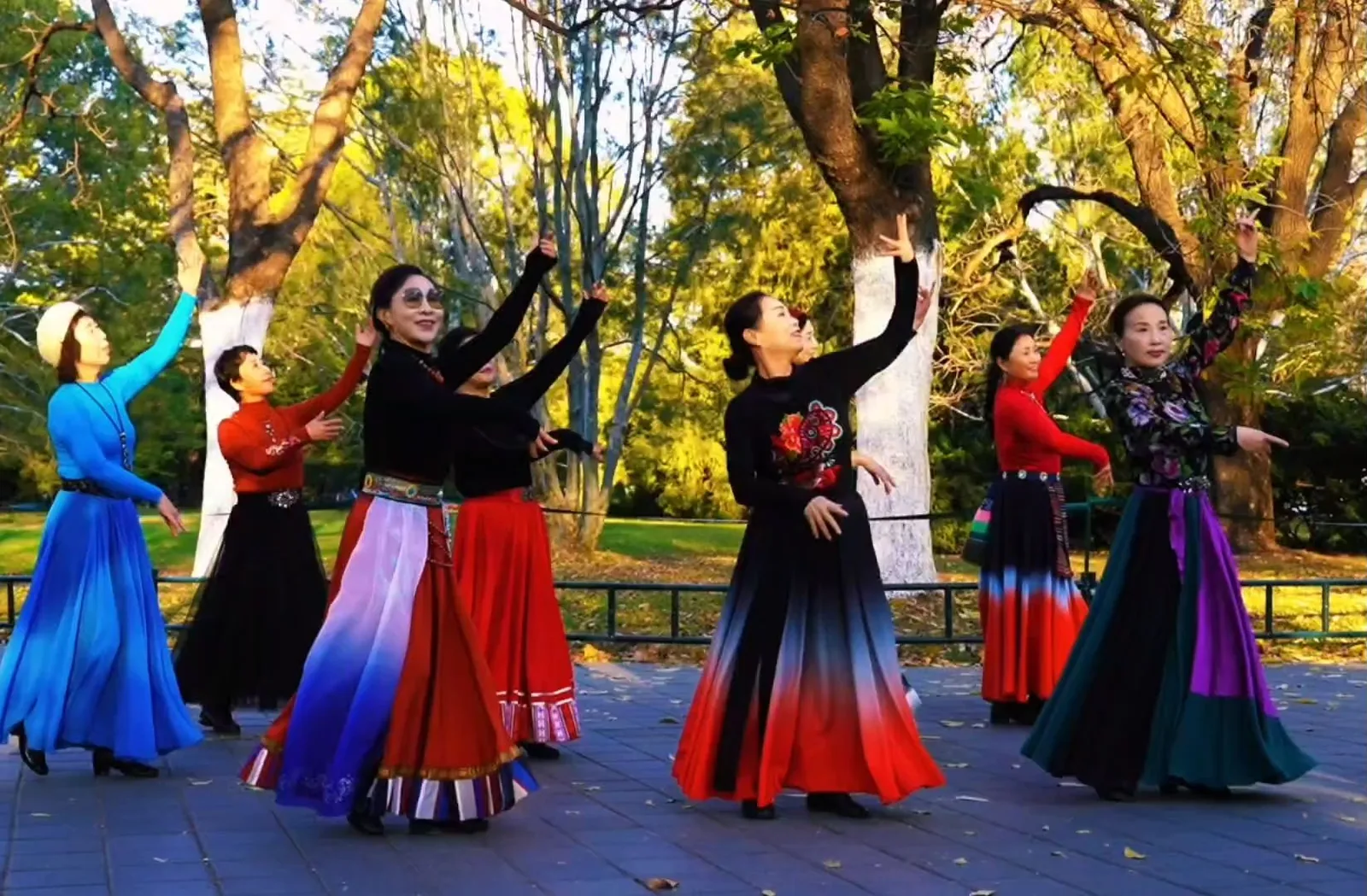
Matching outfits mark the group; paired styles show up at the edges of the practice.
Watch a group on an ordinary weekday and you may see ordinary athletic clothing.
Come back for a performance and the same group may look completely different.
Matching clothing can serve several purposes at once.
It makes the group visually recognizable.
It helps synchronize a performance.
It creates a distinction between members and spectators.
It turns a collection of individuals into a recognizable team.
And it can create a shared project outside the actual dance.
Groups may collectively decide what to wear for an event, order costumes together, distribute sizes, organize payment, and coordinate accessories.
The vocabulary of Guangchangwu clothing is broad.
You may encounter contemporary sportswear, colorful performance costumes, fan-dance outfits, scarves, waist drums, or styles influenced by Yangge and other folk-performance traditions.
The commercial side is substantial as well.
Yiyang in Hunan has developed a major Guangchangwu apparel cluster. Local government reporting has put the industry’s annual output at around ¥2 billion or more, with hundreds of related businesses and a very large share of China’s online Guangchangwu apparel market.
That does not mean every dancer buys expensive costumes.
It means the apparently simple act of “wearing the same clothes” is connected to a much larger cultural and commercial ecosystem.
7. The Economy Behind “Free” Dancing
For most participants, a public Guangchangwu session is remarkably inexpensive.
You can walk into a park.
You can follow the music.
You can leave.
There is usually no membership ticket.
But “free to join” does not mean that the surrounding activity has no economy.
Costumes need to be produced.
Speakers need to be bought.
Competitions need to be organized.
Performances need choreography.
Videos need to be recorded.
Some instructors teach commercially.
Some groups participate in paid performances.
Some people use short-video platforms to distribute tutorials or sell related products.
The important distinction is between the economics of the ecosystem and the income of an individual leader.
Reports sometimes describe particularly successful organizers or instructors earning significant monthly income through teaching, performances, group purchasing, livestreaming, or related commerce.
That should not be interpreted as the normal financial position of a park leader.
For many people, leadership remains unpaid.
The more interesting question is therefore not:
“How much money does the leader make?”
It is:
“How can an apparently free activity generate enough organizational infrastructure to support an entire ecosystem?”
The answer includes thousands of small transactions surrounding participation.
The scale of the apparel industry in Yiyang is one visible example.
A free public activity can therefore sit at the center of a surprisingly substantial commercial network.
8. C-Position: Why the Center Matters
Look at the center of the front row.
In contemporary Chinese popular language, C位 (C-wèi) means the most central or visually prominent position.
In a Guangchangwu formation, the center-front position is unusually visible.
The lead can see it.
The audience can see it.
A phone recording the group can see it.
Other dancers can see it.
That makes the position symbolically important.
But do not turn every C-position disagreement into gossip.
The deeper issue is visibility.
Public dancing gives participants a stage on which age, occupation, wealth, and former professional status may matter less than they did elsewhere.
The person standing in the center is visibly competent, present, and recognized.
For older adults, especially those whose public roles have changed after retirement, that recognition can matter.
This connects with the broader ethnographic literature. Research on Guangchangwu has described the practice as a space in which older women negotiate identity, social relationships, and belonging rather than simply performing exercise.
So when you see people caring about formation, do not automatically read it as vanity.
Sometimes it is simply the human desire to be seen.
9. Time, Territory, and the Problem of Shared Space
There is another thing to watch when reading a session: the ground itself.
A Guangchangwu group does not own the public square.
It occupies it temporarily.
That makes time and territory central to the activity.
One group may prefer the eastern side of a park.
Another may use the same space later.
A basketball group may need the court in the evening.
Tai Chi practitioners may prefer quiet early-morning hours.
Parents may need a passageway.
Residents may object to noise.
The result is continuous negotiation.
Recent research on Guangchangwu groups in several Chinese cities describes exactly this process: spatial boundaries are not simply fixed; they are established, negotiated, adjusted, and sometimes contested through interactions between dancers, other space users, and state actors.
This helps explain why disputes over public dancing can become much larger than arguments about music.
The underlying issue may be: Who gets to use this piece of public space, at what time, and under what conditions?
Some communities respond through time-sharing.
Others establish designated activity areas.
Some experiment with noise monitoring or quieter technologies.
The point is not that every Guangchangwu group creates conflict.
Most ordinary sessions are much less dramatic.
The point is that a public dance group is participating in the governance of shared urban space whether or not anyone calls it governance.
For the wider debate about sound, neighbors and regulation, read Public Space and Sound and the culture site’s page on public space.
10. What Happens When People Disagree?
Every recurring group develops disagreements.
Which music?
Which choreography?
Which location?
How loud?
Who gets the front?
Who can join?
Who speaks for the group?
The solutions vary enormously.
Some disagreements are handled informally.
Someone makes a joke.
Someone asks a senior member to mediate.
The leader makes a decision.
Two people agree to alternate.
Sometimes the disagreement becomes serious enough that the group divides.
This last possibility is important.
A split is not necessarily evidence that the original group has failed.
In a voluntary association, creating a second group can be easier than resolving every disagreement inside the first.
Five people with a speaker can potentially become the beginning of another dance group.
That is one reason Guangchangwu ecosystems can contain several groups in the same neighborhood that share similar styles but maintain separate identities.
At a larger scale, disputes over public space may involve neighborhood organizations, property managers, community officials, or urban-management authorities.
The 2026 academic literature increasingly treats these negotiations as part of the production of public space rather than merely as “noise complaints.”
There is no single “Guangchangwu tribunal.”
Stories about senior members informally mediating disputes are useful field observations, but they should not be mistaken for a standardized institution.
What is standardized is something simpler: recurring groups need ways to negotiate recurring disagreements.
11. How to Join a Guangchangwu Group
This is the part you can actually use.
There is no national membership procedure.
No universal three-month probation period exists.
But if you are new to a group, one principle is remarkably reliable:
Observe before you reorganize.
Stage 0: Watch From the Perimeter
On your first visit, stand outside the formation.
Watch one complete song.
Then another.
Identify:
- the lead;
- the speaker;
- the experienced dancers;
- the back row;
- the people who appear to be newcomers.
If you want to participate, ask.
A simple sentence is enough:
我是新来的,我在后面跟着学就可以。
Wǒ shì xīn lái de, wǒ zài hòumiàn gēnzhe xué jiù kěyǐ.
“I’m new. I’ll just follow along at the back.”
The important part is not perfect Mandarin.
It is the signal: I understand that I am entering someone else’s established activity.
Stage 1: Start at the Back
If the group welcomes you, take a position toward the rear or side.
Do not worry about getting every movement right.
Watch the dancer in front of you.
Copy.
When the song changes, follow again.
Do not worry about the fact that everyone else seems to know what comes next.
They have practiced it before.
You have not.
That is the entire difference.
Stage 2: Become Familiar
If you keep coming back, people will begin to recognize you.
You may learn names.
Someone may add you to a WeChat group.
You may be asked to help with a small task.
You may begin to move farther into the formation naturally.
This stage is less about passing an examination than becoming part of the group’s everyday rhythm.
Consistency matters because relationships require repeated contact.
Stage 3: Earn a Place
Eventually, if you attend regularly and become competent, people may trust you with more responsibility.
You may learn new routines quickly.
You may help beginners.
You may help with equipment or costumes.
You may participate in performances.
You may eventually have a regular position.
There is no universal timetable.
Some groups are extremely informal.
Others have much clearer membership structures.
The safest rule is therefore: let the group reveal its own rules.
For a complete beginner pathway—from finding a group to following the first routine—start with the learn section and the how-to-start guide.
Five useful things to bring
- Water.
- Comfortable shoes with good grip.
- Comfortable athletic clothing.
- Tissues.
- Patience.
You do not need an expensive costume.
You do not need dance experience.
And you definitely do not need to arrive announcing that you are ready for the front row.
12. What Happens After the Dance?
The dance may last an hour.
The social activity can last much longer.
After the final song, the speaker has to be packed away.
People talk.
Some walk home together.
Others go shopping.
Someone sends videos to the group chat.
Tomorrow’s time and location may be discussed.
A costume order may be confirmed.
Someone may mention a family problem.
Someone else may recommend a doctor.
Another person may know where to buy something cheaply.
This is one reason Guangchangwu should not be understood purely as a dance class.
Research on public-square dancing has repeatedly emphasized its social dimensions: interaction, belonging, place attachment, identity, and community.
For people who have retired, moved to a new city, or lost some of the social connections associated with working life, a regular dance group can become an important everyday network.
The square becomes a place to exchange information as well as movement.
And the information is often remarkably ordinary:
Which hospital is good?
Which supermarket is cheaper?
Whose grandchild is starting school?
Who needs help?
Who has been absent?
Who is organizing the next performance?
The dance is visible.
The network around it is less so.
For the documented groups behind this kind of everyday network, see the groups directory, and for how this social layer works as culture, see community life.
13. If You Are Watching as a Traveler or Photographer
The best way to observe Guangchangwu is simple: stay at the edge first.
You can learn a surprising amount without entering the formation.
Do not walk through the middle while a routine is underway.
Do not stand directly in front of the leader.
If you are photographing people at close range, a smile or small gesture of acknowledgment is better than silently putting a camera in someone’s face.
And remember that “public space” does not automatically mean “everyone present has consented to being photographed individually.”
If someone notices your camera and looks uncomfortable, move back.
If someone invites you to dance, however, that is different.
Accepting an invitation can be one of the fastest ways to stop being an observer and become a participant.
You do not have to dance well.
You only have to try.
Frequently Asked Questions
Can a foreigner join Guangchangwu?
Yes, many groups are open to newcomers, including foreigners. But there is no universal national rule, so the best approach is to ask the local group and begin at the edge rather than assuming that public space means automatic membership.
Is Guangchangwu dance or exercise?
It can be both. Some sessions are primarily recreational exercise; others rehearse elaborate choreographies for performances or competitions. The social dimension is also important and is a recurring theme in research on the practice.
Why does everyone face the same direction?
In many fitness-oriented formations, facing the same direction allows dancers to learn by visually following the lead and the experienced dancers ahead of them. It is therefore partly a teaching system as well as a performance formation.
Do men participate in Guangchangwu?
Yes. Guangchangwu is predominantly associated with women, particularly middle-aged and older women, but research does not support treating it as an exclusively female activity.
Who chooses the music?
It depends on the group. The lead may choose the choreography and therefore influence the music, while the person managing the speaker may control the practical playlist. Sometimes one person performs both roles.
Why do dancers wear matching clothes?
Matching clothing can create group identity, improve visual coordination, distinguish a team during performances, and support collective activities such as costume ordering. It is also part of a substantial commercial ecosystem around Guangchangwu apparel.
Are Guangchangwu leaders paid?
Some are. Teaching, performances, choreography, equipment, apparel, and online activities can create income opportunities. But an individual leader’s earnings should not be generalized to ordinary park groups, many of which remain volunteer-based.
What happens when two groups disagree?
The answer varies. Groups may negotiate schedules, divide space, involve community organizations, or eventually split. Where public-space disputes escalate, local authorities may become involved. Recent research specifically identifies boundary negotiation as an important part of how Guangchangwu groups operate in cities.
Is Guangchangwu banned in China?
Guangchangwu itself is not generally prohibited. Public-space activity can, however, be subject to local rules and noise regulations. China’s Noise Pollution Prevention and Control Law has specific provisions concerning social-life noise, while the revised Public Security Administration Punishments Law, effective January 1, 2026, provides penalties for continued serious interference with others’ normal life, work, or study after lawful intervention.
The practical issue is therefore usually not “Is dancing legal?” but whether a particular activity complies with applicable rules concerning noise, location, time, and public-space use.
How long does it take to become a member?
There is no universal timetable. Some informal groups may treat a newcomer as a member almost immediately; more structured groups may take longer to develop trust and assign responsibilities. Consistent attendance and respectful participation matter more than a fixed number of weeks or months.
The Dance Floor Is Also a Meeting
Return to the square at 6:27 the next morning.
The thermos is there again.
The speaker arrives.
The first dancers appear.
The formation begins to assemble.
If you only see the choreography, you see people exercising.
If you watch the formation, you see something else.
You see accumulated memory.
You see seniority.
You see teaching.
You see logistics.
You see friendship.
You see negotiation over space.
You see people learning how to belong.
Guangchangwu does not have one universal hierarchy, and it would be a mistake to turn every park group into a miniature bureaucracy.
But recurring collective activity produces recurring social structures.
People develop roles because somebody has to teach.
They develop routines because somebody has to remember.
They develop boundaries because public space is shared.
They develop relationships because people keep meeting.
And they develop status because being part of a group means more than simply standing in the right place.
That is why the formation is worth reading.
The rows are not just rows.
They are a record of how a group has learned to organize itself.
Stand at the edge for ten minutes.
Then watch again.
You will probably notice much more than dancing.
Further Reading
For the broader definition of the practice, start with What Is Guangchangwu?.
For terminology and the problem of translating 广场舞 into English, see Chinese Plaza Dancing: What Does the Term Mean?.
For the distinction between Guangchangwu and American square dancing, see Guangchangwu vs. Square Dance.
For the academic background behind the discussion of bodily practice and social differentiation, see Zhou Kehan and Huang Yingying’s 2019 study of Guangchangwu teams.
Research on Guangchangwu in public space has also examined social interaction, place attachment, identity, and community formation, while recent urban research has focused specifically on how groups negotiate spatial boundaries with other users and institutions.
For the scale of the Guangchangwu apparel economy, official Yiyang reporting documents an industry worth roughly ¥2 billion or more annually, with hundreds of related enterprises.
Every source cited on this page is listed as plain text in the sources index.