What Is Guangchangwu?
Guangchangwu (广场舞) is a form of organized group dancing practiced in public spaces across China. It brings together music, repeated dance routines, physical exercise, social interaction, and the shared use of public space — and it is more than simply “dancing in a square.”
The word literally combines 广场 (guǎngchǎng), meaning a public square, plaza, or open public space, with 舞 (wǔ), meaning dance.
Guangchangwu is a recognizable form of everyday group activity. Groups commonly gather in parks, residential-community spaces, public squares, plazas, riverfronts, and other open urban areas. Participants follow coordinated routines, often with music played through a portable speaker and with one or more experienced dancers leading the group.
Guangchangwu is particularly associated with middle-aged and older adults, especially women, but describing it simply as “a dance for older Chinese women” misses much of what makes the practice distinctive. It is simultaneously a form of recreation, exercise, social participation, and public-space activity.
In simple terms: Guangchangwu is organized group dancing in public spaces in China, where people use shared music and coordinated routines to combine movement, recreation, social connection, and everyday community life.
What Does Guangchangwu Mean?
The Chinese term 广场舞 (guǎngchǎngwǔ) literally means “square dance” or “dance in a public square.”
The literal translation, however, can be misleading for English speakers, because Guangchangwu is not the same dance tradition as American square dance (Western square dance).
In English-language research and media, Guangchangwu has also been described as:
- Chinese square dancing
- Chinese plaza dancing
- plaza dance
- public square dancing
- public dancing
- Chinese public dancing
These expressions generally refer to the Chinese practice discussed here, although their meanings and usage can vary by context. Longer alias mapping lives on Chinese Plaza Dancing.
The most useful way to understand the Chinese term is therefore not simply as the name of a particular dance style. Guangchangwu describes a mode of collective dancing that takes place in shared public space.
Guangchangwu Is a Practice, Not One Specific Dance Style
One of the most common misunderstandings is that Guangchangwu is a single standardized choreography.
It is not.
A Guangchangwu group may use different kinds of music and movement vocabulary. Research describes the practice as incorporating elements from dance, gymnastics, folk dance, popular music, and other forms of recreational movement.
This means that two Guangchangwu groups in different cities may look quite different while still clearly belonging to the same broader practice — as the documented dance forms also suggest.
What connects them is not one fixed sequence of movements. Instead, the common structure usually includes:
- A group of participants
- An open or publicly accessible space
- Music or another rhythmic accompaniment
- A coordinated routine
- A leader, instructor, or experienced participant
- Repeated group practice
- A shared social setting
The choreography can change. The underlying social format remains recognizable.
Where Does Guangchangwu Take Place?
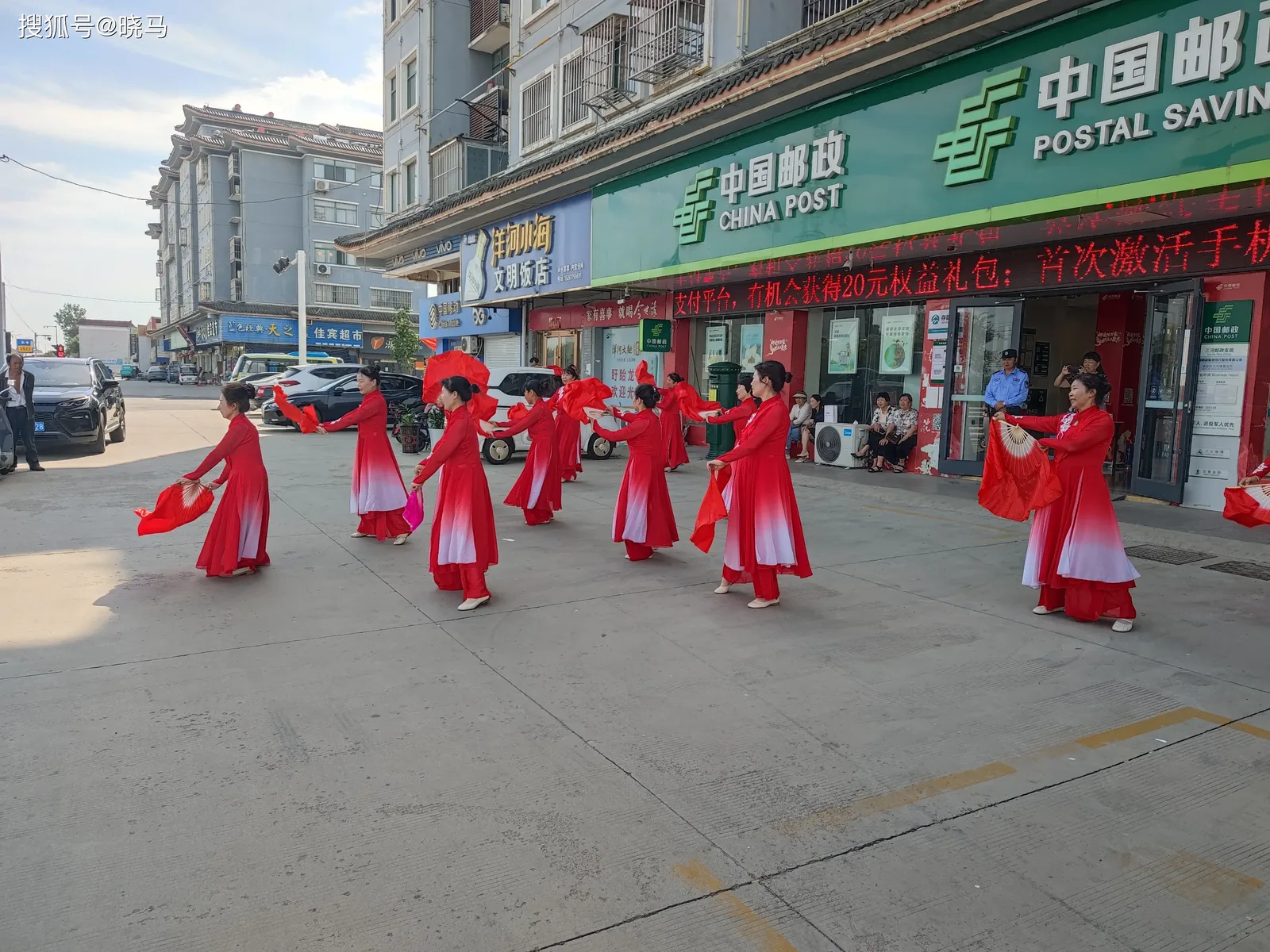
A group works through a routine with red fans on an open plaza.
The “square” in Guangchangwu does not have to mean a formal architectural square.
Groups may dance in many kinds of open urban spaces, including:
- public plazas
- parks
- community courtyards
- residential compounds
- riverside paths and open spaces
- urban gardens
- sports grounds
- areas around public facilities
- other relatively flat outdoor spaces
Recent research continues to document Guangchangwu in parks, urban gardens and other public spaces, emphasizing that the activity requires surprisingly little physical infrastructure: essentially an open area, participants, and music.
This flexibility is important. A Guangchangwu group does not necessarily need a dedicated dance studio, membership-based fitness facility, or formal sports venue.
The city itself can become the activity space.
Why Is Public Space So Important?
The location is not just a backdrop.
Public space is part of the meaning of Guangchangwu.
When people dance together in an open urban environment, they are simultaneously participating in a leisure activity and occupying a shared social space. This helps explain why Guangchangwu has attracted attention from researchers in fields including:
- leisure studies
- urban studies
- sociology
- geography
- public health
- aging studies
- cultural studies
Research on Guangchangwu has found that participants use public spaces not only for physical activity but also for social interaction, community formation, and creating a sense of place. One study of public-square dancing in China describes socially synchronized dancing as a way in which participants develop social connections and relationships with the places where they dance.
This makes Guangchangwu different from an activity that happens entirely inside a private gym or dance studio. The physical activity is visible. The social activity is visible too. How these spaces are negotiated in practice is explored further in Guangchangwu and Chinese Public Space.
Who Participates in Guangchangwu?
Guangchangwu is strongly associated with middle-aged and older women, and this association is well documented in academic research.
This is one reason English-language descriptions have sometimes used expressions such as “dancing grannies” or “China’s dancing aunties.” Those descriptions capture a recognizable demographic pattern, but they can also oversimplify the practice.
Guangchangwu is not formally restricted to older women. Participants can include:
- middle-aged women
- older women
- older men
- middle-aged men
- younger adults
- mixed-age community members
The demographic composition can vary according to the location, group, time of day, and local community. Recent research has also examined square-dancing groups involving both older men and women rather than treating the activity as exclusively female: a 2025 study of older adults participating in square dancing in Chinese urban riverfront spaces included both women and men.
So the more accurate definition is:
Guangchangwu is commonly associated with middle-aged and older women, but it is a broader public group-dance practice rather than an activity formally limited to one age or gender.
The fuller picture of who takes part — including men, younger adults, students and communities outside China — is covered in Who Practices Guangchangwu?.
What Do People Actually Do During Guangchangwu?
Sessions mix repeated set routines with free social dancing.
A typical session is relatively easy to recognize.
Participants gather in an open area and form one or more groups. Music is played through a speaker or similar sound system. A leader or experienced dancer may stand at the front, while other participants follow the movements.
The routine is usually repeated so that participants can learn and synchronize with the group. Depending on the group, movements may include:
- rhythmic stepping
- arm movements
- turns
- coordinated gestures
- changes in direction
- repeated sequences
- simple aerobic movements
- elements adapted from folk or popular dance
The emphasis is usually on collective participation rather than individual performance. A participant does not necessarily need advanced dance training. The group structure makes it possible for people to learn through repetition and imitation — the starting point of the beginner path in Learn.
The Role of the Lead Dancer
Many Guangchangwu groups have one or more participants who function as informal leaders or instructors. They may:
- select or prepare routines
- choose music
- stand at the front
- demonstrate movements
- teach new sequences
- coordinate practice
- organize performances or group activities
This creates a simple but effective learning system. Someone does not necessarily need to enroll in a formal dance class. They can watch the person in front, repeat the movement, and gradually become synchronized with the group.
The result is a form of peer-supported physical activity.
Music Is Part of the Social Structure
Music in Guangchangwu is not merely background sound. It provides the rhythm that allows a group of people to coordinate their movements. A shared music track gives participants a common temporal structure:
music → rhythm → repeated movement → synchronization → group activity
The choice of music can vary considerably. Groups may use:
- popular songs
- Chinese folk-influenced music
- dance music
- specially produced exercise tracks
- familiar songs adapted for group routines
The relationship between music and movement is one reason Guangchangwu can be recognized as a group practice even when the specific choreography changes. How songs turn into shared routines is the subject of the Music hub.
Guangchangwu Is Both Exercise and Social Activity
It is tempting to categorize Guangchangwu as either dance or exercise. In everyday life, it often functions as both.
Participants may join because they want:
- regular physical activity
- recreation
- music and entertainment
- companionship
- a daily routine
- opportunities to meet friends
- participation in community life
Academic research has repeatedly found social dimensions alongside physical ones. A study of Guangchangwu in Guangzhou found that participants described benefits extending beyond physical activity, including social connection, happiness, self-realization, and community belonging. Another study examining public-square dancing found that synchronized participation can strengthen social interaction and people’s relationship with the places where they gather.
This is why describing Guangchangwu simply as “Chinese outdoor exercise” leaves out an important part of the phenomenon.
Why Has Guangchangwu Become So Closely Associated With Older Women?
The association with older women developed within a broader social and demographic context.
China’s rapid urbanization, population aging, changing family structures, expansion of public infrastructure, and increasing attention to recreational physical activity all form part of the background to Guangchangwu’s development.
Research on the everyday lives of Chinese women involved in Guangchangwu has connected the practice with changes in women’s social roles, public-space access, community relationships, and the growth of leisure opportunities after China’s economic reforms.
For many participants, retirement or reduced employment responsibilities can also create more time for organized leisure activities. But the important point is not simply that “older women have more free time.” Guangchangwu provides a social structure for using that time.
A participant can go to the same place, meet the same people, learn new routines, exercise, talk with friends, and return home — all within an ordinary part of the day. That repeated pattern is one reason the activity can become part of everyday life rather than an occasional recreational event.
Guangchangwu and Community
A Guangchangwu group can function as a small social network. Participants may:
- greet one another regularly
- practice together
- share music and routines
- teach newcomers
- organize performances
- exchange information
- socialize before or after dancing
- maintain friendships outside the activity
Research in China has described Guangchangwu as a mechanism through which older women build social networks and develop forms of community within urban neighborhoods.
This is particularly important in large cities, where people may live physically close to one another without necessarily having strong everyday social connections. Guangchangwu can turn a relatively anonymous public space into a familiar meeting place. How groups actually operate is described under community life.
Guangchangwu and a Sense of Place
There is another layer that is easy to miss if Guangchangwu is viewed only as exercise.
When a group repeatedly returns to the same park, plaza, or neighborhood space, the place can acquire social meaning. The space becomes:
the place where our group dances
rather than simply:
an empty public area
Research on Guangchangwu has specifically examined this relationship between synchronized dancing, social interaction, and sense of place.
This helps explain why disputes over Guangchangwu can sometimes become more complicated than disagreements about noise. Different users may have different ideas about what a public space is for.
Why Does Guangchangwu Sometimes Create Conflict?
Guangchangwu is not universally experienced as positive.
Because it takes place in shared public spaces, groups may sometimes compete with other users for space or generate conflicts over sound, timing, or location. Noise has been one of the most visible issues discussed in Chinese media and academic research. A study of People’s Daily coverage found recurring discussion of conflicts involving noise and the use of public squares, alongside positive portrayals of Guangchangwu as physical activity and part of national fitness culture.
The issue is therefore not simply:
“People dislike dancing.”
It is often a question of how different groups negotiate a shared public environment.
Recent research published in 2026 goes further, examining how Guangchangwu groups establish and negotiate spatial boundaries with other users and with institutional actors. It treats these everyday negotiations as part of the production of public space itself.
That is an important development in how Guangchangwu can be understood. It is not only a dance phenomenon. It is also a public-space phenomenon. The practical consequences of this negotiation — sound, timing, rules — are traced in Sounds of the Public Square.
Does Guangchangwu Have Health Benefits?
Physical activity is one reason many people participate in Guangchangwu.
Research has reported associations between participation and physical, psychological, and social outcomes, although the strength of evidence depends on the study design and population being studied. For example, research involving older Chinese adults has examined Guangchangwu in relation to mental health and leisure activity.
A 2025 study of older adults in urban riverfront green spaces examined how the timing and location of square dancing related to psychosocial outcomes, including emotional well-being and quality of life.
And newer controlled research is beginning to examine community-based square dancing through randomized intervention designs rather than relying only on observational studies. A 2026 randomized controlled trial included 150 adults aged 60–79 and investigated physical and mental health outcomes following a 12-week square-dance intervention.
These studies are useful, but they should not be turned into a blanket claim that Guangchangwu automatically improves health. The more defensible conclusion is:
Guangchangwu can provide a practical form of regular physical activity while also creating opportunities for social interaction, but health effects depend on factors such as participation, intensity, duration, individual health, and the specific activity being performed.
A fuller breakdown of what the evidence does and does not support is set out in Square Dancing and Health: What Research Supports.
Is Guangchangwu a Traditional Chinese Dance?
Not exactly.
Some Guangchangwu routines incorporate Chinese folk-dance elements, while others draw heavily from contemporary popular music and recreational exercise. The practice has multiple historical and cultural influences.
Researchers have discussed connections between modern plaza dancing and earlier Chinese collective movement traditions, including yangge (秧歌) — itself documented as a dance form — as well as later forms of organized mass movement and physical culture.
But modern Guangchangwu should not simply be treated as a preserved traditional folk dance. It is better understood as a modern evolving practice that can incorporate traditional cultural elements.
This distinction matters. A Guangchangwu routine using folk-dance movements and a routine built around contemporary pop music can look very different while both functioning within the same broader public-dance culture. The historical layers behind this are traced in The History of Guangchangwu.
Guangchangwu Is Not One Fixed Choreography
This is perhaps the most important conceptual point.
There is no single universal:
“Guangchangwu dance.”
Instead, there are many local groups, routines, songs, instructors, styles, and levels of organization. The practice is therefore better understood as a category of collective activity.
Think of it as a framework:
- public space
- group participation
- music
- coordinated movement
- repeated routine
- social interaction
rather than a single standardized dance form.
Is Guangchangwu the Same as “Square Dance”?
The English translation square dance creates an important problem.
In the United States and other English-speaking contexts, “square dance” can refer to a specific Western dance tradition involving coordinated figures and formations, often associated with groups of four couples.
Guangchangwu is a different practice (Western square dance). The two may both involve groups of people dancing together, but they developed within different cultural, historical, musical, and social contexts.
That distinction is important because translating 广场舞 simply as “square dance” can create an unintended association with the American dance tradition. For a detailed comparison, see Guangchangwu vs Square Dance.
Common Misconceptions About Guangchangwu
“Guangchangwu is just old women dancing.”
Older women are indeed strongly represented in the practice, but Guangchangwu is not formally limited to them. It is better understood as a broader form of public group activity that has become especially associated with middle-aged and older women.
“There is only one Guangchangwu style.”
There is no single universal choreography. Different groups use different music, routines, instructors, and movement traditions.
“It is just exercise.”
Exercise is an important component, but research also identifies social, recreational, cultural, and place-based dimensions.
“Guangchangwu always happens in a formal public square.”
Not necessarily. Parks, residential communities, riversides, gardens, and other open spaces can all become Guangchangwu venues.
“Guangchangwu is the Chinese version of American square dance.”
The names can look similar in translation, but the practices are culturally and structurally distinct.
Why Guangchangwu Matters
Guangchangwu is easy to underestimate because the activity itself looks simple.
People gather. Music plays. Someone leads. Everyone follows.
But that simplicity is precisely what makes it socially powerful. A relatively small amount of infrastructure can support a recurring activity that combines:
- physical movement
- music
- recreation
- social connection
- community
- public-space use
- everyday routine
- cultural expression
It also illustrates a broader feature of urban life in China: public spaces are not merely places people pass through. They can become places where people exercise, socialize, perform, organize themselves, and develop relationships.
Guangchangwu makes all of those functions visible.
Guangchangwu in One Sentence
If you need the shortest useful definition:
Guangchangwu (广场舞) is a form of organized group dancing practiced in public spaces in China, combining coordinated movement and music with exercise, recreation, social interaction, and community life.
That definition is more useful than translating the term word-for-word because it describes what Guangchangwu actually is, rather than only what its Chinese name literally says.
The Short Version
Guangchangwu means 广场舞: organized group dancing in public spaces in China.
It is commonly associated with middle-aged and older women, but the practice is broader than that demographic. It can incorporate elements of dance, exercise, folk traditions, popular music, and recreational movement.
Its defining feature is not one particular choreography. It is the combination of group movement, music, public space, repetition, and social participation.
That is why Guangchangwu is best understood not simply as a dance style, but as a distinctive form of everyday public life in contemporary China.
Next steps
- Guangchangwu vs Square Dance
- Chinese Plaza Dancing
- Who Practices Guangchangwu?
- The History of Guangchangwu
- Learn the basics
- Explore the culture
- Sources
Sources
- Square dancing (China)
- Chinese Square-Dancing: A Description of Group Cultural Life
- Guangchangwu – Chinese Plaza Dancing | Culture Days 2026
- Square dancing / guangchangwu public health RCT (Frontiers, 2026)
- Leisure, mental health and square dancing (PMC10829103)
- China's Relationship with Song and Dance Is Unselfconscious
- Square dance