Who Practices Guangchangwu? Inside China’s Changing Square Dance Culture
When people first encounter guangchangwu (广场舞), or Chinese public square dancing, they often picture the same scene: groups of middle-aged or older Chinese women dancing together in a park or public square, usually to music played through a loudspeaker.
That image is not entirely wrong. Older women remain the core of guangchangwu participation. But it is far from the whole story.
Today, guangchangwu is practiced by retired women and men, university students, younger adults, competition teams, community groups, and Chinese diaspora communities outside China. Some people dance for exercise. Others come for friendship, routine, cultural expression, performance, or simply because they enjoy moving to music with other people — as explained in What is Guangchangwu?.
The important question, therefore, is not simply “Are guangchangwu dancers mostly older women?”
They are.
The more interesting question is why this particular group became the core of guangchangwu — and who is joining them now.
Who Practices Guangchangwu?
The available research consistently shows that middle-aged and older adults, particularly women, form the traditional core of guangchangwu.
Recent Chinese and international research places the female share broadly in the 70–90% range, although the exact figure varies according to the population studied and how participation is defined. The dominant age range is generally around 50–70, with many regular participants being retired or approaching retirement.
Some surveys and industry estimates have placed the number of regular participants in China at around 100–120 million, while broader estimates are considerably higher because they may include occasional participants, event participants, or people involved through digital platforms.
These numbers should therefore be treated as estimates rather than a single definitive census.
What is much more consistent across the research is the demographic pattern:
| Characteristic | Typical pattern |
|---|---|
| Age | Primarily 50–70 |
| Gender | Predominantly women |
| Employment | Many are retired or homemakers |
| Setting | Parks, squares, residential communities and other public spaces |
| Group size | Often dozens of regular participants |
| Leadership | Usually organized around a dance leader or instructor |
| Cost | Everyday participation is generally free |
| Participation | Open to newcomers and usually requires little previous experience |
But demographics alone do not explain why guangchangwu became such a powerful part of everyday life.
To understand that, it helps to look at the generation that built it.
Why Did Guangchangwu Become a Women’s Space?
The dominance of older women is connected to the particular social history of the generation that entered retirement during guangchangwu’s rapid expansion.
Many women now in their 50s, 60s and 70s grew up in a China where collective activities were an ordinary part of social life.
Work units, factories, schools, neighborhood organizations and rural communities provided structured environments in which people regularly participated in collective activities. Group exercise, folk dancing such as Yangge, organized performances and synchronized movement were therefore not unfamiliar forms of social participation.
Retirement changed that structure.
A woman who had spent decades going to work, raising children and participating in a workplace or neighborhood community could suddenly find that much of her daily schedule had disappeared.
Guangchangwu offered something remarkably simple in response:
A place to go. People to meet. A routine to follow. And something to do together.
For some participants, this transition is particularly important because their children have also left home or moved to other cities for work. The result can be a major reduction in everyday social contact.
Guangchangwu does not solve every problem associated with retirement or loneliness. But its structure makes social participation unusually easy.
You do not need to make an appointment.
You do not need to join a private club.
You do not need expensive equipment.
And you usually do not need to know anyone before you arrive.
You can simply stand at the back of the group and follow along — the same low-barrier path described in how to start.
That low barrier to entry is one of the reasons the activity became so accessible to older adults.
The “Dama” Stereotype: Who Are the Dancing Grannies?
English-language media have often described older Chinese female square dancers as “dancing grannies.”
The Chinese term dama (大妈) is more complicated.
Literally referring to middle-aged or older women, dama can be an ordinary social descriptor, but in media and popular culture it can also carry humorous, affectionate or dismissive associations depending on context.
Using “dancing grannies” as the definition of guangchangwu therefore creates a problem.
It turns a demographic tendency into an identity.
Not every older woman practices guangchangwu.
Not every guangchangwu dancer is a grandmother.
And being older is certainly not a requirement for participation.
The more useful way to understand the stereotype is historically: older women became the most visible and numerous group within a public activity that expanded rapidly during China’s urbanization and demographic aging.
Their visibility made them the symbol of the phenomenon.
But the symbol is now becoming less complete.
What Does a Typical Guangchangwu Group Look Like?
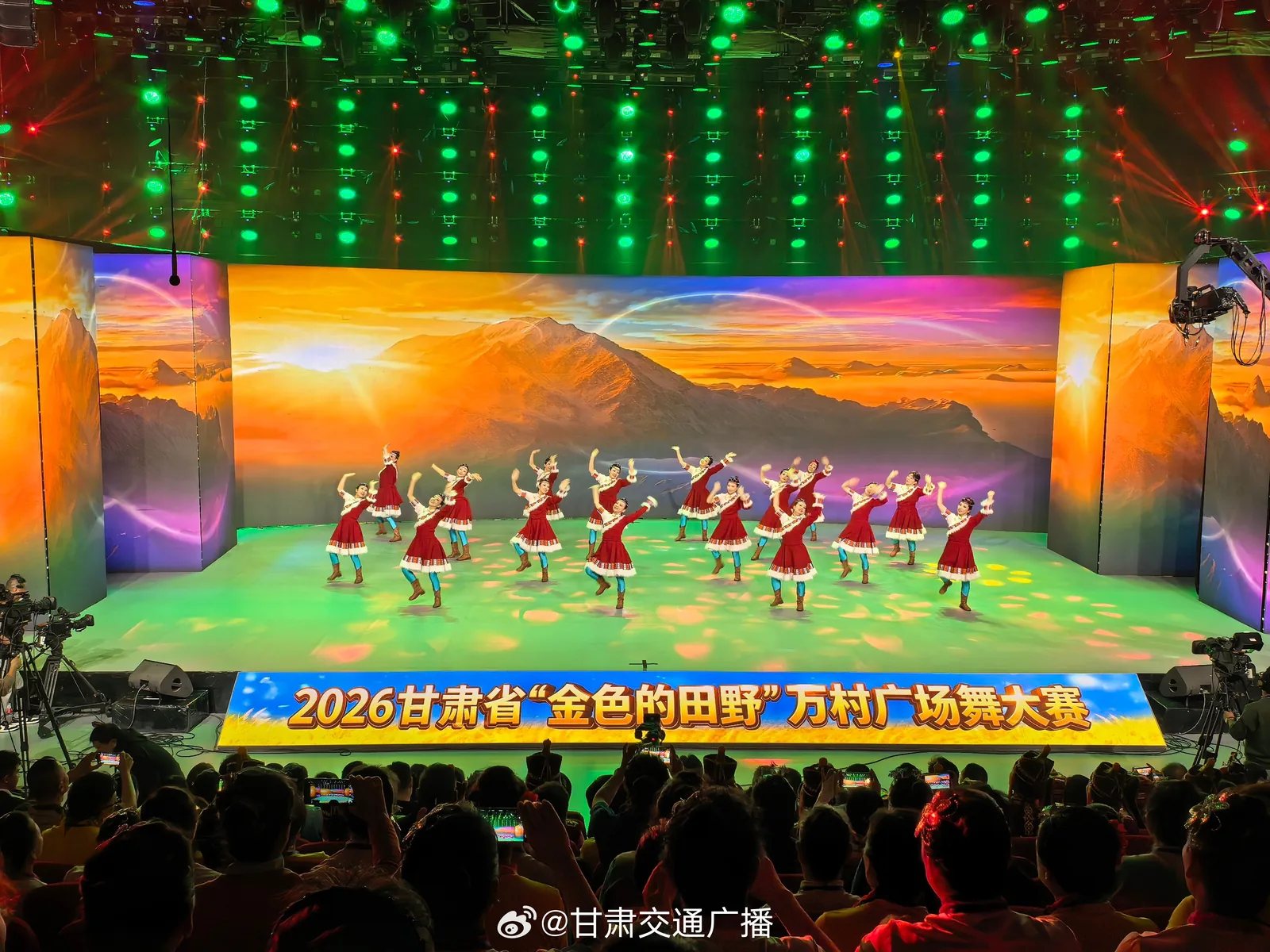
A typical group: mostly women in matching outfits, moving with fans at an even pace.
There is no single standardized guangchangwu group.
A typical community session may consist of several dozen people gathering in a place — a park, residential courtyard, public square or other open space — often in the evening.
One or more experienced dancers lead from the front.
Participants follow a sequence of movements, often repeating a routine until the group becomes synchronized. Beginners can usually observe from the back and gradually learn the choreography.
Music varies considerably.
Traditional Chinese songs, folk music and familiar popular songs remain part of the repertoire, but contemporary groups may also dance to C-pop, K-pop, electronic music or specially produced square-dance tracks — the same song-driven variety documented on the music hub.
Some groups remain informal neighborhood gatherings. Others have become highly organized performance teams with coordinated clothing, rehearsed choreography and participation in competitions or public events — documented examples include Nichangcaiyun in Beijing and the Xicheng Cultural Center Square Dance Troupe.
This distinction matters because guangchangwu is better understood as a broad participation system than as one particular dance style.
The same basic activity can function as casual evening exercise for retirees, a performance practice for a competition team, a social club for migrants, or a cultural activity for an overseas Chinese community.
Guangchangwu Is No Longer Just for “Grannies”
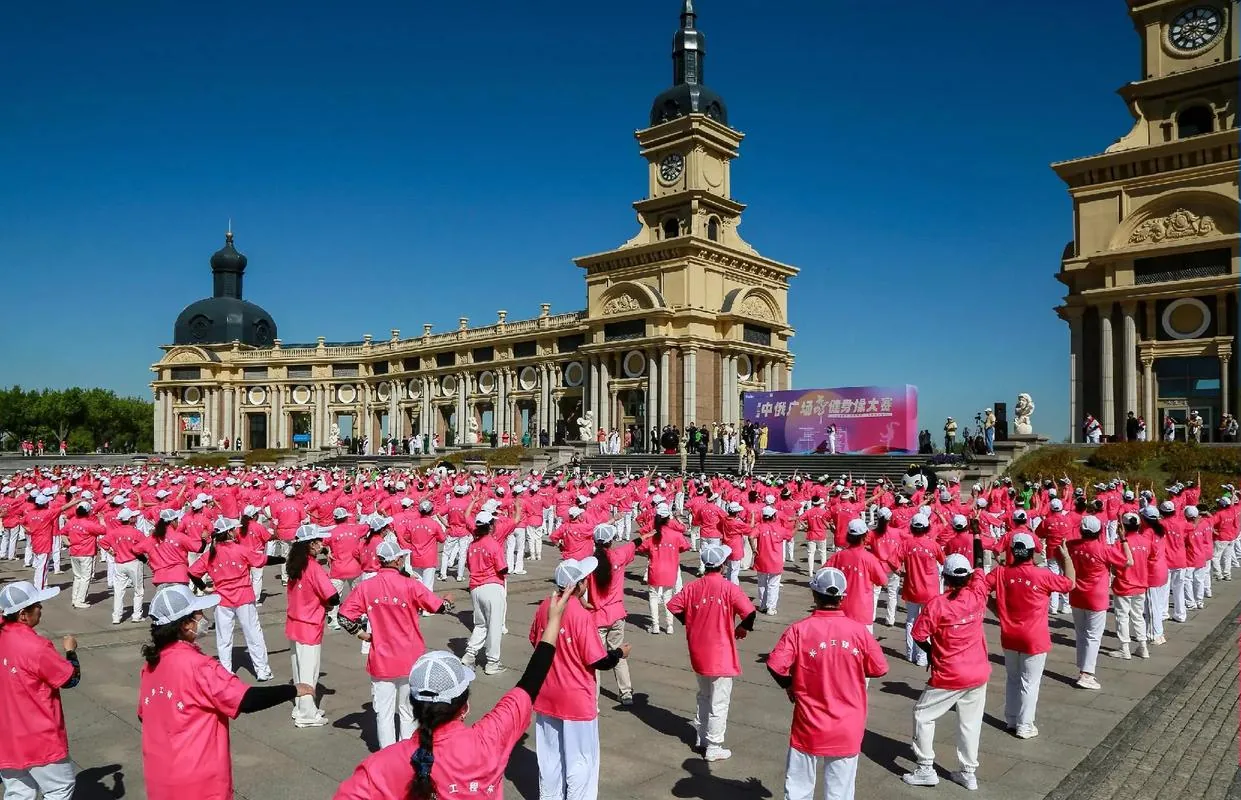
Mass participation events draw hundreds at a time — all ages, all levels.
The most important change in the practitioner population is not that older women have disappeared.
They have not.
Instead, new groups are appearing alongside the traditional core.
Young People and University Students
Young people’s participation has become increasingly visible in China.
One particularly well-documented example is the square-dance group at Beijing Foreign Studies University, where a student-led group has attracted large numbers of students since its formation in 2021. Reports have described participation by both Chinese students and international students, including students from countries such as Myanmar, Vietnam and Japan.
For these students, guangchangwu can serve a very different purpose from the traditional retirement-oriented model.
It can be:
- an inexpensive form of exercise;
- a way to relax after classes;
- a low-pressure way to meet people;
- an informal social environment;
- a cross-cultural activity for international students;
- and a way of experimenting with new music and choreography.
Young dancers have also brought different musical tastes into the practice.
K-pop, C-pop and contemporary choreography can sit alongside the songs and routines traditionally associated with community square dancing.
On Chinese social media, the emergence of “young people’s guangchangwu” (年轻人的广场舞) has become visible enough to develop its own cultural identity.
This does not mean that a new generation has suddenly replaced older dancers.
It means guangchangwu has become flexible enough to be adopted by people who did not grow up with the same social experiences as the original core participants.
Men Who Practice Guangchangwu
Men participate too, although they remain a minority.
Available research generally places male participation in the approximate 10–15% range, depending on the sample and definition used.
There are male dancers, male leaders and mixed-gender teams, but the social image of guangchangwu remains strongly associated with women.
That difference itself is culturally interesting.
Public synchronized dance can be more socially acceptable for women of the older generation than for men, while men may have other established leisure activities such as chess, fishing, mahjong, calligraphy or other forms of exercise.
Still, the existence of male participants is important because it demonstrates that guangchangwu is a community practice rather than a female-only activity.
The “New Elderly”: A Different Generation of Older Adults
Another change is happening within the older population itself.
People entering middle and later adulthood today do not necessarily have the same preferences as the generation that popularized guangchangwu.
Some younger older adults increasingly choose gyms, yoga, Pilates, badminton, walking groups or digitally mediated fitness.
They may also have different expectations around privacy, personal space, exercise variety and consumer choice.
This is why it is misleading to describe the evolution of guangchangwu simply as “young people replacing old people.”
A better description is diversification.
The older generation that built guangchangwu continues to dance, while some younger adults and university students are adopting it in new forms. At the same time, some middle-aged and younger retirees are choosing other forms of exercise.
The result is a more varied participation landscape — exactly the “Guangchangwu is not one dance” distinction the homepage makes.
Who Practices Guangchangwu Outside China?
Guangchangwu did not remain inside China’s borders.
Chinese communities overseas have developed their own forms of public square dancing in places including New York, London, Paris, Moscow, Sydney, Toronto and Vancouver.
Manhattan’s Chinatown, for example, has been documented as a setting for groups of older Chinese dancers at Manhattan Chinatown and Sunset Park, alongside structured gatherings such as the Southwestern Ontario Chinese Square Dance Competition.
In these communities, guangchangwu can perform several functions simultaneously.
Community and Social Connection
For older immigrants, a regular dance session can provide a familiar social environment in a city where language, age and migration history might otherwise make social connection difficult.
The dance becomes a reason to meet regularly.
Cultural Memory
Music and movement can also carry cultural memory.
For people who left China decades ago, dancing to familiar Chinese songs in a public space can reconnect everyday life abroad with memories of home.
Cultural Transmission
Overseas groups can also introduce younger generations and non-Chinese participants to Chinese music, movement and community traditions.
This makes diaspora guangchangwu more than an exercise activity.
It becomes a small-scale form of cultural transmission — the pattern described in Guangchangwu around the world.
Why Do People Practice Guangchangwu?
Exercise is an important reason, but it is not the only one.
Research on Chinese older adults repeatedly identifies several overlapping motivations.
1. Physical Activity
Guangchangwu provides accessible moderate-intensity movement.
A 2026 randomized controlled trial involving 150 adults aged 60–79 examined a 12-week community square-dance intervention consisting of three 60-minute sessions per week. The study reported improvements in aerobic endurance, balance, flexibility, blood pressure, mood and quality-of-life measures, with high adherence and no serious adverse events reported.
Earlier systematic-review research also found evidence of physical, psychological and cognitive benefits among older Chinese adults participating in square-dance interventions.
These studies do not mean that guangchangwu is a universal medical treatment. They do show that the activity can function as a meaningful form of regular physical activity — summarized with full evidence limits in Square Dancing and Health and under Body & evidence in Learn.
2. Social Connection
The social dimension may be just as important.
A person can exercise alone.
Guangchangwu makes exercise collective.
Participants see the same people repeatedly, learn routines together, practice together and often socialize before or after dancing.
For people whose social networks have changed after retirement, migration or children leaving home, this repeated contact can be valuable — the community-life dimension documented under Culture.
3. Daily Routine
Regular sessions create structure.
For someone who previously had a fixed work schedule, retirement can make time feel unstructured. A dance group can restore a simple rhythm:
arrive → meet people → dance → talk → go home.
That routine may be one reason participants continue for years — the path outlined in the beginner guide.
4. Identity and Visibility
Guangchangwu can also provide a public role.
A participant who spends much of the day performing unpaid domestic work or caring for family members can become highly visible in a dance group.
The experienced dancer may become a leader.
The skilled dancer may perform on stage.
The organizer may teach dozens of people.
In this sense, guangchangwu can become a form of serious leisure and identity construction, particularly for older women.
5. Enjoyment
There is also a simpler explanation.
People dance because they like dancing.
Not every activity needs to be reduced to retirement policy, health outcomes or social theory.
Music, movement, performance, friendship and the pleasure of doing something together are themselves reasons to participate.
Guangchangwu Is Different From Western Square Dance
One important clarification for international readers is that guangchangwu is not the same thing as Western square dance.
The English phrase “square dancing” can create the wrong mental image.
Traditional Western square dancing generally involves four couples arranged in a square and responding to a caller who directs the sequence of movements.
Guangchangwu usually looks very different:
| Guangchangwu | Western square dance |
|---|---|
| Often performed in lines, circles or open formations | Usually four couples in a square |
| Movements commonly follow a leader or instructor | A caller directs the dancers |
| Frequently practiced outdoors | Often associated with halls, clubs or organized events |
| Chinese popular, folk or contemporary music is common | Traditionally associated with folk/country musical traditions |
| Everyday participation is generally free | Classes, clubs or events may involve fees |
| Strong traditional participation among older Chinese women | Broader age and gender participation |
The shared English word “square” refers to very different cultural practices — spelled out in Guangchangwu vs. square dance.
For that reason, guangchangwu is increasingly useful as the English-language term when discussing the Chinese phenomenon specifically, as covered in Chinese plaza dancing.
The Guangchangwu Practitioner Is Changing
The most useful way to understand guangchangwu in 2026 is not to ask whether the traditional “dancing granny” is disappearing.
She isn’t.
Instead, the practitioner population is becoming more complicated.
The traditional community dancer remains important:
older → predominantly female → retired or semi-retired → neighborhood-based → regular outdoor participation.
Around that core, however, new forms are appearing:
young adults → university groups → international students → mixed-gender participants → competition teams → diaspora communities → digital dance communities.
The same practice can therefore mean very different things to different people.
For one participant, it may be a way to stay active after retirement.
For another, it may be a daily social lifeline.
For a university student, it may be a cheap and enjoyable way to meet friends.
For an immigrant, it may provide cultural continuity.
For a competition team, it may become a serious performance discipline.
That diversity is arguably the most important fact about who practices guangchangwu today.
What Does the Future of Guangchangwu Look Like?
Several developments are likely to shape the next phase of the practice.
First, guangchangwu is likely to remain strongly associated with China’s aging population, even as the activity diversifies.
Second, participation is increasingly connected to digital platforms. Tutorials, choreography, music and performances can now circulate far beyond the physical square.
Third, younger dancers are changing the music and aesthetics of the practice.
Fourth, public-space conflicts are encouraging experimentation with technologies such as directional sound systems, noise monitoring and headphone-based formats — part of the public space negotiation story.
Finally, guangchangwu is increasingly visible outside China, particularly through Chinese diaspora communities and international cultural exchange.
These changes point toward a useful distinction:
Guangchangwu is not one demographic. It is a social practice used by different demographics.
Frequently Asked Questions
Who primarily practices guangchangwu?
The traditional core consists of middle-aged and older Chinese adults, particularly women aged roughly 50–70. However, men, younger adults, university students, international students and overseas Chinese communities also participate.
How many people practice guangchangwu in China?
Recent estimates commonly place regular participation at around 100–120 million people, although figures vary substantially depending on whether researchers count regular dancers, occasional participants, organized teams or broader forms of dance participation.
Why do so many older Chinese women practice guangchangwu?
Several factors overlap: retirement, increased free time, social connection, accessible exercise, community life, cultural familiarity with collective activities and the low cost of joining a group.
Do men practice guangchangwu?
Yes. Men are a minority, but male dancers, instructors and mixed-gender teams are well documented.
Do young people in China practice guangchangwu?
Yes. University groups and younger urban dancers have become increasingly visible, often using contemporary music and choreography.
Is guangchangwu the same as American square dancing?
No. Although both are sometimes translated as “square dance,” they are different cultural and movement traditions. Guangchangwu usually involves groups following a leader rather than four couples responding to a caller — see Guangchangwu vs. square dance.
Is guangchangwu good exercise?
Research suggests that regular square-dance participation can provide meaningful physical activity and may improve measures such as aerobic endurance, balance, flexibility and some psychological outcomes. The strength of evidence depends on the specific outcome and study design — see Square Dancing and Health.
Where is guangchangwu practiced outside China?
Chinese square-dance groups have been documented in cities including New York, London, Paris, Moscow, Sydney, Toronto and Vancouver, particularly within Chinese diaspora communities.
Why do people dance in public rather than at home?
Public dancing combines exercise with social interaction. Parks, plazas and residential open spaces also provide free or inexpensive places where large groups can meet regularly — the place directory records where these sessions are documented.
Is guangchangwu controversial in China?
Sometimes. The biggest conflicts concern music volume, public-space use and relations with nearby residents. These tensions have contributed to local registration systems, noise limits and experiments with technologies designed to reduce sound reaching surrounding areas — tracked in public space and sound.
Conclusion: Who Is the Guangchangwu Dancer?
There is no single answer.
The image of the older Chinese woman dancing with her neighbors remains an important part of guangchangwu. She represents the generation that turned public square dancing into one of China’s most recognizable grassroots cultural activities.
But she is no longer the entire story.
Young university students are dancing.
Men are dancing.
International students are dancing.
Chinese diaspora communities are dancing.
Competition teams are dancing.
And millions of older women continue to dance because they have found something in the square that is difficult to replace elsewhere: exercise, friendship, routine, music, visibility and belonging.
That is why guangchangwu is better understood as a social practice than simply a dance style.
Not exclusive: the people described here are documented participants, not a rule for who may practice. Guangchangwu remains open to newcomers — the beginner path starts with watching a session.
Its participants reflect China’s changing age structure, urban communities, retirement patterns, public spaces and cultural life.
The people dancing in the square are therefore not just dancers.
They are also a window into how everyday life in China is changing.
Next steps
- What is Guangchangwu? — the definition
- History of Guangchangwu — how the practice grew
- Guangchangwu vs. square dance — the key distinction
- Learn Guangchangwu — start here, find a group, understand the movement
- Culture — public space, community life and generations
Sources
- China's elderly seek health and happiness through square dancing
- Chinese Square-Dancing: A Description of Group Cultural Life
- An African woman's first experience with Chinese square dancing
- China's Relationship with Song and Dance Is Unselfconscious
- The Dancing Grannies of New York City
- Square dancing / guangchangwu public health RCT (Frontiers, 2026)
- Systematic review of square dancing interventions (PMC9141523)