There is no single official “guangchangwu step.” Guangchangwu (广场舞) is built from a shared vocabulary of simple, repeatable movements — steps, arm patterns, turns, and gestures — that each group combines into its own routine. The fastest way to learn the steps is to watch the leader and follow along.
If you search for “Chinese square dance steps,” you are really asking two different questions at once:
- What do the individual movements look like?
- How does a beginner actually pick them up?
This guide answers both, without pretending that guangchangwu is one fixed choreography. Guangchangwu is best understood as a family of public group dances, not a single dance with an official syllabus.
Key point: In American square dance, steps are dictated by a caller through named calls. In guangchangwu, a front leader (领舞, lǐngwǔ) demonstrates a pre-learned routine, and the group copies it. You learn the steps by watching and repeating — not by memorizing written instructions. See the guangchangwu vs. Western square dance comparison.
Is there one correct set of guangchangwu steps?
No. Research on Chinese square dancing describes the practice as drawing on dance, gymnastics, folk dance, and popular movement. Different groups use different combinations. What they share is a structure, not a single sequence:
- a group of participants,
- an open or public space,
- music with a clear beat,
- a coordinated routine,
- a leader who demonstrates the movements,
- repetition until the group is synchronized.
So “the steps” are really a small set of reusable building blocks.
The basic movement vocabulary
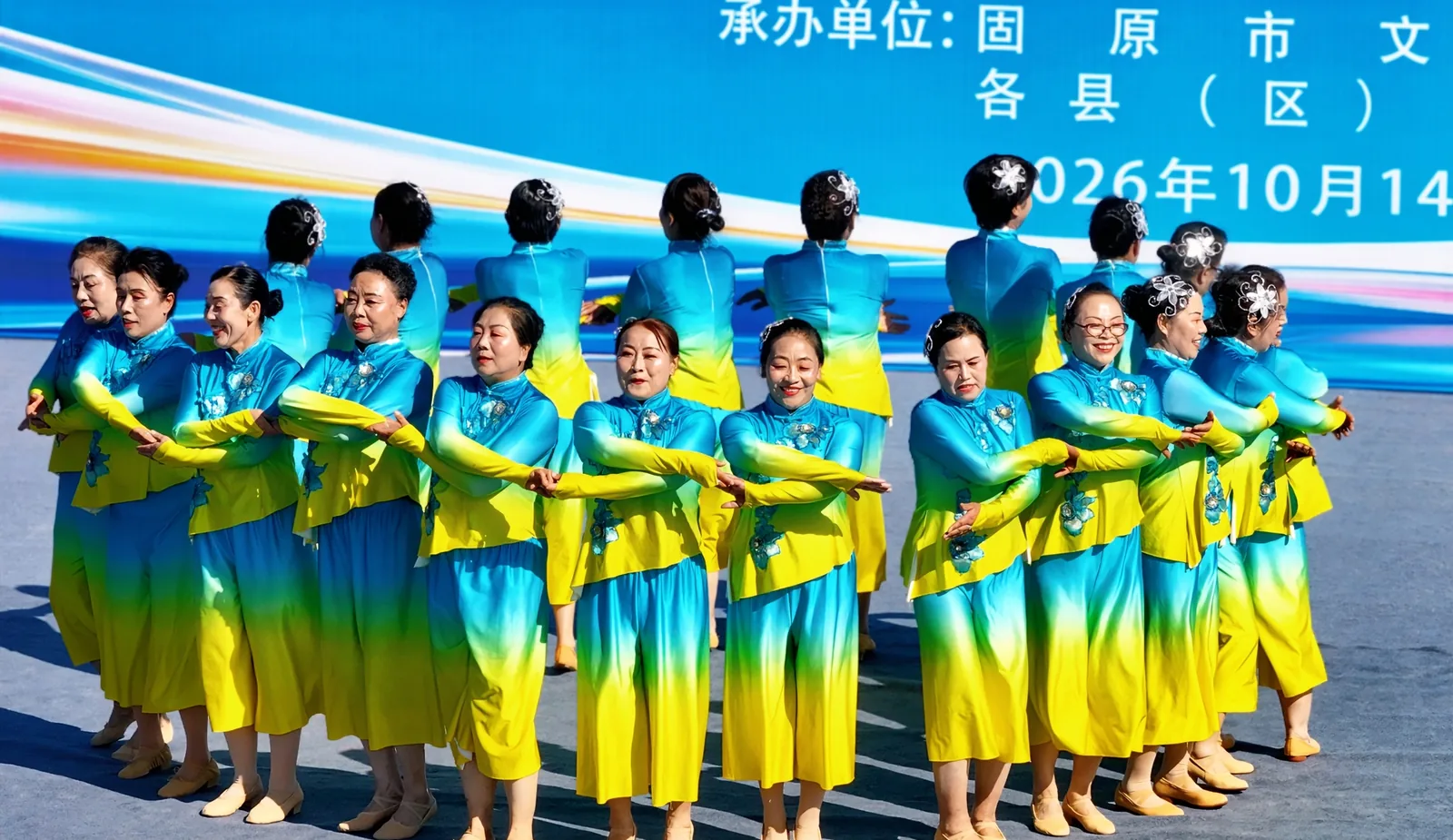
Rows on the same count — the basic vocabulary is small and endlessly recombined.
Most guangchangwu routines combine four kinds of movement.
1. Traveling and weight-shift steps
The rhythmic foundation. Common patterns include:
- Side steps — step out to the side and bring the feet together, repeated.
- Forward–back steps — step forward and return, or step back and return.
- Grapevine / shuffle steps — step sideways, cross behind, step sideways, uncross; a traveling pattern also seen in Shuffle dance.
- Marching in place — simple weight shifts that keep the group on the beat.
These are deliberately easy to learn. The goal is collective, rhythmic movement, not technical difficulty.
2. Arm patterns
Arms carry much of the visual identity of a routine:
- Arm raises — both arms lift overhead or to shoulder height on a beat.
- Arm sweeps — arms draw circles, arcs, or side-to-side sweeps.
- Alternating gestures — one arm extends while the other retracts, then switch.
- Hand shapes — open palms, fists, or gentle finger movements for expression.
Arm patterns are usually mirrored by the whole group, which is what makes a guangchangwu session look so coordinated from a distance.
3. Turns and directional changes
Many routines add gentle rotation:
- Quarter and half turns — the group rotates to face a new direction.
- The “four-corner” turn — a common motif where dancers turn to face each of four directions in sequence.
- Pivot steps — a small turn on the spot timed to the music.
These are low-impact and repeatable, which is why the activity suits a wide age range.
4. Gestures and expressive movements
Some routines borrow from Yangge (秧歌) or popular dance:
- shoulder rolls,
- hip sways,
- clapping on the beat,
- simple ribbon- or fan-like hand motions.
The exact mix depends on the group, the music, and the leader’s style.
How a typical routine is structured
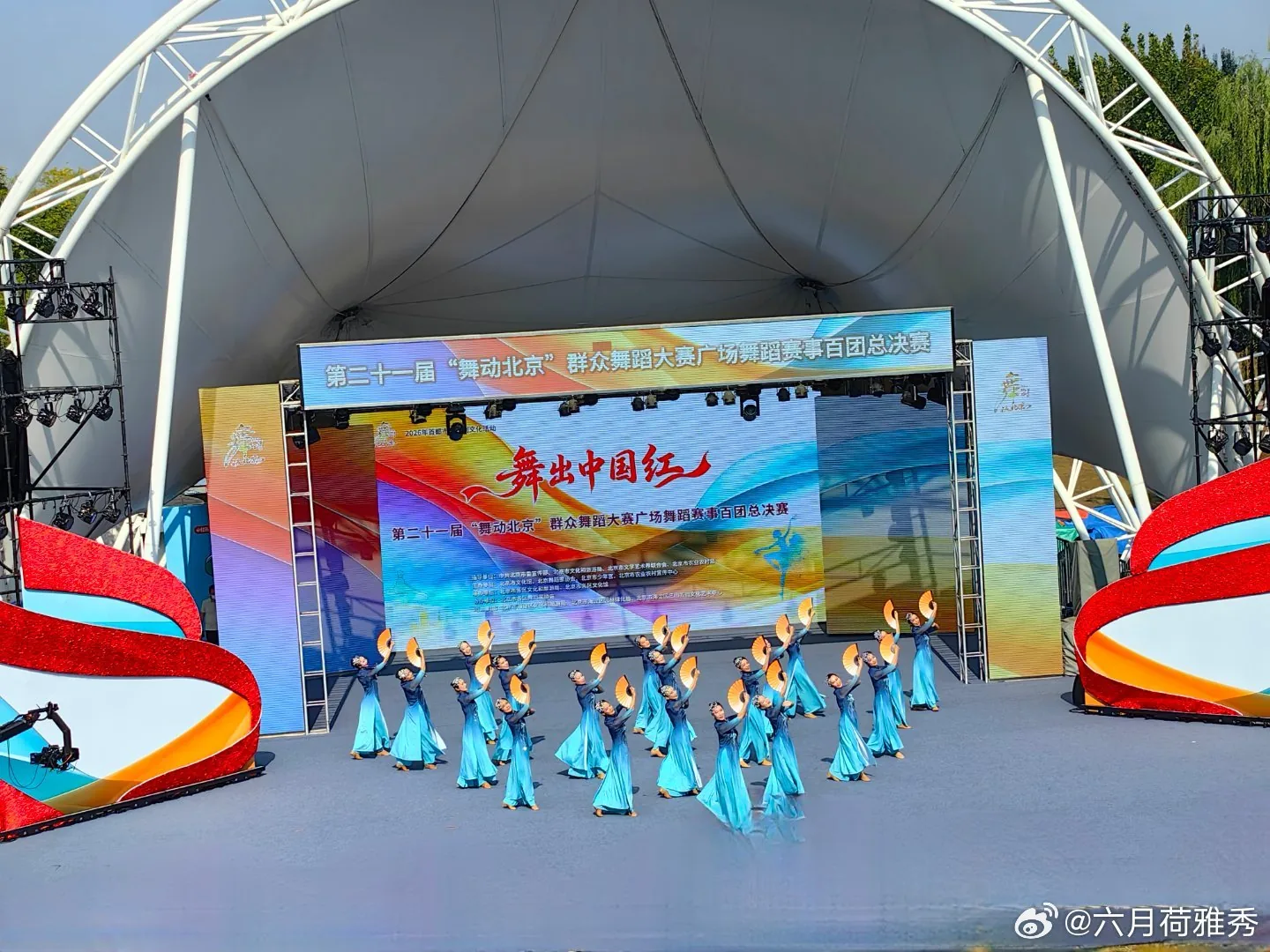
A routine on stage: repeated blocks, clean transitions, one shared count.
A guangchangwu session is usually organized like a short fitness class set to music:
- Warm-up — gentle steps and arm circles to get the group moving.
- Main body — the core routine, repeated several times so newcomers can join in and learn.
- Build or variation — the leader adds a turn, a new arm pattern, or a direction change.
- Cool-down — slower steps and stretching as the music eases.
Because the main body repeats, a bystander can arrive halfway through, stand at the back, and still pick up the steps within a song or two.
How the steps follow the music
The music is the clock. A shared track gives everyone the same tempo, so:
beat → step → repetition → synchronization → group routine
Groups often dance to Chinese pop, folk-influenced music, or specially produced exercise tracks — for example Little Apple (小苹果) or The Most Dazzling Folk Style (最炫民族风). The song chooses the mood; the leader chooses how the steps fit the beat.
How beginners actually learn the steps
You do not need lessons. The usual path is:
- Find a session — parks, plazas, and residential squares, often in the evening. See where guangchangwu happens.
- Watch from the edge — observe the leader and the group’s basic pattern.
- Stand at the back and copy — mirror the person in front of you.
- Count quietly — “step, together, step” helps the rhythm land.
- Return regularly — repetition is how the steps become automatic.
This low barrier is one reason guangchangwu scales from ten people to a few hundred in the same public space.
“Chinese square dance steps” vs American square dance steps
They are different systems. American square dance uses four couples in a square, a caller, and a vocabulary of named calls. Guangchangwu uses rows or open formations, a demonstrating leader, and repeatable choreography — closer in structure to line dance than to square dance. If you are looking for the physical shape of the movement, line dance is the more useful comparison.