Chinese Plaza Dancing: What Does the Term Mean?
Chinese Plaza Dancing is an English descriptive term for Guangchangwu (广场舞), the organized group dancing commonly practiced in public spaces in China. The phrase makes something important visible: this is dancing connected to public space, rather than a single standardized dance style.
But English-language sources use several different expressions for Guangchangwu, including:
- Guangchangwu
- Chinese Plaza Dancing
- Chinese Square Dancing
- Public Square Dancing
- Public Dancing
- Plaza Dancing
- Square Dancing
These expressions overlap, but they are not equally precise.
广场舞 is a Chinese concept, while English does not have one universally standardized translation for it. Understanding the terminology is therefore part of understanding Guangchangwu itself.
Chinese Plaza Dancing = Guangchangwu
The clearest starting point is the Chinese name:
广场舞
Guangchangwu (广场舞) is pronounced approximately gwahng-chahng-woo in Mandarin.
The word consists of:
- 广场 (guǎngchǎng) — square, plaza, or public open space
- 舞 (wǔ) — dance
A literal translation is therefore something like:
“square dance” or “dance in a public square.”
That literal translation is understandable, but it does not completely explain the cultural meaning of the term. Guangchangwu refers to a broader practice of organized group dancing in outdoor or publicly accessible spaces, often accompanied by music and coordinated routines.
Academic research commonly describes Guangchangwu as a public leisure or fitness practice rather than as one fixed choreography. One study defines it as group dancing in outdoor spaces with musical accompaniment, while noting that English-language literature also calls it square dancing, public dancing, and plaza dancing.
That is why Chinese Plaza Dancing can be a useful English description — as the practice’s name in English-language public life also shows: a 2026 Culture Days event is listed simply as Guangchangwu – Chinese Plaza Dancing.
Why “Plaza” Instead of “Square”?
The most important word in Chinese Plaza Dancing may actually be plaza.
In English, square has several meanings.
It can describe a public urban space:
a town square
But square dance can also refer to a particular Western dance tradition (Western square dance) involving established figures, formations, and groups of dancers. That creates a translation problem.
The Chinese word 广场 describes the public-space setting of Guangchangwu. It does not mean that Guangchangwu belongs to the Western square-dance tradition simply because both practices can occur in a “square.”
Using plaza can therefore make the spatial meaning more explicit:
Chinese Plaza Dancing = dancing associated with public plazas and other open public spaces in China.
It does not imply that every Guangchangwu group literally dances in an architectural plaza. Parks, residential-community spaces, riversides, urban gardens, and other open areas can also become Guangchangwu spaces. Recent research continues to describe the practice in parks, squares, and urban gardens, emphasizing that it can require little infrastructure beyond an open area and sound equipment.
What Does “Chinese Plaza Dancing” Refer To?
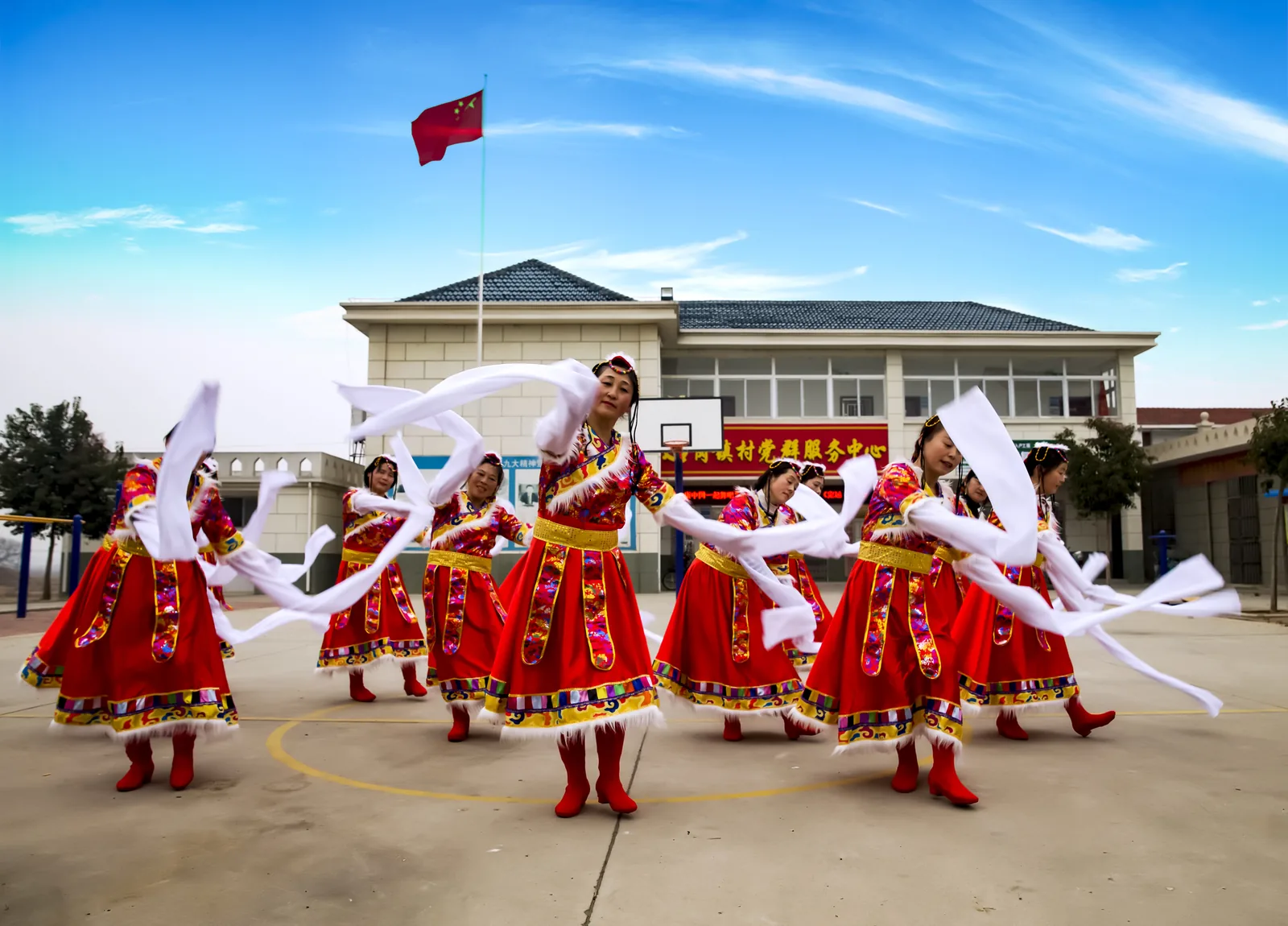
Red fans against an urban backdrop — the image most English readers associate with the practice.
The phrase generally refers to the same broad cultural practice known in Chinese as Guangchangwu (广场舞).
It usually involves:
- groups of people dancing together
- an open public or semi-public space
- music played through a speaker or sound system
- repeated and coordinated movements
- one or more experienced dancers leading the group
- regular participation
- a mixture of physical activity and social interaction
The important point is that Chinese Plaza Dancing describes a practice, not a single choreography.
There is no universal “Chinese Plaza Dancing routine.”
Different communities can use different music, movements, instructors, formations, and levels of organization.
Research on Chinese square dancing has described the activity as a form of group cultural life involving teachers, experienced members, ordinary members, social relationships, and collective performances.
Is Chinese Plaza Dancing the Official English Name?
Not exactly.
There is no single universally adopted English translation that functions as the official English name everywhere.
Different researchers, journalists, translators, and organizations have chosen different terms depending on context.
For example, academic sources use Guangchangwu when they want to preserve the Chinese cultural term. Other researchers use Chinese square dancing to describe the practice directly in English. Other sources use public square dancing, public dancing, or plaza dancing.
This variation is not necessarily evidence that these are different activities. In many contexts, they are different English labels for substantially the same Chinese practice.
The Main English Terms for 广场舞
A useful way to understand the terminology is to separate the Chinese original term from its various English descriptions.
| Term | What it communicates | Main limitation |
|---|---|---|
| Guangchangwu | Preserves the original Chinese concept | Requires explanation for English readers |
| Chinese Plaza Dancing | Highlights Chinese context + public-space character | Not the most common historical translation |
| Chinese Square Dancing | Easy for English readers to understand | Can be confused with Western square dance |
| Public Square Dancing | Emphasizes public-space activity | Less specifically Chinese |
| Public Dancing | Broad and simple | Too general by itself |
| Plaza Dancing | Emphasizes public/open-space setting | Can refer to other activities outside China |
| Square Dancing | Direct literal translation | Strong Western square-dance association |
This is why a page about Chinese Plaza Dancing should not pretend that only one English expression exists.
The terminology itself is part of the story.
Why Do Some Researchers Keep the Word “Guangchangwu”?
There is a practical reason.
In English-speaking contexts, square dance can refer to a different dance tradition.
One influential academic discussion of Guangchangwu explicitly notes that “square dancing” refers to a qualitatively different practice in Western, particularly North American, contexts, and therefore uses Guangchangwu throughout the study.
This is an important distinction.
Using the original Chinese term can avoid forcing the practice into an English cultural category that does not fully match it.
It also makes the term useful as a distinct concept:
Guangchangwu = 广场舞
rather than:
Guangchangwu = Western square dance translated into Chinese
The two should not be treated as equivalent traditions.
Why “Chinese Square Dancing” Is Still Common
Despite the ambiguity, Chinese square dancing is a well-established English expression.
Academic publications themselves use the term. For example, Jun Yang and Tianli Qin titled their 2023 study:
Chinese Square-Dancing: A Description of Group Cultural Life
The study examines the Chinese practice as a form of public fitness, social communication, and group cultural life.
So it would be misleading to claim that “Chinese square dancing” is an incorrect translation.
It is better understood as:
a common English translation that can require contextual clarification.
The word Chinese is doing important work. “Chinese square dancing” tells the reader that the subject is the Chinese practice, not necessarily the Western square-dance tradition.
Why “Public Square Dancing” Is Also Used
Another common translation is:
public square dancing
This expression emphasizes the public nature of the activity.
It is particularly useful in academic writing where the researcher wants to distinguish Guangchangwu from dancing performed in private studios, clubs, or formal performance venues.
Some research uses public square dancing (PSD) as a general English description of the Chinese practice. A 2026 study, for example, describes public square dancing as a widespread social phenomenon in China and examines how groups negotiate public-space relationships.
The phrase therefore highlights one of Guangchangwu’s defining characteristics:
the use of shared public space.
What About “Public Dancing”?
“Public dancing” is even broader.
It can describe many forms of dancing that happen in public.
That makes it understandable but less precise.
For example, a street performance, public dance festival, social dance event, or spontaneous dance could all be described as public dancing.
Guangchangwu is more specific because it normally involves:
regular groups + coordinated routines + music + public space + recurring participation.
Therefore:
All Guangchangwu can be described as public dancing, but not all public dancing is Guangchangwu.
What About “Plaza Dancing”?
Plaza dancing is a useful phrase because it preserves the spatial meaning of 广场.
It is also used in academic discussions of Guangchangwu. Research on older adults in China, for example, lists “plaza dancing” alongside “square dancing” and “public dancing” as English descriptions of Guangchangwu.
However, “plaza dancing” on its own does not necessarily tell an English reader that the subject is Chinese.
Adding Chinese makes the concept much clearer:
Chinese Plaza Dancing
That phrase therefore combines two useful signals:
- Chinese → cultural context
- Plaza Dancing → public-space practice
Is “Chinese Plaza Dancing” a Different Dance From Guangchangwu?
No.
When the term is used to describe the Chinese practice discussed on this site, Chinese Plaza Dancing refers to Guangchangwu (广场舞).
The difference is linguistic rather than a difference in the underlying practice.
Think of the relationship like this:
- 广场舞 — Chinese original
- Guangchangwu — romanized Chinese term
- Chinese Plaza Dancing — English descriptive expression
- Chinese Square Dancing / Public Square Dancing / Plaza Dancing — other English descriptions
These are different ways of naming or describing the same broad phenomenon.
The terms should not, however, be treated as perfectly interchangeable in every English sentence because their connotations differ.
Why Translation Matters
Translation is not just a matter of finding a dictionary equivalent.
A translated term also carries cultural associations.
For Guangchangwu, the most obvious example is:
square dance
To a Chinese speaker, 广场舞 immediately suggests a familiar form of public group dancing.
To an American English speaker, square dance may instead evoke a specific traditional social dance involving formations and calls.
This difference can create an unintended mental image.
The problem becomes particularly important when Guangchangwu is discussed outside China.
An English reader encountering:
Chinese square dancing
may understand the intended meaning from context.
But an English reader encountering:
square dancing
without the word Chinese may reasonably think of the Western tradition.
This is why terminology and disambiguation matter.
Chinese Plaza Dancing vs. American Square Dance
The two practices share a word in translation but should not be treated as the same cultural form.
Guangchangwu
- Chinese term: 广场舞
- Commonly practiced in public spaces in China
- Often involves large groups
- Usually follows recorded music
- Routines may be repeated and led from the front
- Often functions as exercise and leisure
- Strong social and community dimensions
- No single universal choreography
American Square Dance
- A distinct Western dance tradition (Western square dance)
- Typically organized around established dance figures and formations
- Historically associated with caller-led sequences
- Often involves sets of dancers rather than large informal public exercise groups
- Has its own historical, musical, and cultural development
The shared English word square should therefore not be treated as evidence of shared origin.
For a detailed discussion of this boundary, see Guangchangwu vs Square Dance. That page focuses specifically on the structural and cultural differences rather than the translation problem itself.
Why “Chinese Plaza Dancing” Is a Useful Term
The value of Chinese Plaza Dancing is not that it replaces every other English expression.
Its value is that it makes three things immediately visible.
1. Chinese
The practice belongs to a Chinese cultural and social context.
2. Plaza
The activity is strongly associated with shared outdoor and public spaces.
3. Dancing
The activity is fundamentally organized around group movement and music.
Together:
Chinese Plaza Dancing
provides an intuitive English description of Guangchangwu without requiring the reader to already understand the Chinese term.
The Word “Guangchangwu” Is Still Important
Even when using English terminology, the Chinese term should remain visible.
That is because Guangchangwu is the original cultural name.
It also provides a stable reference across languages.
A useful pattern is:
Guangchangwu (广场舞), often described in English as Chinese plaza dancing or Chinese square dancing, is a form of organized group dancing practiced in public spaces in China.
Once the relationship has been established, the shorter term Guangchangwu can be used throughout the rest of the discussion.
This approach avoids repeatedly translating the term and helps preserve its cultural specificity.
How English Media Have Framed Guangchangwu
English-language coverage has often focused on the most visible aspects of Guangchangwu:
- large groups
- older participants
- outdoor dancing
- loud music
- public-space conflicts
- “dancing grannies”
These descriptions reflect real features of the phenomenon, but they can also narrow the reader’s understanding.
Academic research has increasingly examined Guangchangwu beyond the familiar media image. Studies have treated it as:
- a leisure practice
- a form of public fitness
- a social network
- a community activity
- a practice of place-making
- a way of negotiating public space
- a form of everyday cultural life
For example, research on Chinese square dancing describes layered relationships among dance teachers, experienced members, and ordinary members, showing that the group itself can function as a form of community life.
Other research has examined how synchronized dancing contributes to social interaction and people’s sense of place.
More recent work has gone further, examining how dancers negotiate permission to use public space and how groups respond to competing claims on that space.
So the English terminology is evolving alongside the research itself.
“Dancing Grannies” Is Not a Translation of Guangchangwu
One particularly visible English expression is:
dancing grannies
This is a media description rather than a direct translation.
It comes from the strong association between Guangchangwu and older women. Academic research has documented this demographic association, particularly among older women in urban China.
But dancing grannies is not equivalent to Guangchangwu.
It emphasizes who is dancing rather than what the practice is.
That distinction matters.
A Guangchangwu group can include people outside the stereotype, while the term itself describes the practice rather than the age or gender of its participants. The fuller demographic picture is covered in Who Practices Guangchangwu?.
For that reason, dancing grannies is best treated as a media phrase or cultural shorthand, not as the canonical English name of the practice.
“Dama” and Other Chinese Expressions
Another term that sometimes appears in English-language discussion is:
dama (大妈)
The word has a much more complicated cultural meaning than simply “older woman.”
In discussions of Guangchangwu, dama can refer to the middle-aged or older women stereotypically associated with the activity.
But translating it simply as “granny” loses some of the social and cultural associations carried by the Chinese term.
This is another reason that a direct translation does not always produce an equivalent concept.
The safest approach is to preserve the original Chinese term when its cultural meaning matters and explain it in context.
There Is No Need to Choose Only One English Name
The terminology surrounding Guangchangwu does not have to be treated as a competition in which one expression is “correct” and every other expression is wrong.
Different terms are useful for different purposes:
- Guangchangwu — best for preserving the original Chinese concept.
- Chinese Plaza Dancing — useful when explaining the practice to English readers while emphasizing its Chinese and public-space context.
- Chinese Square Dancing — a well-established English expression, particularly in academic and media contexts, but one that benefits from clarification because of the Western meaning of “square dance.”
- Public Square Dancing — useful when emphasizing the public-space and fitness dimensions.
- Public Dancing — broader and less specific.
- Plaza Dancing — useful as a shorter descriptive phrase, but less clearly Chinese without context.
Guangchangwu (广场舞) remains the most precise cross-language reference because it points directly to the original Chinese term.
A Practical English Definition
If you need one concise definition for an English-speaking audience, a useful formulation is:
Chinese Plaza Dancing, or Guangchangwu (广场舞), is a form of organized group dancing commonly practiced in public spaces in China, combining music, coordinated movement, physical activity, and social interaction.
This definition does several things at once.
It identifies the English term.
It preserves the Chinese name.
It explains the public-space context.
And it avoids defining Guangchangwu as a single choreography or as an activity exclusively for older women.
How the Terms Relate
The terminology can be visualized like this:
                    广场舞
                 GUANGCHANGWU
                       │
              Chinese original term
                       │
          ┌────────────┼────────────┐
          │            │            │
          ↓            ↓            ↓
 Chinese Plaza   Chinese Square   Public Square
   Dancing          Dancing         Dancing
          │            │            │
          └────────────┼────────────┘
                       ↓
             English descriptions
                       │
                Public Dancing
                       │
              broader category
The important boundary is here:
Guangchangwu / 广场舞
        ≠
American / Western Square Dance
The English word square creates the potential ambiguity.
The Chinese term Guangchangwu removes much of it.
Why This Website Uses “Chinese Plaza Dancing”
On this website, Chinese Plaza Dancing is used as a clear English description of Guangchangwu (广场舞).
It is not intended to claim that this is the only correct English translation.
Instead, the phrase makes the central concept immediately understandable to readers who do not know Chinese while avoiding the strongest possible implication that Guangchangwu is simply another form of Western square dance.
The relationship is:
Chinese Plaza Dancing → Guangchangwu → 广场舞
The Chinese term remains the underlying concept.
The English phrase is the accessible description.
What Is Guangchangwu, Then?
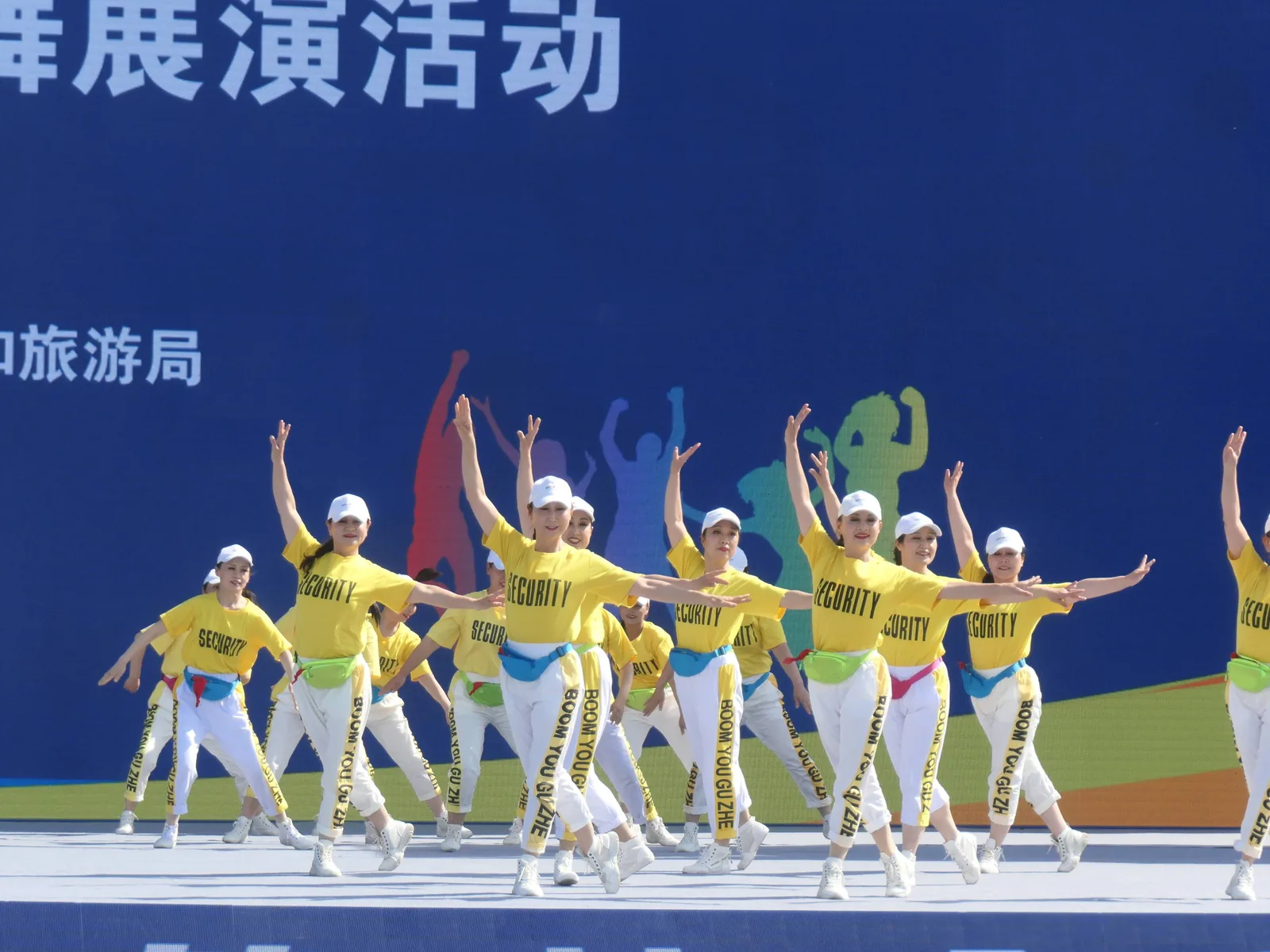
Yellow fans in bright daylight — one practice, many local styles and costumes.
If you arrived here because you simply want to understand the practice itself, the answer is straightforward:
Guangchangwu is organized group dancing in public spaces in China.
It commonly combines:
music + coordinated movement + exercise + recreation + social interaction + public space.
Its participants are often middle-aged and older adults, especially women, but the practice is broader than that stereotype.
It does not have one universal choreography.
And it should not automatically be equated with the Western square-dance tradition.
For the full explanation of the practice itself, see What Is Guangchangwu?.
Frequently Asked Questions
What is Chinese Plaza Dancing?
Chinese Plaza Dancing is an English descriptive term for Guangchangwu (广场舞), organized group dancing commonly practiced in public spaces in China.
Is Chinese Plaza Dancing the same as Guangchangwu?
Yes. When used in the context of Chinese public group dancing, Chinese Plaza Dancing refers to Guangchangwu (广场舞). The difference is primarily one of language and framing.
Is Chinese Plaza Dancing the same as Chinese Square Dancing?
In most contexts, both terms refer to Guangchangwu. However, Chinese Square Dancing can create ambiguity because “square dance” already has a distinct meaning in Western dance traditions.
What does Guangchangwu literally mean?
广场舞 combines 广场 (guǎngchǎng), meaning square, plaza, or public open space, with 舞 (wǔ), meaning dance.
Why is Guangchangwu sometimes called plaza dancing?
Because 广场 refers to the public or open spaces where the activity commonly takes place. “Plaza dancing” emphasizes that spatial meaning.
Is Guangchangwu a traditional Chinese dance?
Not in the narrow sense of being one traditional dance form. Modern Guangchangwu can incorporate folk-dance elements, popular music, exercise movements, and other influences.
Is Guangchangwu only for older women?
No. Older women are strongly associated with the practice and are prominent participants, but Guangchangwu is not formally restricted to one age or gender.
Why do some researchers use the word Guangchangwu instead of square dance?
Because square dance can refer to a different Western dance tradition. Some researchers therefore retain the Chinese term to avoid cultural and semantic confusion.
Is “dancing grannies” another name for Guangchangwu?
It is a media expression associated with the older women who participate in Guangchangwu, but it is not a literal or complete translation of the Chinese term.
The Short Version
Chinese Plaza Dancing is an English description of Guangchangwu (广场舞), the Chinese practice of organized group dancing in public spaces.
Several English expressions are used for the same broad practice, including Chinese Square Dancing, Public Square Dancing, Public Dancing, and Plaza Dancing.
They are related, but each emphasizes something different.
The most important distinction is between Guangchangwu and Western square dance.
The Chinese term refers to a contemporary public group-dance practice involving music, coordinated movement, exercise, recreation, and social interaction.
The English word square can make the practice sound more closely related to Western square dancing than it actually is.
That is why Chinese Plaza Dancing can be a useful descriptive term — and why Guangchangwu (广场舞) remains the clearest name for the underlying cultural concept.
Next steps
- What Is Guangchangwu?
- Guangchangwu vs Square Dance
- History of Guangchangwu
- Square Dancing and Health: What Research Supports