You do not need a dance partner, expensive equipment, or years of training to begin guangchangwu. In many groups the easiest way to start is remarkably simple: watch, stand at the back, follow the leader, learn a few repeating steps, and come back regularly.
If you have ever walked through a Chinese park, residential plaza, or public square in the evening, you may have seen groups of people moving together to music — sometimes dozens of dancers, sometimes hundreds.
This is guangchangwu (广场舞), often translated as Chinese square dance, Chinese square dancing, or Chinese plaza dancing.
And if you already know the American form of square dancing, there is one important thing to understand before you start:
Guangchangwu is not American square dance.
American square dancing traditionally involves couples arranged in formations and guided by a caller through named figures. Guangchangwu is a different tradition: a music-led, group-synchronized form of recreational dance and exercise that commonly takes place in public outdoor spaces. See the full guangchangwu vs. Western square dance comparison.
This guide explains what guangchangwu is, what happens at a typical session, what you need, which basic movements to learn first, how to join a group even if you do not speak much Chinese, and how to participate respectfully in a shared public space.
What Is Guangchangwu?
The Chinese word 广场舞 (guǎngchǎngwǔ) literally combines:
- 广场 (guǎngchǎng) — square, plaza, or public open space
- 舞 (wǔ) — dance
So guangchangwu can be understood literally as “square dance” or “plaza dance.” But the literal translation can be misleading for English speakers. The canonical answer lives in What is Guangchangwu?.
Guangchangwu is Chinese public-space group dancing
Guangchangwu developed into a highly visible form of community recreation in modern China. People commonly practice it in:
- public squares
- community plazas
- parks
- residential compounds
- riverside promenades
- open areas near cultural or sports facilities
How that space is negotiated — sound, residents, hours, rules — is its own topic: see public space and the research essay Public space and sound.
A typical session combines music, repeated choreography, aerobic movement, and group synchronization. There is usually a person or small group at the front demonstrating the movements. Everyone else follows.
That makes guangchangwu less like a formal dance class and more like a community activity that happens to teach dance through participation. More on how groups actually work is in Communities.
You do not necessarily need to arrive knowing the routine. You learn by watching.
Guangchangwu Is Not American Square Dance
This distinction matters because the English phrase square dance normally refers to an established American folk-dance tradition. In American square dancing, dancers commonly work in couples and formations, with a caller directing the dancers through sequences of recognized figures — the tradition documented for Western square dance.
Guangchangwu generally works differently:
| Guangchangwu | American square dance |
|---|---|
| Commonly practiced in public outdoor spaces | Traditionally practiced in organized dance settings |
| Usually music-led | Commonly caller-led |
| Often performed as a group following a leader | Usually organized around couples and formations |
| No partner is normally required | Partner roles are commonly part of the formation |
| Often combines dance and fitness | Primarily a social/folk dance tradition |
| Choreography varies widely | Uses established dance figures and terminology |
There are also other dance traditions that can cause confusion. Line dance can look similar because dancers may face the same direction and repeat choreography. But guangchangwu is a broader category of Chinese public group dancing and fitness activity rather than simply another name for Western line dancing. The same is true of contra dance, which has its own historical tradition, formations, and movement vocabulary.
So when this guide says Chinese square dance, it means guangchangwu — 广场舞. The dances section maps how these forms relate.
Who Dances Guangchangwu?
For many years, international media coverage often focused on China’s older women who participated in public square dancing, sometimes using the term dama (大妈) — a colloquial term that can refer to middle-aged or older Chinese women.
That slice reflects an important part of guangchangwu’s social history, but it is not the whole picture. Chinese square dancing is not inherently a women’s activity or an activity exclusively for older adults. Official Chinese sports materials have described participation across age groups, and a 2015 national competition explicitly stated that competitors could be of either sex and encouraged male participation.
Today you may encounter:
- older women
- middle-aged adults
- men
- younger adults
- families
- community fitness groups
- specialized dance groups
- competitive teams
The exact mix depends heavily on the location and the particular group — see who practices guangchangwu and the group directory.
For a foreign visitor or newcomer, the most important point is simple:
Do not assume that you need to fit a particular age or gender profile before you can participate.
A Short History of Guangchangwu
Guangchangwu is a modern phenomenon, but it draws on older Chinese traditions of communal dance, folk movement, music, and public celebration. One important cultural connection is Yangge, a traditional Chinese folk dance associated with northern China.
Modern guangchangwu, however, should not simply be described as “modern yangge.” Today’s public square dance includes many different musical and choreographic influences. A fuller sketch is in History of guangchangwu.
From community activity to mass fitness
The rapid development of guangchangwu is closely associated with China’s expanding urban public spaces and the growth of community-based recreational exercise. By the 2010s, square dancing had become sufficiently widespread that Chinese government sports and cultural organizations — including General Administration of Sport of China — began developing programs to encourage more organized and standardized forms of the activity.
In March 2015, the General Administration of Sport of China and the Ministry of Culture jointly launched a national program featuring Standardized guangchangwu routines — twelve square fitness dance routines. The program was designed to provide routines that were easy for ordinary people to learn and suitable for different groups. It included popular songs such as Little Apple and The Most Dazzling Folk Style.
Importantly, the purpose was not simply to force everyone in China to perform one standardized dance. Chinese sports officials explicitly described the 12 routines as an expanded “fitness menu” rather than a compulsory national choreography — the standardization push met organized backlash, as documented by NOEMA.
That distinction helps explain why modern guangchangwu remains so diverse. One group may be practicing a standardized routine. Another may be doing a folk-inspired dance. Another may be practicing Shuffle dance. Another may combine aerobic exercise with choreography. There is no single movement vocabulary that describes every guangchangwu session.
Why Guangchangwu Is Beginner-Friendly
One reason guangchangwu works so well as a community activity is that the barrier to entry is low. You generally do not need:
- a dance partner
- a dance studio
- expensive clothing
- competition-level technique
- previous dance experience
The group itself becomes part of the teaching system. Someone at the front demonstrates. Everyone behind follows. The choreography repeats. You gradually learn. The step-by-step entry path is laid out in the learn section.
It can also be genuine exercise
Research on Chinese square dancing has found associations with physical and psychological benefits, particularly among older adults. A 2022 systematic review identified 24 studies of square-dance interventions among older Chinese adults. The authors reported improvements across physical, mental, and cognitive outcomes, while also noting that the underlying studies had moderate-to-high risk of bias. See the health evidence summary for how to read those findings.
More recent evidence provides a useful example of what structured participation can look like. A 2026 randomized controlled trial involving 150 adults aged 60–79 compared a 12-week community square-dance program with a health-education control group. Participants in the intervention completed three 60-minute sessions per week. Compared with controls, the square-dance group improved its six-minute walking distance by 41.5 meters, reduced Timed Up and Go performance time by 1.05 seconds, and had reductions of 3.8 mmHg in systolic blood pressure and 2.4 mmHg in diastolic blood pressure. Measures of depressive symptoms, anxiety, wellbeing, and quality of life also improved.
That does not mean every casual evening dance session will produce those exact results. The study used a structured intervention with defined frequency and duration.
For a beginner, the more useful takeaway is this:
Guangchangwu can be more than cultural observation. It can be a real form of group physical activity.
And because it is social, the motivation to keep attending may come from the group as much as from exercise itself. The related research questions are tracked in Movement & Health.
Low barrier is the point. Open park sessions typically need no membership fee, partner, or costume. Bring water, shoes you can pivot in, and curiosity.
What You Actually Need to Start
The equipment list is surprisingly short.
1. Comfortable shoes
Wear shoes that allow you to step comfortably, turn without excessive slipping, move laterally, and absorb repeated impact. You do not need specialized “square dance shoes” for your first session. Comfort matters more than appearance.
2. Comfortable clothing
Choose clothing that allows your shoulders, hips, knees, and ankles to move freely. A typical beginner does not need a costume. You are joining a community activity, not entering a stage performance.
3. Water
A session can become a sustained period of aerobic movement, especially when several songs are performed consecutively. Bring water, particularly in warm weather.
4. A speaker?
Usually, no. If you are joining an existing group, someone is normally already responsible for the music. Do not arrive with your own speaker and start playing music over the group. If you eventually organize your own group, then a portable speaker or PA system becomes relevant.
This is also where an important issue appears: sound management.
How to Join Your First Guangchangwu Session
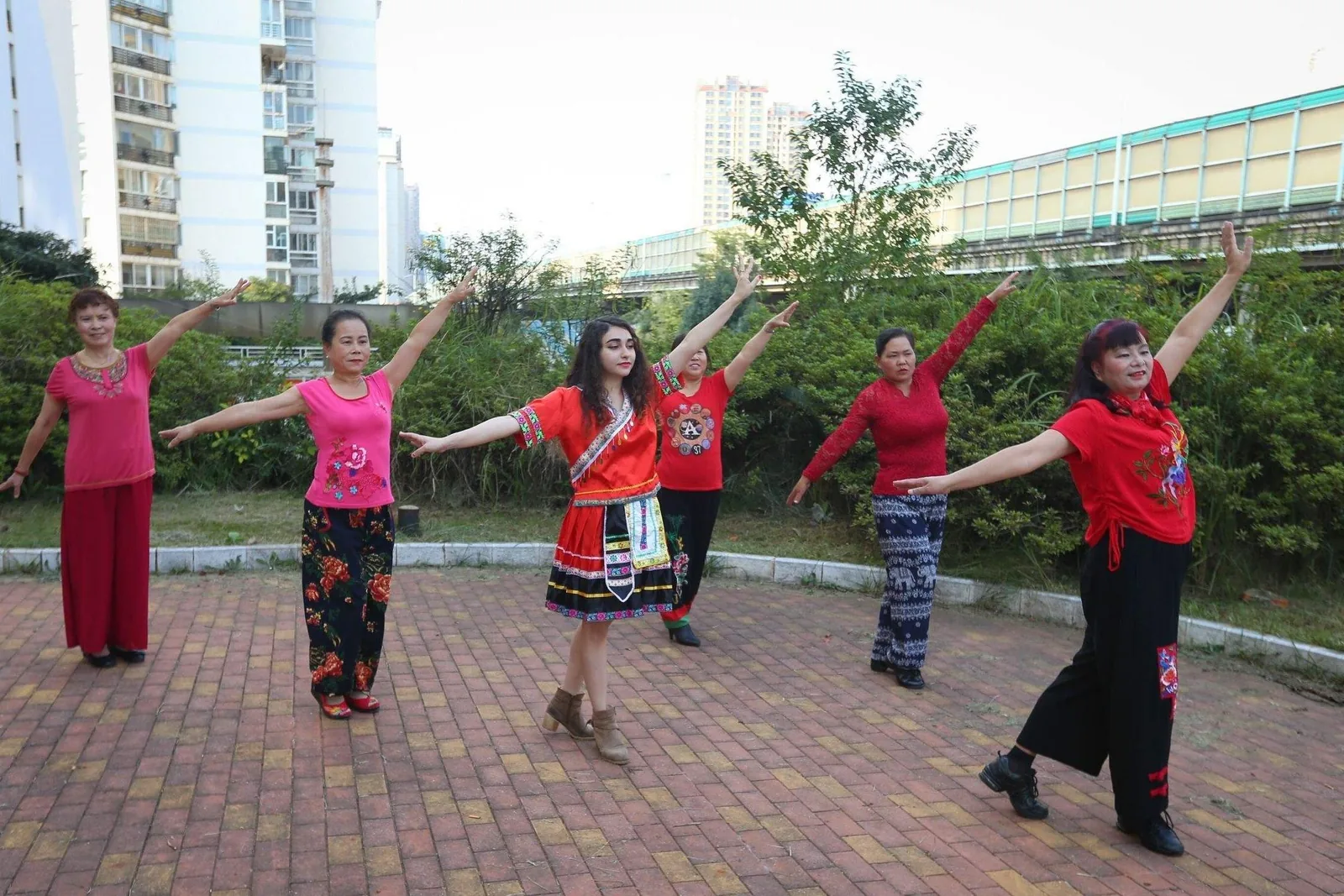
Most beginners join a group like this one — outside a residential block, after dinner.
You do not need to walk directly into the middle of the group. In fact, there is a much easier way.
Step 1: Find a group
Look in places where community exercise commonly takes place: neighborhood parks, public squares, residential compounds, riverside walking areas, community fitness areas, cultural plazas. Documented open sessions are listed in the places directory.
Early evening is a common time for outdoor group exercise, although schedules vary by location, season, weather, and group. If you are visiting China, ask a local resident:
这里有广场舞吗?
Zhèlǐ yǒu guǎngchǎngwǔ ma?
“Is there square dancing here?”
Or:
广场舞在哪里跳?
Guǎngchǎngwǔ zài nǎlǐ tiào?
“Where do people do guangchangwu?”
Step 2: Watch one song
Before joining, watch the group for one complete song. Look for:
- who is leading
- where beginners stand
- how large the formation is
- whether the group moves forward or stays in place
- whether the choreography repeats
- whether the group welcomes newcomers
You are learning the social choreography before learning the dance choreography. Reading a session breaks down what to watch for.
Step 3: Stand toward the back
This is probably the single most useful beginner tip.
Do not try to stand in the front row on your first day.
The back or side of the formation gives you room to make mistakes without disrupting everyone else. You can watch the person in front of you. If you miss a movement, wait for the next repetition.
Step 4: Follow the rhythm first
Do not immediately try to copy every arm movement. First find the beat. Then identify the basic stepping pattern. Then add the arms.
Think: Beat → feet → direction → arms → style
rather than: everything at once.
The Basic Steps to Learn First
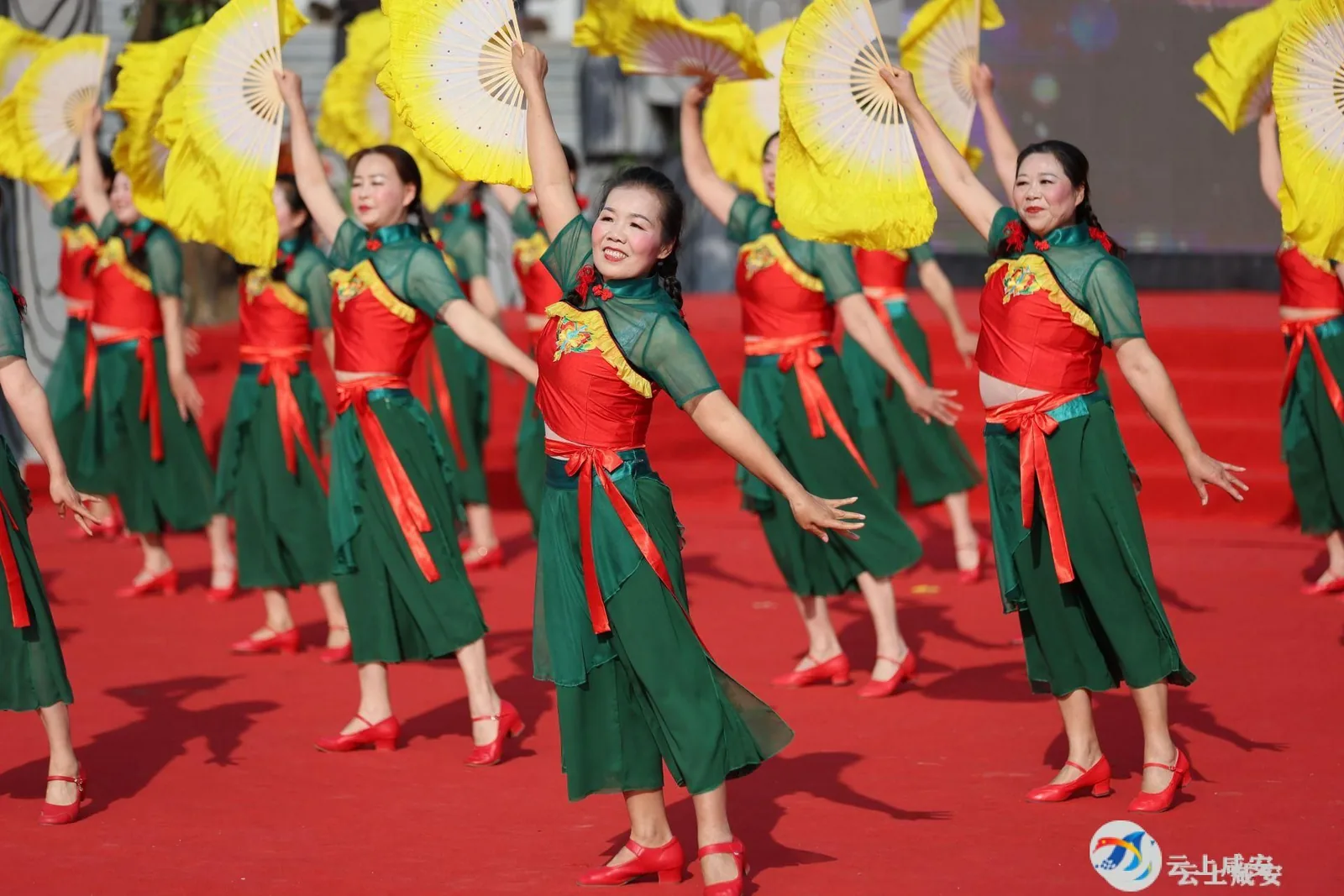
Blue-and-white outfits, pink fans: a set routine in progress, everyone on the same count.
There is no single universal beginner vocabulary for all guangchangwu. Different routines use different combinations. But several simple movements appear frequently enough that they are useful concepts for beginners — they map onto the movement concepts of rhythm, weight shifting, and group synchronization.
Step-touch
Step to one side. Bring the other foot toward it. Repeat. This simple movement teaches you to shift your weight while staying synchronized with the group.
Side point
Step or transfer weight to one side while the other foot points or lightly touches the floor. The movement may be performed with different arm patterns depending on the choreography.
Cross step
The feet cross as you move through a directional pattern. Cross steps can look complicated when watched at full speed, but become much easier when reduced to individual weight transfers. Start slowly.
Heel or toe points
Some routines use repeated heel or toe contacts with the floor. These are useful for learning how the choreography accents the music.
Yangge-style steps
If you encounter Yangge-influenced routines, the movement quality may feel different from a straightforward fitness dance. The emphasis can include rhythmic weight shifts, expressive arms, and distinctive foot patterns.
Do not worry about mastering the cultural movement vocabulary immediately. First learn to stay with the group.
How to Learn a Routine Without Getting Lost
This is where many beginners make the same mistake: they try to memorize the entire routine. Don’t.
Learn the repeating phrase
Listen for the point where the choreography comes back to something familiar. Many routines contain repeated sections. Once you recognize one sequence, you have an anchor.
Use the person in front of you
You do not need to watch the leader constantly. The dancer directly in front of you can act as your visual reference. This is one reason standing near the back is so effective.
Learn from the back-view perspective
If you are practicing at home from a video, a back-view demonstration can be particularly useful. A mirror-image front-facing video can force you to mentally reverse left and right. A back-view teacher lets you simply copy the movement. For a beginner, that can reduce the cognitive load considerably.
Don’t stop when you make a mistake
If you miss four counts, don’t freeze. Wait for the next recognizable phrase and rejoin. The group keeps moving. You should too.
When you are ready to practice one routine seriously rather than sampling many, see learn a routine and the standardized routines catalog.
Music: What Should a Beginner Listen To?
Music is one of the defining features of guangchangwu. You will encounter different genres, tempos, and choreography styles, but some songs have become strongly associated with Chinese public dancing.
Little Apple — 小苹果
Little Apple, performed by the Chopstick Brothers, became one of the most recognizable songs associated with the Chinese square-dance phenomenon.
Coolest Ethnic Trend — 最炫民族风
The song by The Most Dazzling Folk Style (Phoenix Legend) is another iconic example. Phoenix Legend’s combination of pop production, folk-inspired sounds, and highly recognizable melodies helped make its music particularly compatible with mass participation.
Other songs appear constantly as trends change. This is important:
There is no permanent “official guangchangwu playlist.”
Music changes. Choreography changes. Local groups have their own favorites. So instead of trying to memorize a fixed list of songs, train your ear to recognize the rhythmic structure of the routine. Browse the current set in Music.
Different Styles of Guangchangwu
Once you understand the basic format, you will discover that guangchangwu is not one dance. You may encounter:
Fitness square dance
Choreography designed primarily around accessible exercise and group synchronization.
Line dance
Dancers move in lines or rows and repeat choreographed sequences.
Yangge
Traditional and modernized forms influenced by Yangge.
Fan dance
Choreography incorporating handheld fans.
Shuffle dance
More rhythmic footwork and sliding patterns — see Shuffle dance.
Social dance
Some community groups incorporate partner-based forms such as three-step or four-step social dances.
Regional and community styles
Local groups may develop their own routines, music choices, formations, and teaching methods.
This diversity is one of the reasons it is better to think of guangchangwu as a cultural category and social practice, rather than as one standardized choreography. The full picture is in Dances.
How to Join If You Don’t Speak Chinese
You do not need fluent Mandarin. Guangchangwu is highly visual. Watch. Copy. Repeat. That already gets you surprisingly far.
Still, a few phrases can make the social entry easier.
“Can I join?”
我可以一起跳吗?
Wǒ kěyǐ yìqǐ tiào ma?
“Can I dance with you?”
“I’m a beginner.”
我是初学者。
Wǒ shì chūxuézhě.
“I’m a beginner.”
“Can I follow along?”
我跟着你学,可以吗?
Wǒ gēnzhe nǐ xué, kěyǐ ma?
“Can I learn by following you?”
“Which song is this?”
这是什么歌?
Zhè shì shénme gē?
“What song is this?”
You may also encounter WeChat groups used by local communities to coordinate schedules, share videos, announce events, or organize practice. If someone invites you into a group, it is usually more useful to observe the group’s normal communication before immediately posting — see how groups work.
How Much Does Guangchangwu Cost?
One of the attractions of community guangchangwu is that ordinary public sessions can have very low barriers to participation. An open outdoor session may cost nothing to attend.
However, costs vary considerably. You may encounter:
- free community sessions
- informal group contributions
- paid private instruction
- studio classes
- competition-oriented training
- costume or performance expenses
So don’t assume that “guangchangwu” automatically means either free or paid. If someone asks you to pay, simply ask what the fee covers:
这个费用包括什么?
Zhège fèiyòng bāokuò shénme?
“What does this fee include?”
For a first experience, there is usually little reason to commit financially before you know whether you enjoy the activity.
Guangchangwu Etiquette: The Part Beginners Should Not Skip
Learning the steps is only half of learning guangchangwu. The other half is understanding that you are sharing a public space.
Give the group enough space
Do not walk directly through the middle of a formation while people are dancing. Walk around the edge when possible.
Don’t suddenly change the music
If the group has an established music leader, don’t replace the playlist without asking.
Match the group’s volume
If you eventually organize your own group, think about the people around the activity as well as the dancers. Public space is shared space — the public space lens explains why.
Be aware of nearby residents
Noise has been one of the most visible social issues associated with guangchangwu in China. The debate is not simply “dancers versus residents.” For dancers, music provides the rhythm and makes coordinated movement possible. For nearby residents, repeated loud music can interfere with sleep, work, or everyday life. A respectful group tries to accommodate both. The longer analysis is Public space and sound.
Guangchangwu and China’s Noise Rules
This is an area where older articles about guangchangwu can now be outdated.
As of September 2026, China’s Ecological and Environmental Code (生态环境法典) has taken effect. It came into force on August 15, 2026, replacing several earlier environmental laws, including the Noise Pollution Prevention and Control Law.
Article 1190 addresses certain forms of noise-producing activity in public places. It includes recreational and fitness activities that fail to follow rules concerning activity areas, times, or volume, or that use audio equipment at excessive volume and cause noise pollution.
For violations covered by that provision, an individual may face a fine of RMB 200–1,000, while an organization may face RMB 2,000–20,000, following the specified enforcement process.
The practical lesson for a beginner is not to memorize the fine. It is:
Find out what rules apply to the particular place where you are dancing.
A park, residential compound, commercial plaza, or community facility may have its own requirements concerning:
- permitted hours
- designated areas
- speaker volume
- equipment
- noise-sensitive surroundings
A considerate dancer makes those rules part of the activity. In some settings, technologies such as wireless or “silent disco” headphones can also allow synchronized participation without broadcasting music to the surrounding neighborhood. Earlier national guidance is covered in the Sources section (BBC, 2015).
Is Guangchangwu Only for Older People?
No.
The older-women image became internationally famous because older women were highly visible participants in the rapid expansion of public square dancing. But the activity itself is broader. Government sports materials have described guangchangwu as attracting different age groups, and research has increasingly examined mixed-gender and broader community participation — see who practices guangchangwu.
If you are young, male, foreign, or completely inexperienced, those characteristics do not automatically make you an outsider. The particular group matters much more.
Some groups are strongly oriented toward older adults. Some are mixed. Some are organized around a specific dance style. Some are competitive. Some are simply neighbors meeting for exercise. The easiest way to find out is to watch.
Your First Week of Guangchangwu
You don’t need a six-month training program. Try this instead.
Day 1 — Observe
Find a group. Watch one complete session or at least one complete song. Pay attention to the formation and leader.
Day 2 — Join the back row
Stand at the edge or back. Don’t worry about getting every movement right. Your goal is simply to stay with the music.
Day 3 — Learn the basic rhythm
Practice step-touch, side point, simple weight shifts, and basic arm patterns. Don’t chase complicated choreography yet.
Day 4 — Choose one routine
Pick one song or routine. Practice it repeatedly rather than jumping between ten different dances.
Day 5 — Practice at home
Use a back-view demonstration if available. Practice slowly. Then gradually increase the speed.
Day 6 — Return to the group
You will probably discover something surprising: the routine that seemed impossible on Day 1 now looks familiar. Your brain has already learned the sequence.
Day 7 — Start participating rather than watching
At this point, stop worrying about whether you “look like a dancer.” You are learning the same way most group activities are learned: by doing them with other people.
The full beginner path, one step at a time, is in the learn section.
Beginner FAQ
Is guangchangwu difficult to learn?
The first few minutes can feel confusing because you are trying to process music, footwork, arms, direction, and other dancers simultaneously. But most beginner-friendly routines use repetition. The goal is not to memorize everything immediately. Learn one repeating phrase at a time.
Do I need a partner?
Usually, no. This is one of the major differences between guangchangwu and many partner-based dance traditions. Most public square-dance routines allow individuals to participate independently within the group formation.
Can men do guangchangwu?
Yes. Men participate in guangchangwu, although the gender balance varies considerably between groups. The 2015 national competition rules explicitly allowed participants of either sex and encouraged male participation.
Can foreigners join?
Often, yes. Whether you can join a particular group depends on the group’s culture and local circumstances, but there is no general requirement that a guangchangwu participant must be Chinese. Visual imitation also makes the activity relatively accessible across language barriers.
Is guangchangwu the same as line dancing?
No. Some guangchangwu routines use line formations, but guangchangwu is a broader category of Chinese public group dancing and fitness. See Dances for how forms are categorized.
Is guangchangwu the same as American square dancing?
No. They are different traditions with different histories, formations, teaching systems, and movement vocabularies — see guangchangwu vs. Western square dance.
Can I dance alone?
Yes. You normally do not need a partner. You can also practice alone at home before joining a group.
What time do people do guangchangwu?
Schedules vary by location. Morning and evening sessions are common, but local weather, season, neighborhood rules, and group preferences all matter. The best approach is to observe the location you are interested in or ask locally.
How long is a typical session?
There is no single standard length. A community session may consist of multiple songs or routines, with the total duration depending on the group.
Do I need special shoes?
No. For a beginner, comfortable athletic shoes with adequate support and traction are generally more important than specialized dance footwear.
Your First Guangchangwu Session Starts With Watching
The hardest part of starting guangchangwu is often not the dancing. It is taking the first step into an unfamiliar social environment.
You may feel that everyone else knows what they are doing. They probably do. That’s because they have practiced together. You don’t need to catch up with them before you join. You join in order to learn.
Find a public session. Watch one song. Stand toward the back. Follow the rhythm. Copy the person in front of you. Learn one small sequence. Come back again.
Over time, the choreography becomes familiar, the music becomes recognizable, and the group stops looking like a crowd of strangers. That is the real beginner path into guangchangwu — 广场舞.
It isn’t simply learning a dance. It is learning how a particular community moves together. And once you understand that, the next song becomes much easier.
Next: start with the definition, follow the beginner path, learn the basic steps, or browse songs before your next session.