At around 7 p.m., the sound arrives before the dancers are visible.
A beat comes across a residential courtyard. Then another speaker starts somewhere beyond the trees. A third group sets up farther down the plaza. Within minutes, the open space that looked almost empty an hour earlier has become a coordinated landscape of music, movement, conversation, benches, children, walkers, and competing sound.
This is one of the most recognizable features of Guangchangwu (广场舞), the organized public-space dancing practiced across Chinese cities and communities.
It is tempting to describe the scene simply as “Chinese square dancing” and move on. But the sound is telling you something more important.
Guangchangwu is not simply dancing that happens to take place outdoors. It is a practice built around public space.
Research on Guangchangwu increasingly treats it this way. Studies have examined how older women use public spaces for leisure and identity, how synchronized dancing creates a sense of place, and, most recently, how spatial boundaries themselves become part of the governance of Guangchangwu groups. A 2026 Journal of Urban Affairs study based on multi-site ethnography argues that publicness around Guangchangwu is continually produced through the interaction of formal rules, everyday negotiations, and relationships among dancers, state actors, and other users of the same space.
That makes the question “Where does Guangchangwu happen?” much more interesting than it first appears.
The Spatial Template: Three Things Guangchangwu Needs
Almost every Guangchangwu session needs three basic conditions:
- A reasonably flat and visible surface
- A predictable period of access
- A place from which music can reach the dancers
Everything else is negotiable.
A flat, open surface
The choreography of Guangchangwu is designed for collective visibility.
Unlike a partner dance that depends on couples moving around one another, a typical group can arrange itself in lines or rows facing a leader. Participants need enough space to see the person ahead of them and enough lateral room to move without colliding.
That is why plazas, paved park areas, schoolyards, community courtyards, and promenades can all become dance spaces.
The exact formation changes with the geometry.
A broad civic plaza can support several parallel rows. A narrow riverside promenade may force dancers into a long line. A circular clearing may encourage a ring formation. A space interrupted by trees, benches, columns, or playground equipment may produce several smaller groups.
The floor therefore does more than provide somewhere to stand.
The architecture of the space becomes part of the choreography.
This is one reason Guangchangwu is so adaptable. It does not require a purpose-built dance studio. It can use whatever public surface is available.
Predictable timing
The second requirement is temporal rather than physical.
A group needs to know when a particular space is available.
Morning sessions can coexist with walkers, tai chi practitioners, badminton players, or people exercising before work. Evening sessions may overlap with children returning from school, basketball games, runners, families, and other dance groups.
The result is a constantly changing timetable of public-space use.
A park that belongs to no single group can nevertheless develop recognizable time slots.
That makes time almost as important as territory.
A group may not legally or formally “own” a particular corner of a park, but after months or years of repeated use, members may know that this is where they normally meet at 7 p.m., while another group uses the same area earlier in the morning.
Recent ethnographic research describes precisely this kind of arrangement: access to public space is not necessarily spontaneous or unlimited. Boundaries are established, negotiated, and adjusted through everyday interactions.
A speaker position
Then comes the third requirement: sound.
Guangchangwu is visually collective, but it is also acoustically collective.
The leader needs to hear the music. Participants farther back need to hear the rhythm. Newer members often rely on the beat as much as on visual imitation.
That creates a simple physical problem:
The larger the group, the farther the sound has to travel.
This is where the portable speaker became so important to the development of modern Guangchangwu.
And it is also where public-space design begins to collide with residential life.
Where Guangchangwu Happens: Six Common Site Types
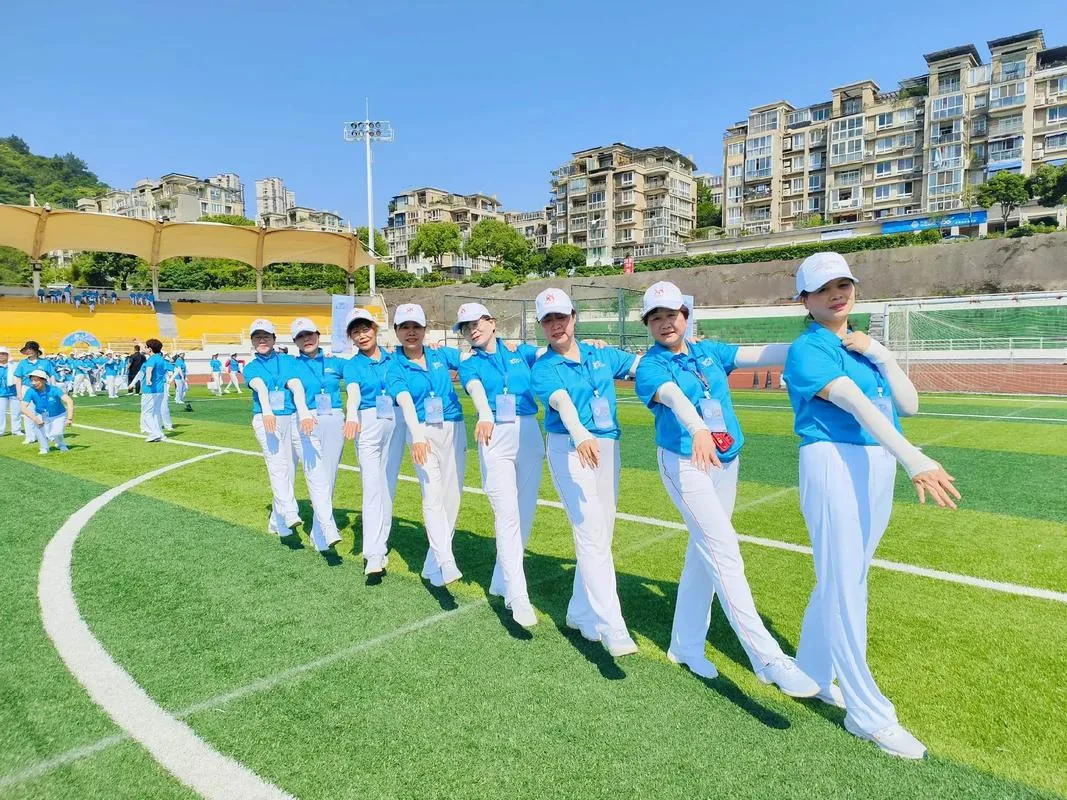
The most common site: a hard square at the foot of residential towers.
There is no single “Guangchangwu venue.”
Instead, the practice has adapted to several recurring categories of urban space.
Civic plazas: the city’s living room
Large civic and cultural plazas are among the most obvious settings.
These spaces are usually open, paved, highly visible, and designed to accommodate large numbers of people. Their hard surfaces are good for movement, but they are also highly reflective acoustically.
A large plaza can accommodate multiple groups at once.
That creates advantages: plenty of space, good visibility, and room for large formations.
It also creates competition.
Five groups using the same open area do not simply occupy five pieces of land. They may also produce five overlapping sound fields.
In Beijing, Financial Street Square provides a useful example. The approximately 1,000-square-meter plaza regularly hosted five dance groups, with individual groups ranging from several dozen to around 200 people. Before a sound-management retrofit, the local street office received 73 complaints through the 12345 hotline in one year, all concerning excessive speaker volume.
The interesting part of the case is what happened next.
The solution was not to remove dancing from the plaza.
It was to redesign the sound system.
Community parks: the everyday venue
Community parks are more varied.
Trees, paths, lawns, benches, exercise equipment, ponds, and small paved areas create a patchwork of possible activity zones.
These spaces often support smaller groups and more mixed-age activity.
A Guangchangwu group may share the park with walkers, parents, children, chess players, tai chi practitioners, singers, and people simply sitting outside.
This makes the community park a particularly useful example of what public space actually means.
No single activity defines the park for the entire day.
Instead, different users continually negotiate their presence.
Research on Guangchangwu in Guangzhou found that older women use public dancing partly because public space offers accessible, low-cost leisure in an urban environment where commercial leisure spaces can be expensive or limited. The researchers also found that dancing provided social connection, self-expression, and a stronger sense of community.
The park is therefore not merely a convenient dance floor.
For many participants, the park is part of the value of the activity itself.
Residential compounds: the acoustic worst case
The Chinese xiǎoqū (小区) is different.
Residential compounds combine housing, internal roads, landscaped areas, playgrounds, fitness equipment, and small plazas within a relatively compact environment.
That makes them convenient.
It also makes them acoustically difficult.
A dance group may be only a short distance from apartment buildings. Hard paving reflects sound. Building façades return part of the acoustic energy toward the courtyard. Windows and balconies face directly onto the activity area.
A speaker that seems reasonable to someone standing beside the dancers can therefore become much more intrusive several floors above.
This is why residential compounds have become one of the most persistent sites of Guangchangwu conflict.
The problem is not simply that one side is “loud” and the other side is “intolerant.”
It is a spatial mismatch.
The same sound has radically different meanings depending on where the listener is standing.
A dancer hears music needed to maintain synchronization.
A resident hears an external sound entering a private space.
The physical distance between those two experiences may be only a few dozen meters.
Riverside and lakeside promenades
Linear spaces produce different choreography.
A broad square encourages grids and rows. A narrow riverside path encourages lines, arcs, or compact circles.
The larger setback from residential buildings can also change the conflict profile.
But these sites have their own constraints: cyclists, runners, pedestrians, bridges, railings, trees, and changes in pavement width.
Here the dancers are sharing a corridor rather than occupying a single room-sized plaza.
The boundary between “dance space” and “passing space” therefore becomes particularly important.
Commercial plazas
Shopping-center forecourts and commercial plazas can provide excellent surfaces and visibility.
But access is rarely automatic.
Security personnel, property managers, businesses, and event schedules may determine when and where groups can gather.
This creates a more explicitly negotiated form of publicness.
A group may be welcome on Monday evening but displaced when a commercial event occupies the same space on Saturday.
Found space
Finally, there are the spaces that were never designed as dance venues.
Underpasses, unused lots, parking areas, leftover spaces beside roads, and other underused urban surfaces can become temporary gathering places.
These locations demonstrate one of Guangchangwu’s defining characteristics:
the activity follows available space.
If there is an open surface, a group can potentially turn it into a temporary social venue.
Why China Has So Many Places to Dance
The abundance of potential Guangchangwu space is not accidental.
It is part of the history of Chinese urbanization.
China’s post-reform cities created large quantities of public open space: civic squares, cultural plazas, community parks, pedestrian areas, and landscaped residential compounds.
Some were intended for civic ceremonies or large public gatherings. Others were products of urban redevelopment, community planning, or the expansion of municipal amenities.
Later, mass-fitness policy helped create an institutional environment in which everyday exercise in public spaces became increasingly normal.
Guangchangwu did not invent these spaces.
It found a use for them.
This distinction matters.
A civic square may have been designed as a symbolic center of a city. A residential courtyard may have been designed as shared amenity space. A riverside promenade may have been designed primarily for walking.
None necessarily anticipated hundreds of people moving to amplified music every evening.
Yet the spaces were physically suitable.
So the dance moved in.
Research on public-space Guangchangwu has described this process as a response to both the scarcity and commercialization of leisure space. Older women could use open public areas without paying for a gym, club, or private facility.
More recent research goes further.
Shang Li’s 2025 doctoral research describes Guangchangwu as a form of serious leisure through which older adults, particularly women, construct identities and negotiate their place in changing urban environments.
The public square therefore became something more than leftover urban land.
It became a social resource.
The Speaker: The Center of Gravity
If the plaza provides the floor, the speaker provides the invisible architecture.
The familiar lāgān yīnxiāng (拉杆音响) — the pull-rod portable speaker — is one of the most recognizable pieces of Guangchangwu equipment.
It combines portability with enough amplification for a large outdoor group.
And it solves a real problem.
A leader cannot simply play music from a phone if 80 people need to follow the beat across a large plaza.
The problem is that amplification changes the boundaries of the group.
Without a speaker, the dance occupies the physical space of the dancers.
With a powerful speaker, the dance occupies an acoustic space extending beyond them.
That is why the speaker is not just equipment.
It is a boundary-making device.
It tells the surrounding city:
Something is happening here.
And that acoustic boundary can extend far beyond the dancers’ physical boundary.
Why Hard Plazas Sound So Loud
There is a straightforward acoustic explanation for much of the conflict.
Outdoor sound does not simply disappear as it travels.
In an unobstructed field, sound generally becomes weaker with distance. But urban environments add reflections from paving, walls, façades, railings, and other hard surfaces.
A tiled courtyard surrounded by buildings is therefore very different from a dance group standing on grass in an open field.
The listener may receive both direct sound from the speaker and reflected sound from nearby surfaces.
This can make the sound feel louder, more persistent, or less clearly localized.
Low-frequency components also tend to travel farther and are more difficult to block completely with ordinary building materials.
That is why a resident several floors above may notice the bass of music even when the higher-frequency details are already fading.
And it explains one of the most common misunderstandings in the debate:
“Why don’t they just turn it down?”
Sometimes that works.
Sometimes it does not.
If the speaker is reduced enough to avoid disturbing nearby buildings, dancers at the back of a large formation may no longer hear the rhythm clearly.
This is why some of the newer interventions do not simply reduce volume.
They change where the sound goes.
The Acoustic Day: A Park Is Never Just One Public
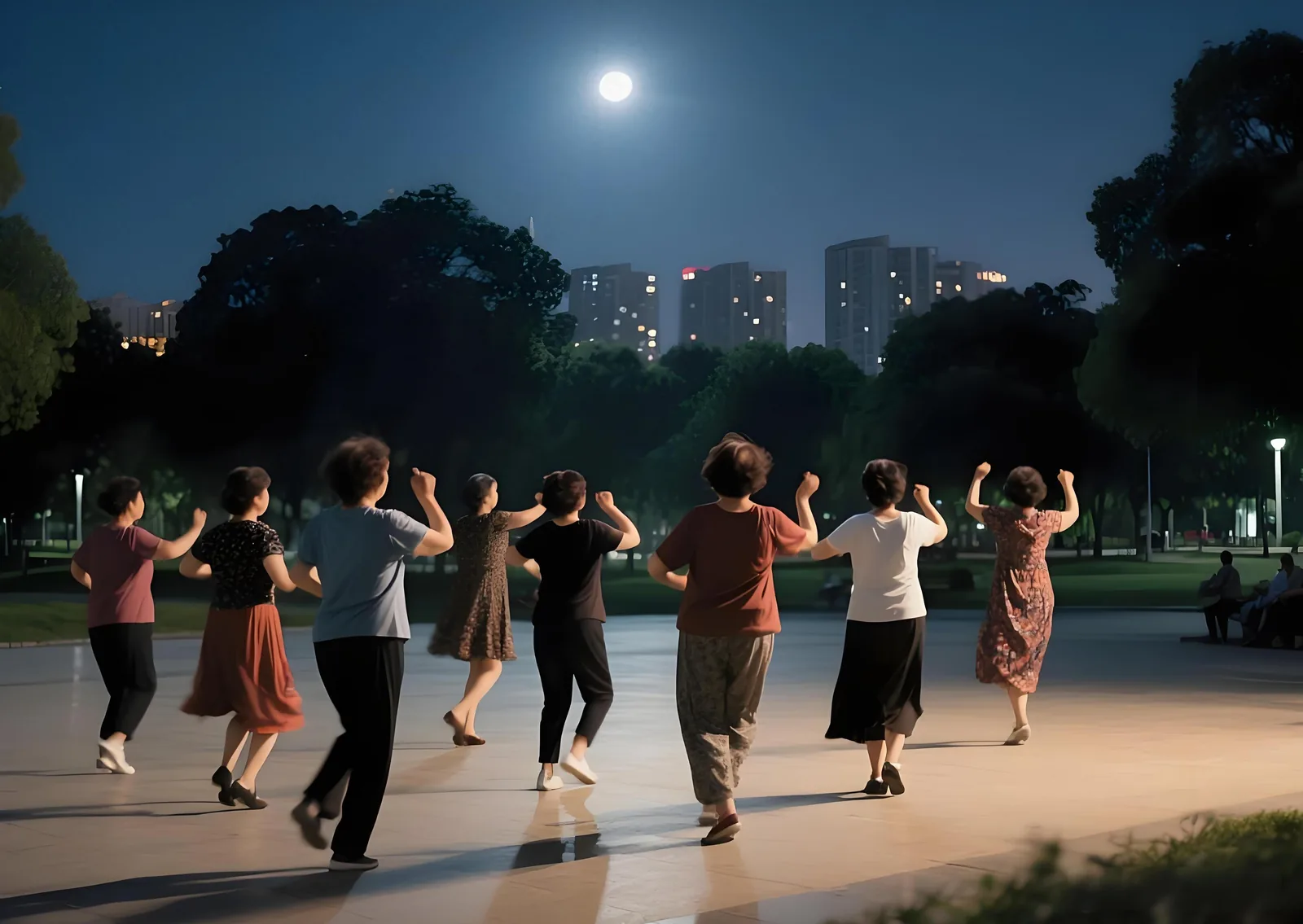
The night shift: after dark, the same squares host quieter, smaller groups.
Consider a typical urban park over the course of a day.
At dawn, the dominant sounds may be footsteps, birds, conversation, and individual exercise.
Then tai chi, walking, badminton, or other activities appear.
Later, parents and children occupy playgrounds and paths.
In the evening, multiple groups arrive.
The important point is not that Guangchangwu “takes over” the park.
It is that the park is continuously repopulated by different publics.
The same physical location may serve different groups at different times.
This is close to Jane Jacobs’s famous idea that successful urban spaces are sustained by overlapping patterns of use throughout the day.
But Guangchangwu introduces an especially interesting variable:
sound makes temporal occupation spatially visible.
A group can be visually confined to a 20-meter formation while its music reaches hundreds of meters.
That makes its claim on space larger than its physical footprint.
And this is precisely why sound becomes a governance problem.
The Numbers: How Big Is the Noise Problem?
It is important not to confuse Guangchangwu noise with all urban noise in China.
It is one category within a much larger national problem.
According to China’s Ministry of Ecology and Environment, approximately 6.833 million noise complaints were recorded nationwide in 2025. About 5.002 million, or 73.2%, were classified as social-life noise. The category includes many sources besides Guangchangwu, so the national number should not be interpreted as a measure of dance-related complaints.
That distinction matters.
Guangchangwu is highly visible because it produces a recognizable social conflict, but it competes with many other sources of urban noise: commercial activity, construction, household activity, vehicles, entertainment, and other forms of public recreation.
The more useful evidence comes from specific places.
Shijiazhuang: when measurement replaced argument
In Shijiazhuang, prosecutors investigated complaints concerning Guangchangwu activity at five locations.
Investigators found multiple groups operating in morning and evening periods. Music at the sites was generally above 80 dB(A), with some measurements exceeding 100 dB(A), compared with a 60 dB(A) daytime limit applicable to the relevant Class 2 acoustic environment under the standards used in the case.
The important lesson is not that “Guangchangwu is 100 dB.”
It is that measurement changed a subjective argument into an administratively actionable problem.
The dancers could say:
“It doesn’t sound that loud.”
Residents could say:
“It is unbearable.”
A calibrated measurement creates a third language.
From Guidance to Law
China’s approach to Guangchangwu noise has evolved from informal guidance toward increasingly explicit governance.
The 2022 Noise Pollution Prevention and Control Law specifically addressed entertainment and fitness activities in streets, squares, and parks. Article 64 required such activities to comply with rules concerning activity areas, time periods, and volume, and required effective measures to prevent noise pollution.
That legal framework has now been incorporated into the Ecological Environment Code, which took effect on August 15, 2026.
Article 593 of the current Code states that organized entertainment and fitness activities in streets, squares, parks, and other public places must comply with the public-place manager’s rules concerning areas, periods, and volume, and must take effective measures to prevent noise pollution. Public-space managers may also establish automatic noise monitoring and display systems.
The enforcement framework has also changed.
The revised Public Security Administration Punishments Law, effective in 2026, provides that when social-life noise continues to disturb others after lawful intervention, mediation, or handling by grassroots organizations, property-management bodies, or relevant departments, penalties can include up to five days’ detention or a fine of up to RMB 1,000. In serious cases, detention can reach five to ten days.
This does not mean that a person playing music in a park automatically faces detention.
The statutory conditions matter: the conduct must constitute social-life noise that continues to interfere with others after the specified forms of intervention and handling.
That distinction is important when describing the law.
The modern system is not simply:
dance → complaint → detention.
It is closer to:
activity → rules → warning/intervention → continued interference → escalating enforcement.
The Real Question Is Not “Dance or No Dance”
This is where the public-space debate becomes more interesting.
If a city bans every noisy activity from every public space, it loses much of the social life that makes those spaces valuable.
If it allows every group to use every space at any volume, the people living around those spaces effectively lose access to quiet.
Neither extreme solves the underlying problem.
The actual question is:
How can multiple publics share the same urban space?
That is a much more productive way to understand Guangchangwu.
Recent research describes this process as negotiated publicness. Guangchangwu groups establish and adjust spatial boundaries through interaction with other users and with formal institutions. Public space is therefore not simply “open to everyone” in an unlimited sense. Participation is often conditional, negotiated, and shaped by local governance.
That insight changes how we understand the conflict.
A dance group is not merely “occupying” a square.
Residents are not merely “trying to stop” the dance.
Both are negotiating the conditions under which the same place can remain usable. For more on this lens, see how we read public space in the culture section.
The Technology Fix: From Loudspeakers to Sound Beams
One of the most interesting developments in Chinese urban governance is the move from controlling dancers to controlling sound.
Financial Street Square provides a particularly clear case.
The local government had already tried conventional methods: persuasion, mediation, enforcement, and additional nighttime patrols. These approaches produced temporary improvements but did not solve the recurring problem.
In 2024, the square introduced a “smart dance floor” system using directional speakers.
Instead of broadcasting sound broadly in all directions, the speakers concentrate the sound toward the dance area.
But the technology was only part of the solution.
Officials first met with the dance-team organizers.
One leader initially objected that a shared system could not match the sound quality of the team’s own equipment. After three rounds of discussions and an explanation of the system, the teams agreed to test it.
That detail is more important than it may appear.
The intervention was not simply technological.
It was technological plus social.
After installation, the street office reported that the surrounding residents no longer experienced the previous level of disturbance, while the dance groups continued using the square.
This suggests a broader principle:
The most promising solution is often not removing a public activity but redesigning the interface between the activity and its surroundings.
Four Ways Cities Can Govern Shared Sound
The emerging solutions can be understood as four broad approaches.
1. Voluntary technology
Examples include:
- headphones or wireless receivers;
- directional speakers;
- shared sound systems;
- automatic volume displays;
- timed equipment.
These preserve the activity while reducing its acoustic footprint.
2. Voluntary social coordination
Groups can also coordinate through:
- agreed time slots;
- designated dance areas;
- posted community conventions;
- team-leader communication;
- rotating use of limited space.
This is often less visible than technology but may be just as important.
3. Managed technology
A city can impose technical limits:
- controlled power supply;
- fixed sound systems;
- automatic monitoring;
- volume restrictions;
- equipment that cannot be freely repositioned.
This reduces reliance on individual compliance.
4. Formal enforcement
When other measures fail, legal enforcement remains available.
The current legal framework gives public-space managers and enforcement authorities clearer tools than they had in earlier years. The Ecological Environment Code specifies responsibilities around public-place activity and noise, while the revised Public Security Administration Punishments Law provides a stronger administrative penalty framework for persistent social-life noise that continues after intervention.
The important point is that enforcement is one layer of governance, not the entire system.
Why “Just Turn It Down” Is an Incomplete Solution
Imagine a 100-person group spread across a large square.
The leader stands at the front.
The speaker is ten or fifteen meters away from some participants and thirty meters away from others.
If the speaker is turned down enough that a nearby apartment receives very little sound, the back row may struggle to hear the beat.
The problem is geometric.
A single sound source is being asked to serve two incompatible spaces:
- the dance floor;
- the surrounding residential environment.
A directional sound system changes the geometry.
Instead of asking:
How loud can the speaker be?
the city can ask:
Where does the sound need to be loud?
That is a fundamentally different design question.
It treats sound as part of urban architecture.
And that may be one of the most important developments in the future of Guangchangwu.
The Public-Space Theory Behind the Dance
For an urban-studies reader, Guangchangwu offers an unusually rich case.
The park as a third place
Ray Oldenburg’s idea of the “third place” describes informal social environments outside home and work where people can gather repeatedly and build relationships.
A community park can perform exactly this function.
The attraction of Guangchangwu is therefore not exhausted by exercise.
People return because they know other people will be there.
The routine matters.
The social recognition matters.
The shared activity matters.
Research on Guangchangwu has found that synchronized dancing can contribute to socialization, place attachment, and a sense of communal meaning.
The right to the city
A second interpretation asks who gets to use urban space.
As people age, they may lose workplaces, professional identities, and some of the social structures that previously organized daily life.
A public dance group creates a visible alternative.
Participants are not merely passing through the city.
They are making a place in it.
Shang Li’s research describes Guangchangwu as a practice through which older adults negotiate public-space access, identity, ageing, and social visibility.
That does not mean every dance group is consciously making a political statement.
Most participants are simply exercising, meeting friends, listening to music, and enjoying themselves.
But the accumulated effect is still spatially significant.
Every evening, bodies make a claim:
We are here too.
The Cultural Variable: Rènao
There is also a cultural dimension to sound.
The Chinese concept of rènào (热闹) is difficult to translate with a single English word.
It can describe a place that is lively, animated, sociable, warm, crowded, and full of activity.
A completely silent public square is not necessarily experienced as the ideal version of public life.
For some participants, music contributes to the atmosphere that makes the gathering enjoyable.
This helps explain why technological proposals such as headphone dancing have sometimes encountered resistance.
Technically, headphones solve the external sound problem.
Socially, they can remove part of the shared atmosphere.
The distinction is important.
The objection is not necessarily:
“We want to disturb our neighbors.”
It may instead be:
“The shared sound is part of why we come here.”
That does not override noise rules.
But it explains why governance solutions that preserve the social experience while reducing external disturbance can be more sustainable than solutions that simply eliminate sound.
When Guangchangwu Travels Overseas
The same spatial logic follows Guangchangwu outside China.
The activity still needs:
- a flat surface;
- a predictable time;
- enough visibility;
- music;
- enough room for a group.
But the surrounding legal and cultural environment changes.
At Columbus Park in Manhattan Chinatown, public dancing has become part of a much more diverse urban soundscape.
At Sunset Park in Brooklyn, however, the interaction between Chinese dance activity and local noise expectations produced a famous 2013 dispute involving a Chinese waist-drum performer.
The significance of such cases is not that Chinese people are uniquely noisy.
Public amplified recreation creates conflicts in many countries.
The Chinese specificity lies more in the scale of the practice, the demographic concentration of participants, the frequency of use, and the particular urban environments in which it developed.
The same activity therefore changes when it crosses borders.
A diaspora group may choose different hours, smaller speakers, different surfaces, or greater distance from homes.
This is why Guangchangwu should not be understood as a fixed choreography detached from its surroundings.
The environment changes the practice.
For more on that process, see our companion article on Guangchangwu Around the World.
What the Future Public Square May Sound Like
The next generation of Guangchangwu space is unlikely to be defined by a simple choice between loud dancing and silent parks.
Instead, several trends are converging.
Smarter sound
Directional speakers, automatic monitoring, and controlled equipment make it increasingly possible to shape the acoustic boundary of a group.
Better zoning
Cities can designate specific areas for different activities rather than asking every user to compete for the same surface.
More negotiated schedules
Time-sharing can reduce direct competition between dancers, runners, children’s activities, and residents.
More purpose-designed senior recreation
As China’s population ages, the demand for accessible social exercise is unlikely to disappear simply because noise complaints exist.
The planning question therefore becomes increasingly important:
Where should these activities happen, and how should the space be designed for them?
A park with a dance area, sound management, walking paths, basketball courts, seating, and residential setbacks can accommodate far more users than a park that leaves every activity to fight over the same central plaza.
FAQ
Where does Guangchangwu usually take place?
Guangchangwu commonly takes place in civic plazas, community parks, residential-compound courtyards, riverside or lakeside promenades, commercial plazas, and informal underused spaces. The exact venue varies by city and neighborhood.
How loud is Guangchangwu music?
There is no single national “Guangchangwu volume.” Measurements vary substantially by site, equipment, distance, and time. In a 2023–24 Shijiazhuang investigation, multiple dance sites exceeded 80 dB(A), with some measurements above 100 dB(A). The case was handled against applicable noise standards rather than treated as a universal measurement for all Guangchangwu.
Is Guangchangwu legal in China?
Yes. Guangchangwu itself is not prohibited. However, public-space entertainment and fitness activities must comply with applicable rules concerning location, time, volume, and noise control. The current Ecological Environment Code explicitly addresses such activities in streets, squares, parks, and other public places.
What time does Guangchangwu usually end?
There is no single national Guangchangwu closing time. Local public-space rules and community agreements can establish specific hours. Some locations impose earlier evening limits than the general legal framework.
How are Chinese cities dealing with Guangchangwu noise?
Approaches include designated areas, time-sharing, community agreements, monitoring, mediation, enforcement, and increasingly directional sound systems. Beijing’s Financial Street Square is a documented example of combining negotiations with dance groups and directional speakers.
What is a “smart dance floor”?
In Chinese urban projects, a “smart dance floor” generally refers to a managed dance area incorporating technologies such as directional sound equipment, controlled power, monitoring, or other systems designed to limit the external impact of amplified music. The exact technology varies by project.
Why do Guangchangwu groups use speakers?
Large groups need music that can be heard across the formation so participants can synchronize their movements. The speaker also contributes to the shared atmosphere of the activity. This is one reason simply replacing amplified music with headphones can solve the noise problem while changing the social experience — a practical question we take up in Sounds of the Public Square.
Is Guangchangwu the same as American square dancing?
No. Guangchangwu and American square dance are different traditions with different formations, musical structures, and social organization. The term “Chinese square dancing” is commonly used in English but can create confusion with Western square dance. See Guangchangwu vs. Square Dance for the distinction.
Do Guangchangwu groups have to negotiate for space?
Often, yes. A group may repeatedly use the same location and time without formally owning it. Everyday arrangements can emerge among dancers, other park users, property managers, and local authorities. Recent research specifically identifies spatial boundary negotiation as central to how Guangchangwu publicness is produced.
Is the noise conflict simply a problem between dancers and residents?
No. The conflict is better understood as a shared-space problem. Dancers seek accessible exercise and social connection; residents may need quiet for sleep, study, childcare, or everyday life. Cities increasingly attempt to redesign the spatial and acoustic interface rather than treating either group as inherently unreasonable.
The Public Square Is the Real Story
The most useful way to understand Guangchangwu is not to begin with the stereotype of older women dancing to loud music.
Begin with the square.
Look at its paving.
Look at the apartment buildings around it.
Look at the walking paths.
Look at the distance between the dance floor and the nearest bedroom.
Look at who was there an hour earlier.
Look at who will arrive an hour later.
Then listen.
The music tells you where the group has drawn its temporary boundary.
The formation tells you how much space it needs.
The speaker tells you how far that boundary extends beyond the dancers.
And the negotiations around volume, timing, and location reveal something larger about the city itself.
Guangchangwu exists because Chinese urban public space provides places where people can gather cheaply, repeatedly, and visibly. Research increasingly shows that these spaces are not passive backdrops: they are actively negotiated environments in which leisure, ageing, identity, governance, and competing claims on public space intersect.
That is also why the future of Guangchangwu will not be decided by dance alone.
It will be decided by urban design, sound technology, local rules, social negotiation, and the question of how many different kinds of public life a single square can accommodate.
The challenge is not to make the public square silent.
It is to make it possible for more than one public to belong there.
Further Reading
- What Is Guangchangwu? — the practice itself
- Chinese Plaza Dancing: What Does the Term Mean? — terminology and English-language naming
- Guangchangwu vs. Square Dance — why the two traditions should not be conflated
- Reading a Guangchangwu Session — formations, leadership, speaker management, and group structure
- Guangchangwu Around the World — how the practice adapts outside China
- Guangchangwu Research & Scholarship — the foundational Seetoo (2016) study and the 2026 “atmospheric threshold” concept
- Sources — the full source index for every claim on this site
Selected research and official sources
Sun, L. & Feng, Q. (2026). Boundary as a technology of governance: The operation of spatial boundaries and the production of publicness among Guangchangwu groups. Journal of Urban Affairs.
Lin, M., Bao, J. & Dong, E. (2020). Dancing in public spaces: an exploratory study on China’s Grooving Grannies. Leisure Studies.
Tian, E. & Wise, N. (2025). Dancing in Public Squares – Toward a Socially Synchronous Sense of Place. Leisure Sciences.
Li, S. (2025). Square Dancing as Serious Leisure: Gender Representation and Public Space Negotiation in Urban China. Durham University.
Ministry of Ecology and Environment of the People’s Republic of China. China Noise Pollution Prevention Report 2026.
Supreme People’s Procuratorate. Shijiazhuang public-interest litigation case concerning Guangchangwu noise pollution.
Government of Beijing / Beijing Daily. Financial Street Square smart dance-floor case study.
People’s Republic of China. Ecological Environment Code, Article 593 and Article 1190.
People’s Republic of China. Public Security Administration Punishments Law, Article 88.