Most hit songs are listened to. A few are danced to. This piece traces how two songs — The Most Dazzling Folk Style (最炫民族风, 2009) and Little Apple (小苹果, 2014) — became the sound of Guangchangwu, by two opposite roads.
A song can be streamed a billion times and never generate a single choreographed step. These two did. One was annexed by the public, step by step; the other shipped, in effect, with instructions.
How to read this piece: a short, source-linked story. The full facts live on the song pages — The Most Dazzling Folk Style and Little Apple — and every claim below links to a named source at the foot of this page.
The Most Dazzling Folk Style and Little Apple: two songs, one question
China has a word for a hit that lodges in the skull: shénqǔ (神曲), “divine song,” used with heavy irony. Both songs here are shénqǔ, five years apart, from opposite directions. Both ended up in the same place — the plaza — and then diverged completely.
Part I. The Most Dazzling Folk Style: a song born before its moment
The song was written by Zhang Chao, a self-taught songwriter from Kaili in southwestern China’s Guizhou, where Miao and Dong villages still sing work songs and mountain ballads. He spent three years gathering folk material; the song itself reportedly took three days. His rule was “plain, plainer, plainest” — lion-dance drums, bamboo flute, guzheng, and the suona, the piercing double-reed horn China associates with weddings and funerals. The suona almost didn’t make the record: the label boss heard the mixed track, found the opening clarinet too polite, and had it swapped on the spot.
The melody is built to be remembered: the pentatonic scale, a 2/4 thump-thump pulse, and almost every line ending on the same rhyme. There is nowhere in it to get lost. But in 2009 the song was not yet a phenomenon — the stage that would claim it, the plaza, was only beginning to exist.
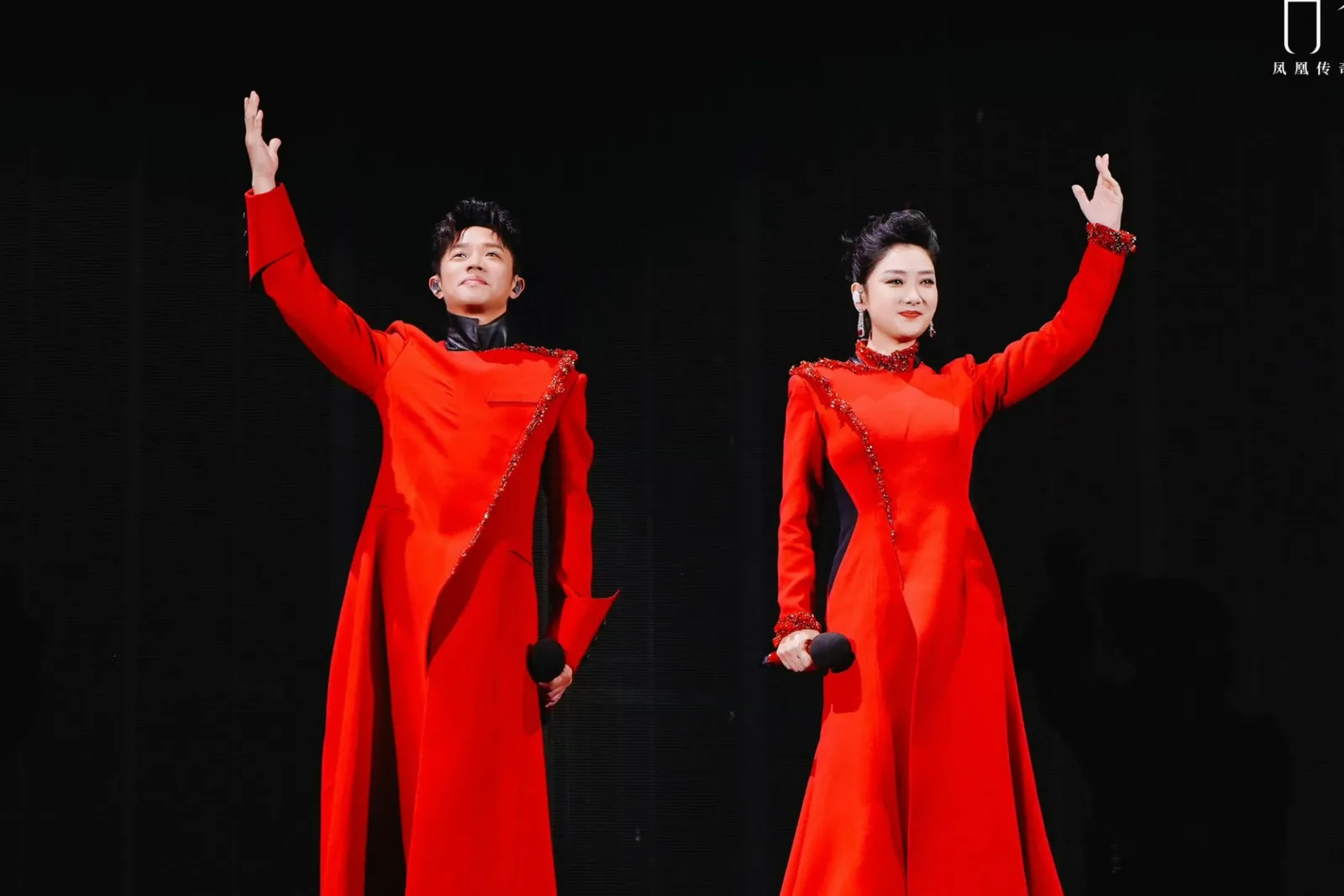
Phoenix Legend on stage — Ling Hua and Zeng Yi, the duo behind The Most Dazzling Folk Style.
Part II. 2012: the internet taught The Most Dazzling Folk Style to dance
Three things happened in the early 2010s, and only the last happened in China.
First, it left the country. In 2010 the fitness instructor Wang Guangcheng, trained with the American brand Zumba, brought the song to a convention in the United States; roughly a thousand foreign exercisers, none of whom understood a word, danced to it. He went on to choreograph ten Phoenix Legend songs.
Then, in April 2012, it landed in the NBA. A Houston Rockets arena played the track and the team’s dancers performed to it; a clip travelled home and detonated, framed as a point of pride — a song written by a man from Guizhou, on an American scoreboard.
Then came the mashups. Video sites filled with clips cutting the song against Michael Jackson, Beyoncé and K-pop footage — everything, it turned out, was “on the beat.” Faye Wong reposted a fan’s cut with the line that became the epigraph: “My biggest problem is being too popular.” A promoter later admitted his team engineered the early burst in a paid campaign — but that “the real promoter was the netizens.”
Part III. Little Apple: when the machine learned the trick
By 2014 everyone in the industry had watched The Most Dazzling Folk Style become a national ritual. So when the Chopstick Brothers needed a promotional song for their film, the brief was, in effect: build the next one.
Little Apple is a retro-electro track in 4/4 with a chorus of four-syllable hooks, shot in South Korea and choreographed by Lee Ju-seon — the man behind PSY’s Gangnam Style horse dance. And here the story departs from 2012: the dance was not left to chance. Youku released adaptation videos — tutorials, a “plaza aunties” version — at roughly two every three days, more than forty in total, and seeded the song to plazas and fitness classes. Within about a hundred days it counted over 130,000 related clips and 500 million cumulative views.
The Most Dazzling Folk Style went viral and then, separately, the public invented a dance. Little Apple shipped with its dance. One was bottom-up; the other was top-down.
Part IV. Why the plaza chose these two songs
So who actually turns a song into a dance in China? Several million fifty-something women, most of whose names we will never know. Official figures put participation past 120 million — mostly female, mostly between 50 and 70. Each group has a leader who learns the routine first and teaches it line by line: the largest choreographic labour force in the country, and almost entirely uncounted.
Why these two songs and not a ballad? The reasons are physical. Both sit near the walking-to-jogging heart-rate zone — hospitals even used The Most Dazzling Folk Style to teach CPR compressions, its pulse matching the guideline 100–120 per minute. The downbeats are heavy and metronomic. The lyrics are emotionally flat: horizons, rivers, flowers. And the suona-and-electro mix survives a loudspeaker in open air.
Which points to a counter-intuitive conclusion: we say these songs “conquered” the plaza, but it is closer to the reverse. The plaza went looking for a soundtrack and selected them — in some ways because they lack artistic ambition. A song that asks to be listened to closely is a poor song to stomp to.
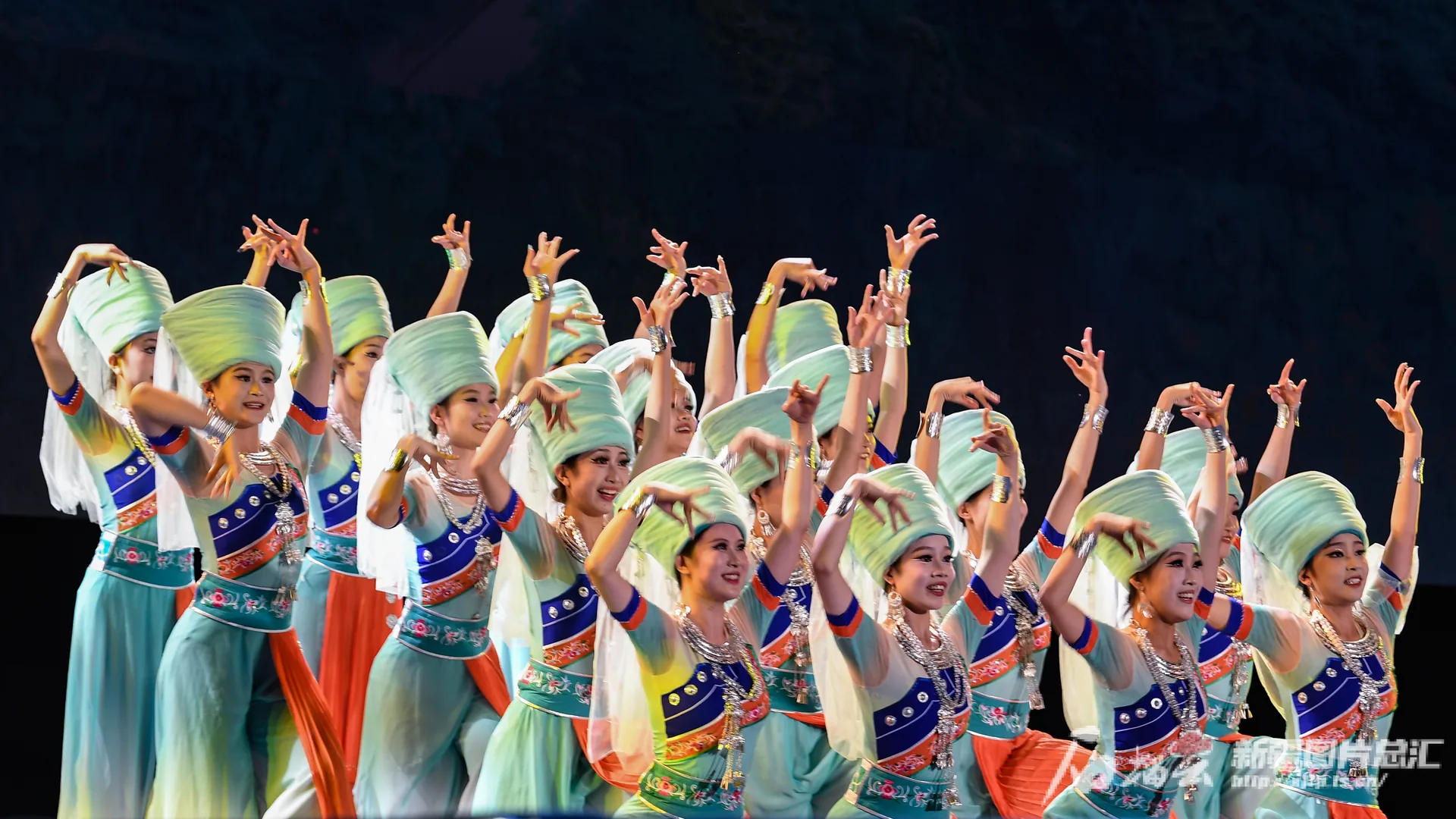
Folk dance on stage — the mountain-song tradition behind the folk elements folded into The Most Dazzling Folk Style.
Part V. The state seal, and two roads out
In February 2015, on the CCTV Spring Festival Gala, both acts appeared together for a mash-up of the two songs, choreographed by Wang Guangcheng — the same instructor who had carried the song to an American Zumba floor five years earlier. A month later the General Administration of Sport of China and the culture ministry published twelve official routines “for reference,” both songs on the list: guidance, not mandate — but the seal was set.
After the peak, the songs parted company. Little Apple was a single marketing event; its dance survives as a nostalgia challenge on short-video platforms. Phoenix Legend outlasted the joke — by the mid-2020s their stadium audiences were more than sixty per cent aged 18 to 29. The change was not in the music. It was in the listeners.
Next steps
- The song pages: The Most Dazzling Folk Style and Little Apple
- Standardized guangchangwu routines — the twelve official routines of 2015
- Reading a session — how a plaza evening is structured
- Random guangchangwu video — a different clip every refresh