Guangchangwu vs Square Dance: Why “Chinese Square Dancing” Is Misleading
If you hear the phrase “Chinese square dancing,” what do you imagine?
Perhaps eight people standing in a square.
Perhaps couples turning around one another while a caller shouts instructions such as “do-si-do.”
Perhaps cowboy shirts, colorful skirts, and a dance hall somewhere in rural America.
That would make perfect sense. It would also be the wrong picture.
In Chinese, 广场舞 (guǎngchǎngwǔ) does not mean “dance performed in a square formation.” The word 广场 (guǎngchǎng) refers to a public square, plaza, or open public space. The word 舞 (wǔ) means dance.
So the literal translation is understandable. But the cultural meaning is not equivalent.
Modern Guangchangwu is a large-scale form of public group dancing that developed in China’s urban communities. Dancers usually stand in loose rows, follow a leader at the front, and perform memorized routines to recorded music. There are generally no partners, no caller, no required lessons, and no fixed eight-person formation.
Western square dance is something else entirely: a partnered dance organized around four couples, a caller, a vocabulary of standardized movements, and a highly structured social-dance tradition.
The two share a translated English name.
Structurally, they are very different.
And that distinction matters because the translation does more than create a linguistic oddity. It can cause English-speaking readers to misunderstand what guangchangwu actually is, who participates in it, where it happens, and why it became such a visible part of Chinese public life.
There is an even more interesting comparison.
If you are looking for a Western dance form that resembles guangchangwu structurally, line dance is much closer than square dance.
That does not make them the same either. Guangchangwu has its own history, social setting, music, organization, and relationship with public space.
The best way to understand it is therefore not to ask, “What is China’s version of American square dance?”
It is to ask:
What happens when a society turns everyday public space into a place for collective movement?
1. The Translation That Created the Confusion
The Chinese name is straightforward:
广场舞 = guǎngchǎng + wǔ = public square/plaza + dance.
The English phrase “square dancing” is therefore a natural-looking translation.
But English already had another meaning for “square dance.”
In American English, a square dance is a specific dance tradition in which four couples form a square. The dancers interact with partners and other couples while following instructions from a caller.
The problem is therefore not that “square dance” is a bad literal translation.
The problem is that English already has a strong cultural referent for the phrase.
For a Chinese speaker, “广场舞” immediately points toward a location and activity: people dancing together in a public square, park, residential open space, or other accessible outdoor area.
For an American reader, “square dance” points toward a formation.
The same English word therefore activates two completely different mental pictures.
This is a classic problem in cross-cultural translation: a literal translation can be linguistically correct while being culturally misleading.
What “square” means in each language
| Chinese term | What it refers to |
|---|---|
| 广场 | A public square, plaza, or open public space |
| 舞 | Dance |
| 广场舞 | Dance performed in public communal spaces |
Compare that with the English expression:
| English term | What it refers to |
|---|---|
| Square | The geometric formation |
| Dance | The activity |
| Square dance | A particular partnered dance tradition |
The distinction is small in vocabulary but enormous in cultural meaning.
This is why guangchangwu is increasingly useful as an English-language term in its own right — see Chinese plaza dancing for how the term is used in English.
Rather than forcing it into an existing Western category, the pinyin preserves the identity of the Chinese practice.
2. What Is American Square Dance?
To understand why the translation is confusing, it helps to understand what American square dance actually is.
American square dance emerged from several European dance traditions brought to North America, including English country dancing, the French quadrille, contra-dance traditions, and Appalachian forms.
Over time, these influences developed into a distinctly American social-dance tradition.
Its defining visual feature is simple:
Four couples form a square.
That means eight dancers occupy the basic formation, with couples positioned around the center.
But the formation is only part of the story.
The caller is central
American square dance is organized around a caller.
The caller announces movements and combinations in real time, directing the dancers through a sequence of figures.
That creates an unusual relationship between language and movement.
A dancer is not simply memorizing one choreography and repeating it.
Instead, dancers learn a vocabulary of calls and respond to the caller’s instructions.
Modern square dancing consequently developed a highly standardized instructional system.
CALLERLAB and standardization
CALLERLAB, the International Association of Square Dance Callers, played an important role in establishing common definitions and programs for modern square dancing.
Its historical materials describe the codification of the Basic program beginning in 1969, followed by further development of the Mainstream program.
The result is a standardized vocabulary that allows dancers trained in the same program to participate in dances in different locations.
That standardization remains important today. In September 2026, CALLERLAB implemented updated Mainstream and Plus program lists, continuing the organization’s role in maintaining a common international vocabulary for modern square dance.
The important point for our comparison is this:
American square dance is not simply “people dancing together.” It is a rule-based social dance system.
You learn the vocabulary.
You learn how the formations work.
You learn how to respond to the caller.
Then you participate in dances using that shared system.
Henry Ford and the revival of square dance
The history becomes even more interesting in the early twentieth century.
Automobile industrialist Henry Ford became an important patron of the revival of American square dancing during the 1920s and 1930s.
Ford viewed traditional dancing as an alternative to the jazz and popular culture he regarded with suspicion. His support helped transform square dancing from a declining regional tradition into a highly visible form of organized American recreation.
That history creates an unexpected parallel with guangchangwu.
Both traditions have, at different points in their histories, been encouraged or promoted as culturally meaningful forms of collective recreation.
But the resulting social structures are very different.
The costume is part of the identity
Modern Western square dance also developed a distinctive visual culture.
Men may wear Western-style shirts, bolo ties, and other cowboy-associated clothing. Women traditionally wear full skirts or crinolines.
The clothing is not simply practical exercise wear.
It helps signal participation in a particular cultural tradition.
A square dance gathering therefore often looks immediately recognizable before the music even begins.
3. What Is Guangchangwu?
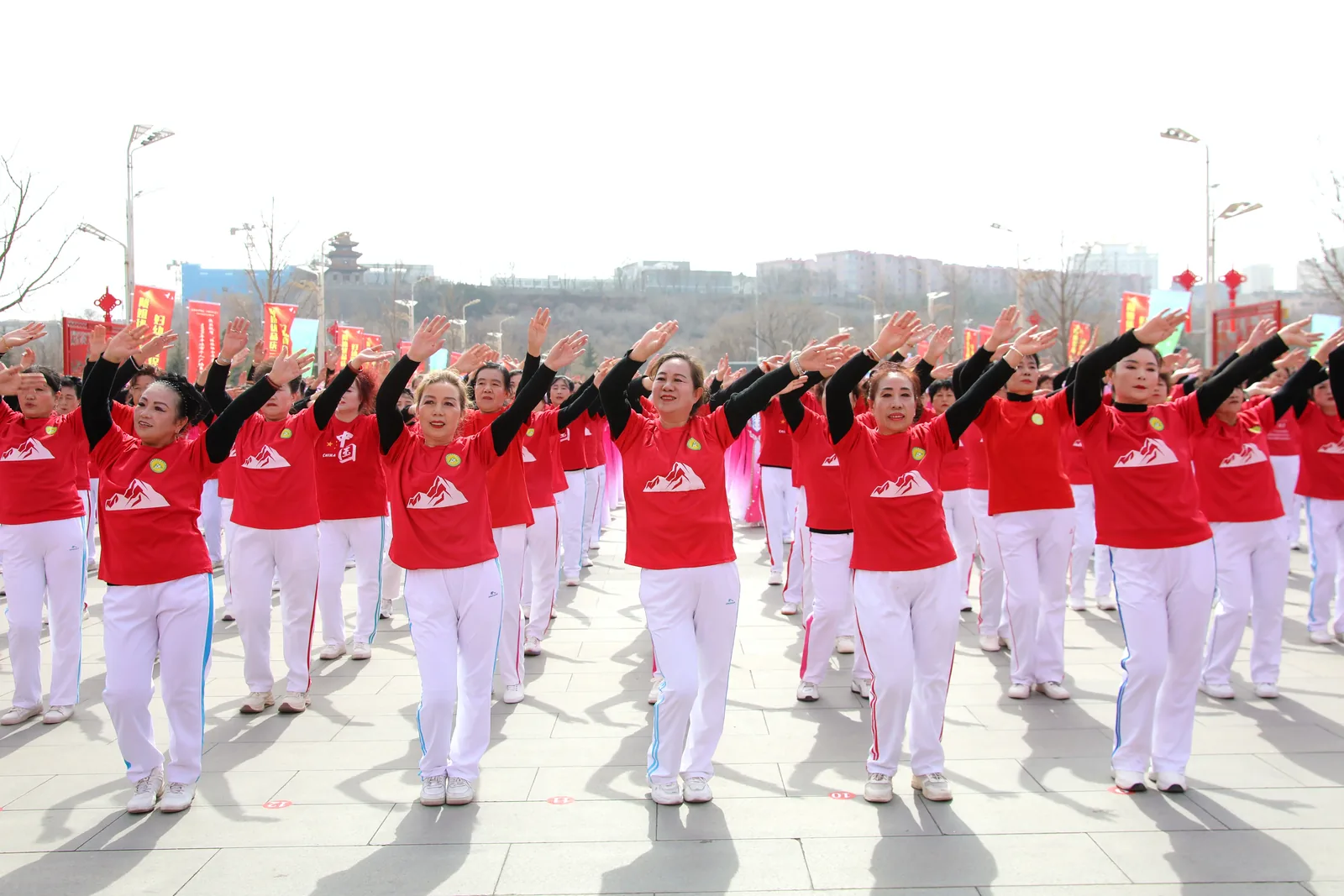
Rows, not squares: guangchangwu forms face one direction, with no partners or caller.
Now picture a very different scene.
It is early evening.
A group of people gathers in a public park or open plaza. Someone places a portable speaker near the front. A leader stands where everyone can see her.
Music begins.
The dancers move together.
There is no caller shouting out a sequence of commands.
There are no required partners.
There is no eight-person square.
And someone who has been watching from the side can often step into the back row and begin following along.
That is guangchangwu.
As Who practices guangchangwu? and the history of guangchangwu have explored, modern guangchangwu developed through multiple historical layers rather than descending directly from one ancient dance tradition.
Today it is best understood as a public, collective, fitness-oriented dance practice — defined in What is Guangchangwu?.
The formation is usually rows, not squares
Most guangchangwu groups arrange themselves in loose rows.
The precise arrangement varies with the location and number of participants.
A small group may occupy only part of a plaza.
A large group may fill an entire open area.
The basic principle remains:
everyone faces the leader and follows the choreography.
There is no requirement to form four couples.
There are normally no partners
This is one of the clearest differences.
A guangchangwu participant generally dances independently.
You do not need to arrive with a partner.
You do not have to find a partner before joining.
You do not have to change partners during the routine.
This makes the activity particularly accessible to people who arrive alone.
There is no caller
The front leader, or 领舞 (lǐngwǔ), demonstrates the movements.
The music provides the rhythm — the song-driven ecosystem is explored on the music hub.
The dancers follow the visual demonstration and the choreography they have already learned.
That means guangchangwu is closer to a repeatable choreographed group routine than to a caller-directed improvisational dance.
It is usually free and open
One of the defining features of guangchangwu is its low barrier to entry.
A participant generally does not need:
- a club membership
- formal lessons
- special clothing
- a dance partner
- an admission ticket
The public nature of the setting is part of the practice itself.
This is why public space is not merely the background to guangchangwu.
Public space is part of what guangchangwu is. The negotiation around it is traced in Public space.
China’s national fitness authorities have also formally recognized and promoted the activity. In 2015, the General Administration of Sport of China and the Ministry of Culture and Tourism of China introduced 12 nationally promoted Standardized guangchangwu routines, along with training and nationwide activities.
Importantly, the purpose was not simply to force everyone to dance identically. The national program was presented as a way to provide accessible, scientifically designed routines and guide the healthy development of the activity — the resistance is documented in Sources.
4. Guangchangwu vs Square Dance: Side by Side
The difference becomes much clearer when the two are placed next to one another.
| Dimension | American Square Dance | Guangchangwu |
|---|---|---|
| Basic formation | Four couples forming a square | Loose rows or open group formation |
| Typical unit | Eight dancers | Potentially dozens or hundreds |
| Partners | Central to the form | Not required |
| Direction | Caller gives instructions in real time | Front leader demonstrates choreography |
| Choreography | Built from calls and combinations | Pre-learned routines |
| Learning | Formal lessons are common | Observation, practice, video and group learning |
| Setting | Dance halls, clubs, organized events | Parks, plazas and open public spaces |
| Cost | Often club/event based | Usually free to join |
| Clothing | Distinctive Western dance costumes | Everyday athletic/casual clothing; matching outfits for some teams |
| Music | Country, folk and popular music | Chinese pop, folk, traditional-inspired and viral popular music |
| Primary context | Social recreation and dance tradition | Fitness, recreation and community participation |
| Social structure | Club/community based | Open public participation |
| Standardization | Highly standardized through dance programs | Multiple routines and locally created choreography |
| Core authority | Caller | Leader/choreographer |
| Access | Usually learned before joining regular dances | Often possible to join by following along |
The most important differences can be reduced to five questions:
Square dance asks:
Who is your partner?
What call did the caller give?
What formation are we in?
What level have you learned?
Which dance event are we attending?
Guangchangwu asks:
Where is the open space?
Who is leading?
What music are we dancing to?
Can I follow along?
Can I join?
Neither system is inherently “better.”
They simply organize collective dancing around different principles.
5. The Real Western Cousin: Line Dance
Here the comparison becomes much more interesting.
If an English-speaking reader wants a familiar dance form that helps explain the physical structure of guangchangwu, line dance is generally a more useful starting point than square dance.
Line dancers typically stand in rows.
They face the same direction.
They do not need partners.
They perform a fixed sequence of movements to recorded music.
That sounds much more familiar if you have watched guangchangwu.
But the two should not be treated as identical.
Line dance has its own history
Modern line dancing developed in the United States through several streams of popular dance, including disco and country-western dance culture.
The 1980 film Urban Cowboy helped popularize country dance culture, while Billy Ray Cyrus’s 1992 hit “Achy Breaky Heart” helped generate another major wave of line-dance enthusiasm.
Unlike guangchangwu, modern line dance also developed substantial systems of standardized choreography and competition.
A particular line dance can be taught through a step sheet describing a fixed sequence.
That creates a very different relationship between dance and standardization.
Line dance: the same choreography can travel internationally.
Guangchangwu: the same social model can travel while choreography remains much more flexible.
This is an important distinction.
Guangchangwu is not simply Chinese line dancing.
But structurally, the comparison is much more useful.
6. When Line Dance Came to China
Line dance also has its own Chinese history.
The research literature and Chinese sports sources describe line dance, or 排舞 (páiwǔ), as becoming part of China’s national fitness landscape in the early 2000s.
It developed alongside organized fitness programs and international dance systems.
In 2014, Hangzhou hosted a mass line-dance event involving 25,703 participants, illustrating the extraordinary scale that organized group dance could reach in China.
Chinese sports organizations have also explicitly distinguished 排舞 from 广场舞.
The difference can be summarized simply:
Line dance emphasizes standardized choreography. Guangchangwu emphasizes open public participation and flexible group practice.
That distinction is useful because it prevents another oversimplification.
It would be tempting to say:
“Guangchangwu is really just Chinese line dance.”
It is not.
Line dance helps explain the formation and choreography.
It does not fully explain the public-space culture.
And that public-space dimension is essential to guangchangwu.
7. Guangchangwu Belongs to a Much Larger Family of Communal Dance
There is another way to understand the phenomenon.
Instead of comparing guangchangwu only with American square dance, place it alongside communal dances around the world.
Suddenly the pattern becomes much clearer.
Zumba: fitness through collective movement
Zumba is a commercial fitness system built around group movement and popular music.
An instructor leads the class.
Participants generally do not need partners.
Everyone moves together.
The resemblance to guangchangwu is obvious.
But the social structure is different.
Zumba is a branded commercial fitness system, while guangchangwu is largely grassroots and embedded in everyday public space.
One is usually a paid class.
The other can begin when someone brings a speaker to a park.
Garba: the circle
In Gujarat, India, garba is traditionally performed in circles during Navratri.
Participants move together, often around a central symbolic focus.
It can reach enormous scale.
The dance is communal and accessible, but its cultural logic is different from guangchangwu because garba is deeply connected to religious and festival traditions.
Bon Odori: everyone can participate
Japan’s Bon Odori provides another useful comparison.
During Obon, communities gather for collective dancing, commonly arranged around a raised platform.
The movements are simple enough for broad participation.
Like guangchangwu, the form creates a temporary community through shared movement.
But Bon Odori is strongly associated with a seasonal festival and ancestral remembrance.
Guangchangwu is generally more secular and much more routine.
People may dance several times a week.
Sometimes every evening.
Morris dance: tradition through identity
England’s morris dance represents another model.
Dancers may wear distinctive clothing, bells and other traditional accessories, and perform choreographed folk routines.
Morris dancing demonstrates how movement, costume and group identity can preserve cultural traditions.
But its scale is tiny compared with China’s mass public-dance phenomenon.
8. The Global Pattern: Rows and Circles Are More Common Than Squares
Once these traditions are compared, something interesting appears.
| Feature | Guangchangwu | Garba | Bon Odori | Zumba | Line Dance | Morris Dance | Square Dance |
|---|---|---|---|---|---|---|---|
| No partner required | ✓ | ✓ | ✓ | ✓ | ✓ | Often | ✗ |
| Open participation | ✓ | ✓ | ✓ | Class-based | Usually class/event | Group-based | Usually learned first |
| Rows/circle rather than square | ✓ | ✓ | ✓ | ✓ | ✓ | Varies | ✗ |
| Collective movement | ✓ | ✓ | ✓ | ✓ | ✓ | ✓ | ✓ |
| Outdoor public tradition | ✓ | ✓ | ✓ | Sometimes | Sometimes | Often | Less central |
| Daily/regular practice | ✓ | Seasonal | Seasonal | Weekly | Regular | Often seasonal/event-based | Club-based |
The point is not that square dance is somehow unusual or inferior.
It is that the square formation is not the universal model of communal dance.
Across cultures, people have developed circles, rows, processions, lines, paired formations, and many other ways of organizing collective movement.
Guangchangwu makes sense within that much larger global family.
Its defining characteristic is not a geometric square.
It is collective movement in accessible public space.
9. Two Very Different Popularity Stories
The contrast becomes even more striking when we look at demographics and institutional development.
American square dancing experienced a major period of popularity in the twentieth century.
The National Square Dance Convention became an important national gathering, with attendance reaching its historical peak around the 1976 American Bicentennial.
Since then, the organized square-dance community has faced substantial demographic and recruitment challenges.
CALLERLAB’s own materials have acknowledged problems including declining dancer numbers, difficulty attracting new learners, expensive halls and a shrinking caller population.
The organization continues to maintain and update its standardized dance programs, but the demographic challenge remains an important part of the modern square-dance story.
Guangchangwu followed a different trajectory.
Its explosive growth occurred in the context of China’s urbanization, population aging, national fitness movement, expanding public spaces and the spread of inexpensive portable audio and digital video — the social history detailed in Who practices guangchangwu?.
By the 2010s, the activity had become so widespread that national institutions began developing official routines, competitions, instructor training and management frameworks.
A 2025 Chinese survey cited in the research for this article estimated roughly 100 million regular participants, while broader estimates using different definitions can be substantially higher.
These numbers should not be treated as directly comparable with American square-dance counts because the definitions differ.
But the scale difference is nevertheless enormous.
The important contrast is not simply:
old dance vs new dance.
It is:
club-based dance tradition vs mass public fitness culture.
10. The Deeper Cultural Difference: Who Belongs?
This may be the most important part of the comparison.
The difference between guangchangwu and square dance is not merely choreography.
It is also about how people become part of a group.
American square dance traditionally creates social connection through structured participation.
You learn the calls.
You learn the figures.
You understand the etiquette.
You arrive at an organized dance.
You participate with partners and other dancers who share the same vocabulary.
Membership is therefore partly earned through learning.
Guangchangwu creates belonging differently.
You can see the group from outside.
You can watch.
You can move closer.
You can stand at the back.
You can copy the leader.
You can gradually learn — the entry path is described in Learn Guangchangwu.
The barrier between spectator and participant is extremely thin.
Membership can therefore be claimed through participation.
That difference has important consequences.
Square dance: structured sociality
The square-dance model emphasizes:
- partners
- caller authority
- learned vocabulary
- organized events
- shared etiquette
- club or community membership
Guangchangwu: public belonging
The guangchangwu model emphasizes:
- individuals moving together
- visual leadership
- open access
- public space
- shared music
- repeated everyday participation
Anthropological research on guangchangwu has particularly emphasized the importance of public space for older women.
For some participants, dancing is not simply exercise.
It is a way of becoming visible, socially connected and physically present within an urban environment.
This is why debates over guangchangwu are often debates over more than dance — the long form is Public space and sound.
They can also become debates over:
Who gets to use public space?
Whose voices and music are acceptable?
What should an aging population do with its evenings?
Who has the right to be visible in the city?
Those questions are difficult to see if guangchangwu is reduced to the phrase “Chinese square dance.”
11. What Guangchangwu and American Square Dance Actually Have in Common
It would be a mistake to push the comparison too far in the opposite direction.
They are not completely unrelated.
Both are examples of organized collective movement.
Both have developed recognizable identities and communities.
Both have received institutional or government support at different points in their histories.
Both have developed relationships between dance and cultural identity.
Both have experienced tensions around aging populations and recruitment.
And both use clothing and visual presentation to create group identity in some contexts.
American square dance has its Western shirts, bolo ties and crinolines.
Guangchangwu competition groups may use matching athletic outfits, fans, scarves or coordinated costumes.
These similarities are worth recognizing because they reveal something more interesting:
Both societies have used collective dance to create community.
They simply built that community through different spatial and organizational systems.
12. So What Should We Call Guangchangwu in English?
There is no single perfect translation.
But there are better and worse choices depending on the audience.
1. Guangchangwu
This is the most precise choice for serious writing.
On first reference, explain it:
guangchangwu, or Chinese plaza dancing
After that, use guangchangwu consistently.
This avoids forcing a Chinese cultural practice into a pre-existing Western category.
2. Plaza dancing
This is probably the clearest descriptive translation for a general English reader.
“Plaza” communicates the spatial meaning of 广场 better than the formation-based meaning of “square.”
Chinese plaza dancing is therefore a useful explanatory term.
3. Chinese public square dance
This can work when maximum immediate clarity is needed.
The modifier “Chinese” helps prevent readers from automatically assuming American square dance.
But it still contains the problematic phrase “square dance.”
4. Chinese line dancing
This is useful only as a structural analogy.
It explains the rows, lack of partners and choreographed movement.
But it can also create a second misunderstanding because line dance has its own established history and country-western associations.
So it should not replace the term guangchangwu.
A practical style guide
For writers encountering the subject for the first time:
Guangchangwu (广场舞), often translated as Chinese square dancing, is a form of public plaza dancing in which groups perform choreographed routines in parks and other open spaces.
Then continue with Guangchangwu.
That formula gives readers the familiar search term while immediately correcting the mental model.
13. Why the Translation Matters
At first glance, this may seem like an unusually elaborate argument over a translation.
It is not.
Names shape categories.
Categories shape expectations.
And expectations shape how people interpret what they see.
If a visitor sees fifty older Chinese women dancing in rows in a city park and calls it “square dancing,” they may assume they already understand what they are looking at.
They don’t.
They may expect:
- partners
- a caller
- eight-person formations
- cowboy costumes
- indoor dance halls
- formal lessons
Instead, they encounter:
- individuals
- rows
- a front leader
- portable speakers
- public space
- fitness routines
- spontaneous participation
The word has created the wrong frame before the explanation has even begun.
That is why guangchangwu should increasingly be treated as its own English-language cultural practice.
The goal is not to eliminate the phrase “Chinese square dancing.”
It remains useful because people search for it and because it has become established in English-language media.
The goal is to make clear that it is a translation label, not a definition.
14. Frequently Asked Questions
Is guangchangwu the same as American square dance?
No.
They share a translated English name, but their formations, partner requirements, leadership systems, learning methods, settings and social structures are substantially different.
What is the best English translation of 广场舞?
Guangchangwu is the most precise term when cultural accuracy matters. Plaza dancing or Chinese public plaza dancing can be used as descriptive translations.
Why is Chinese 广场舞 called “square dancing” in English?
Because 广场 literally refers to a public square or plaza. The English translation “square dance” is a literal word-for-word rendering, but “square dance” already refers to a different American dance tradition.
Do people need partners for guangchangwu?
No. Guangchangwu normally does not require dance partners. Participants follow a leader and perform routines individually in rows or other open formations.
Does guangchangwu have a caller?
Generally, no.
American square dance uses a caller who gives instructions in real time. Guangchangwu normally uses a front leader who demonstrates a pre-learned routine while recorded music provides the rhythm.
Is guangchangwu closer to line dance than square dance?
Structurally, yes.
Both commonly use rows, no required partners and repeatable choreography. However, guangchangwu differs from organized line dance in its stronger connection to public space, open participation and flexible local choreography.
How many people participate in guangchangwu?
Estimates vary depending on how “participant” is defined. A 2025 Chinese survey estimated roughly 100 million regular participants, while broader estimates including occasional participation have been higher.
How many people participate in American square dance?
Estimates vary considerably depending on the definition of an active dancer. Modern Western square dance has a much smaller organized participant base than guangchangwu, and its major organizations have documented long-term recruitment and demographic challenges.
Why did Henry Ford promote square dancing?
Henry Ford became a major patron of the early twentieth-century revival of American square dancing. He viewed traditional dance as a wholesome alternative to forms of popular culture, including jazz and ragtime, that he regarded negatively.
Is guangchangwu practiced outside China?
Yes.
It has become visible in overseas Chinese communities, including Chinatown and community settings in cities such as New York, London, Sydney, Melbourne, Paris and Vancouver — told in Guangchangwu around the world.
Its overseas presence is another reason that having a precise English-language vocabulary matters.
15. The Name Is Different Because the Dance Is Different
The easiest way to remember the distinction is this:
American square dance gets its name from the shape of the dancers.
Guangchangwu gets its name from the place where people dance.
That one distinction explains much of the confusion.
American square dance is a highly structured partnered social dance built around squares, calls and learned movement vocabulary.
Guangchangwu is an open public group-dance practice built around rows, music, demonstration, repetition and participation.
Line dance provides a closer structural comparison.
Zumba provides a useful fitness comparison.
Garba and Bon Odori reveal how communal movement can organize huge public gatherings.
Morris dance demonstrates how dance can preserve identity and tradition.
And all of these examples point toward a larger truth:
There is no universal way to organize people through dance.
Some cultures choose partners.
Some choose circles.
Some choose lines.
Some choose squares.
China’s modern public-dance phenomenon chose the public square itself.
That is why calling it simply “Chinese square dance” misses something important.
Guangchangwu is not American square dance in China. It is its own cultural form.
And as it continues to change—through younger participants, digital choreography, overseas communities and new forms of public-space participation—the word guangchangwu may become increasingly useful in English precisely because it allows the phenomenon to be understood on its own terms.
Next steps
- Who practices guangchangwu? — who is participating
- History of guangchangwu — how this form emerged
- What is Guangchangwu? — the definition
- Chinese plaza dancing — the term in English
- Sources — the evidence behind this page