If you have ever walked through a Chinese park and heard the same irresistible beat coming from a portable speaker, you have already encountered guangchangwu music.
The English phrase “square dance music” can be misleading here. In the United States, square dance music usually refers to a tradition built around callers, repeated dance figures, and country or folk instrumentation. Guangchangwu, or Chinese public square dancing, has a very different musical world.
Its soundtrack is much broader: Chinese pop songs, folk-inspired music, nostalgic classics, patriotic songs, electronic remixes, internet hits, and specially edited versions designed to make the beat easy to follow.
This guide is part of the music layer of this site. It explains what Chinese square dance music sounds like, which songs are worth knowing, how songs become guangchangwu hits, where dancers find their music, how to choose a portable speaker, and what to know about noise and copyright.
By the end, you should understand not only what people are dancing to, but why these songs work so well in a public square.
What Guangchangwu Music Actually Sounds Like
There is no single musical genre called guangchangwu music.
That is the first thing to understand.
A better way to think about it is as a use-based music culture. A song becomes “square dance music” because dancers can organize movement around its rhythm, a teacher can choreograph a routine to it, and other groups can learn and reproduce that routine. Song choice, choreography, and repetition do more work here than genre labels — the same pattern shows up when you browse dances and routines.
Four beats, a strong pulse, and an easy-to-follow rhythm
A large amount of guangchangwu music uses a clear 4/4 pulse. The important feature is not the time signature itself — it is how clearly the beat can be felt.
For a group dancing outdoors, the music needs to survive several practical problems:
- people may be learning the routine for the first time;
- dancers may be spread across a large area;
- the music may be played through a relatively simple portable speaker;
- the choreography may repeat many times;
- dancers need to hear where the next movement begins.
A strong kick drum, obvious downbeats, repetitive phrases, and familiar melodies all help.
This is one reason a complicated studio production can sometimes work less well for square dancing than a simpler remix.
Why so many songs have a “square dance version”
Search Chinese music platforms and you will often find the same song in several versions:
- original version;
- DJ remix;
- square dance version;
- dance version;
- 32-step version;
- slow version;
- instrumental version;
- medley or nonstop version.
These labels do not necessarily describe a standardized musical format.
Usually, they tell you that somebody has adapted the track for a particular dance or teaching purpose.
The adaptation may change the tempo, strengthen the drum pattern, extend an intro, repeat a chorus, simplify the arrangement, or create a continuous mix.
The result is often easier to choreograph and easier for a large group to follow.
Eight counts matter more than the name “square dance”
If you come from a Western dance background, one useful bridge is the eight-count phrase.
Many Chinese group routines organize movements into repeated blocks of counts. Teachers may describe a sequence as “8 counts,” “16 steps,” “32 steps,” or another number depending on the choreography.
But do not assume that the number of steps tells you the exact musical structure of the song.
A “32-step” routine is a choreography label, not a universal musical time signature. That distinction becomes important when you start comparing different teachers, dance styles, and music versions — and it is why this site keeps routines in their own section rather than folding them into the music index.
Guangchangwu Is Not American Square Dance Music
The shared English word “square dance” creates a surprisingly large source of confusion. The two traditions have different histories, instruments, and social settings, as the vs. Western square dance comparison sets out in detail.
American square dance
Traditional American square dancing is associated with:
- groups arranged in squares;
- a caller directing dancers through figures;
- folk, country, old-time, and related musical traditions;
- fiddle, banjo, guitar, and other acoustic instruments in many styles;
- repeated dance structures coordinated with the caller.
The music serves a particular dance tradition. For the short version, see Western square dance.
Guangchangwu
Chinese public square dancing is different.
A typical playlist may contain:
- contemporary Chinese pop;
- folk-pop;
- electronic dance remixes;
- ethnic-inspired songs;
- nostalgic songs;
- patriotic or revolutionary-era songs;
- internet hits;
- instrumental dance tracks.
There may be no caller at all.
Instead, the teacher, choreography video, familiar routine, and musical repetition provide the structure.
So when an English-speaking reader searches for “Chinese square dance music,” it is worth making the distinction explicit:
Guangchangwu music is the soundtrack of Chinese public square dancing.
It is not simply the Chinese version of American square dance music.
The Songs You’ll Hear: A Starter Guangchangwu Playlist
There is no official national ranking of the “best” guangchangwu songs.
That would also miss the point.
Music popularity changes with new internet hits, local dance teachers, holidays, televised performances, and the routines currently circulating on Chinese platforms.
Instead of a permanent ranking, it is more useful to build a starter listening list.
| Chinese title | Pinyin | English gloss | Common character |
|---|---|---|---|
| 小苹果 | Xiǎo Píngguǒ | Little Apple | Bright, repetitive pop |
| 最炫民族风 | Zuì Xuàn Mínzú Fēng | The Most Dazzling Ethnic Style | Energetic ethnic-pop |
| 荷塘月色 | Hétáng Yuèsè | Lotus Moonlight | Melodic, softer |
| 郎的诱惑 | Láng de Yòuhuò | The Lover’s Temptation | Upbeat pop |
| 倍儿爽 | Bèi’r Shuǎng | Feeling Great | High-energy pop |
| 爱情买卖 | Àiqíng Mǎimài | Love for Sale | Nostalgic internet hit |
| 酒醉的蝴蝶 | Jiǔ Zuì de Húdié | Drunken Butterfly | Folk-pop / internet hit |
| 早安隆回 | Zǎo’ān Lónghuí | Good Morning Longhui | Inspirational pop |
| 上春山 | Shàng Chūnshān | Up the Spring Mountain | Contemporary Chinese pop |
| 站在草原望北京 | Zhàn zài Cǎoyuán Wàng Běijīng | Looking Toward Beijing from the Grassland | Ethnic-pop |
| 火火的姑娘 | Huǒhuǒ de Gūniang | The Fiery Girl | Energetic ethnic-pop |
| 开门红 | Kāimén Hóng | A Prosperous Beginning | Festive |
| 映山红 | Yìngshānhóng | Azalea | Nostalgic / traditional |
| 茉莉花 | Mòlì Huā | Jasmine Flower | Traditional Chinese melody |
| 我的祖国 | Wǒ de Zǔguó | My Motherland | Patriotic / nostalgic |
| 南泥湾 | Nánníwān | Nanniwan | Traditional revolutionary repertoire |
| 浏阳河 | Liúyáng Hé | Liuyang River | Folk song |
| 山丹丹开花红艳艳 | Shāndāndān Kāihuā Hóngyànyàn | Red Lilies in Bloom | Folk / traditional |
| 梁祝 | Liáng Zhù | The Butterfly Lovers | Classical Chinese melody |
| 策马奔腾 | Cèmǎ Bēnténg | Galloping on Horseback | Energetic dance style |
This is not a ranking. Think of it as a musical map.
If you know these songs, you will recognize several of the musical worlds that frequently appear in Chinese public square dancing. Several of them — including The Most Dazzling Folk Style and Moonlight Over the Lotus Pond — appear as entries in the music index with their source context.
Little Apple: a useful case study
“Little Apple” is especially useful for understanding how a song can cross from mainstream entertainment into public dancing.
Released by the Chopstick Brothers in 2014, the song quickly became a nationwide pop phenomenon. Contemporary reporting documented people adapting it for group dancing almost immediately, including simplified choreography that could be learned quickly. The song subsequently became strongly associated with square dancing in popular culture — Little Apple carries that history on its page.
That tells us something important about guangchangwu music:
A song does not need to be written specifically for square dancing to become square dance music.
It needs a combination of familiarity, rhythm, repeatability, and a choreography that people can learn and share.
Why Do These Songs Become Square-Dance Hits?
One of the most interesting things about guangchangwu is that there is no single record label deciding what the public square will dance to.
The process is much more distributed. A simplified version of the cycle looks like this:
- Popular song
- Dance-friendly remix or edit
- Teacher creates choreography
- Tutorial video appears online
- Dancers learn the routine
- Other dance teams copy or adapt it
- The song becomes associated with a particular routine
- More people hear it in parks and public squares
The cycle can then repeat with the next song.
The teacher matters
A dance teacher is not simply demonstrating movement.
The teacher can effectively turn a song into a socially reproducible routine. Interviews with routine creators describe exactly this work: building an official demonstration step by step so other groups can copy it faithfully.
A song that is difficult to choreograph may disappear quickly.
A song with a recognizable chorus, stable beat, and simple repeating structure can support a routine that hundreds or thousands of people learn. Once a routine stabilizes, it often becomes part of the standardized routines that groups rehearse across cities.
The internet changed the distribution system
Older square-dance cultures depended heavily on local teachers, CDs, MP3 files, television programs, and word of mouth.
Today, short-form video and dance-learning platforms accelerate the process.
A dancer can encounter a song, watch the choreography from the back, slow the video down, practice it repeatedly, and eventually bring the routine to a local group.
That makes the internet part of the choreography infrastructure — not merely a place to listen to music.
Matching Music to Movement
If you are new to guangchangwu, do not start by asking:
“What is the fastest song?”
Start by asking:
“Can I clearly hear the beat and predict what happens next?”
That is usually much more useful. For how rhythm and repetition work in the body, see the movement pages; for a structured first path, see learn guangchangwu.
A practical guide to common dance styles
The following ranges are practical reference points, not official standards. Individual versions can be considerably faster or slower.
| Dance style / routine | Approximate musical feel | What to listen for |
|---|---|---|
| 16/32/64-step routines | Moderate, steady | Clear repeated phrases |
| Slow three / slow four | Slow to moderate | Smooth pulse and phrasing |
| Cha-cha | Moderate | Distinct syncopation |
| Jitterbug-style routines | Moderate to fast | Swinging or bouncing rhythm |
| Shuffle-style routines | Fast | Continuous, strong beat |
| Sailor / three-step styles | Moderate to fast | Clearly separated step points |
| Fitness yangge | Moderate to fast | Strong rhythmic accents |
| Fitness routines | Moderate to fast | Repetitive, easy-to-count phrases |
The table maps to styles you will actually meet: fast shuffle footwork in Shuffle dance, rhythm-driven folk movement in Yangge, and long-form fitness stepping in Jiamusi happy dance steps.
What does 32-step or 64-step actually mean?
This is one of the most common questions from beginners.
The number usually refers to the movement sequence, not the length of the song.
A 32-step routine might contain a sequence that repeats after a certain number of counts. A 64-step routine may have a longer choreography before returning to its starting point.
Two routines using the same song can therefore have different step counts.
So don’t shop for music simply by looking for “32-step music.”
Instead, look for the specific routine and teacher you want to learn — the routine index is organized around exactly that.
Where Do Chinese Dancers Find the Music?
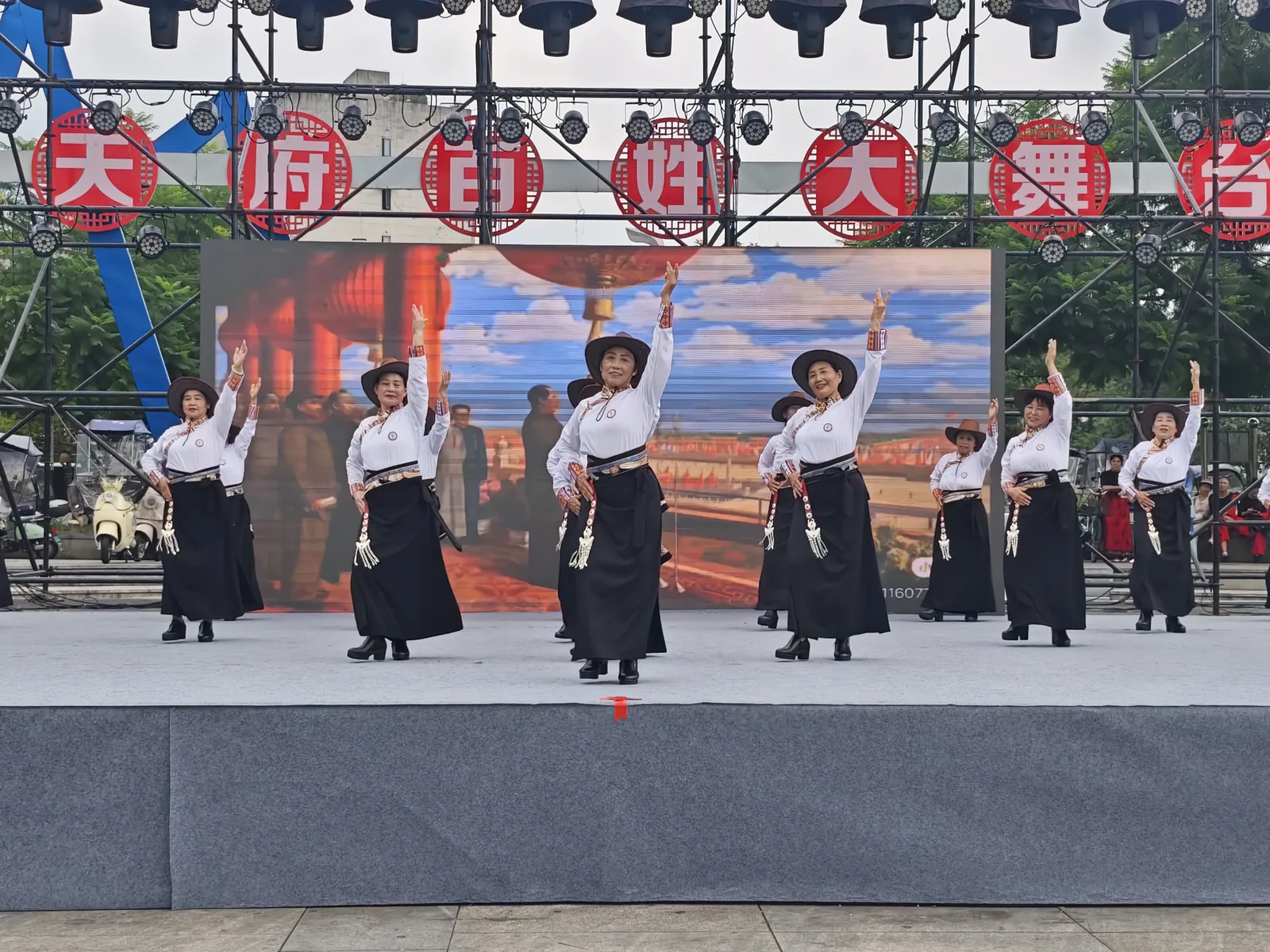
Night events mix live stages with recorded sets — the soundtrack is shared, not personal.
The answer is not one website.
Different dancers use different combinations of music platforms, video platforms, teaching platforms, and locally shared files.
Tangdou: a major dance-learning platform
Tangdou (糖豆) is one of the most useful names to know if you are researching Chinese square dance.
Its current platform combines dance and fitness tutorials with music-related functions. Users can browse dance videos, select songs, record themselves dancing, and connect a phone to a speaker for music playback.
More importantly for a beginner, Tangdou shows how music and choreography are connected.
You are not simply searching for a song.
You are often searching for:
song + teacher + routine + tutorial.
That is a much more useful search model — and it matches how the learn page structures a first session: pick one routine, not one hundred songs.
Kugou and other music platforms
Chinese music services such as Kugou can be useful for discovering:
- playlists;
- remixes;
- instrumental versions;
- DJ versions;
- longer dance mixes;
- familiar songs in alternative arrangements.
QQ Music and other mainstream services can also be useful depending on the song and licensing availability.
Douyin and short-video platforms
Douyin is especially important for discovery.
A song can become associated with a dance because users repeatedly encounter the same music-and-movement combination in short videos.
For someone outside China, this is also one of the easiest ways to understand why a song suddenly appears everywhere.
Downloading is a separate question
Finding a song online does not automatically mean you have permission to redistribute it.
For personal practice, the simplest approach is to use legitimate streaming or download functions provided by the platform.
If you are organizing a public event, commercial class, paid performance, or other public use, treat music rights as a separate issue. See the copyright section below.
Do not assume that “I found an MP3 online” means “I can publicly play it.”
The Gear: Choosing a Speaker for the Public Square
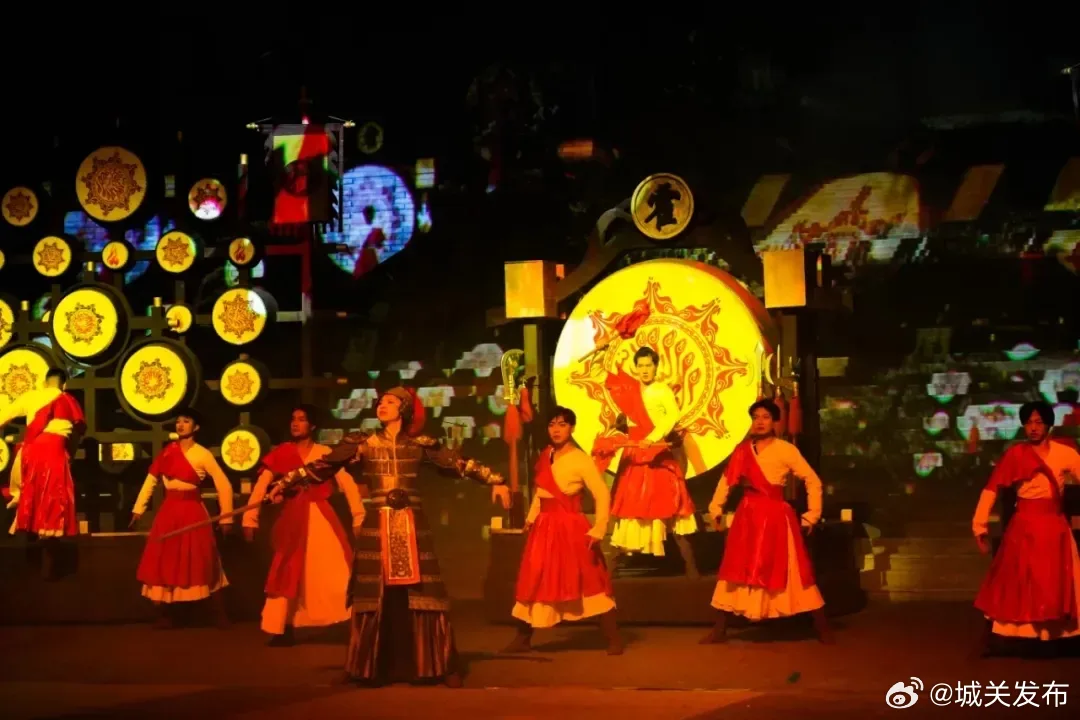
Stage sound at a public event — the same repertoire, amplified for a crowd.
The classic guangchangwu sound system is surprisingly simple:
phone or USB source → portable PA speaker → dancers.
The speaker often has wheels and a telescoping handle, which is why these products are commonly described as trolley speakers or portable PA speakers.
What matters more than the brand
For outdoor group dancing, pay attention to:
- clear midrange and vocals;
- stable Bluetooth playback;
- USB or other local playback options if needed;
- battery life;
- portability;
- wheels and a telescoping handle;
- microphone input;
- anti-feedback controls;
- weather resistance where appropriate;
- volume control that can be adjusted precisely.
Speaker size and advertised wattage can be useful comparison points, but they should not be treated as a simple “bigger is better” formula.
A larger speaker can produce more acoustic output, but the right size depends on the space, group size, speaker placement, local rules, and how much sound is actually necessary. The place a group dances in matters as much as the equipment.
A practical starting point
For a small group, a compact portable PA may be sufficient.
For a larger outdoor group, an 8-inch or 12-inch class portable speaker may provide more headroom.
But there is an important principle:
Buy enough speaker for the dance area — not enough speaker to make the entire neighborhood hear you.
The second goal is not a useful measure of audio quality.
Silent Square Dancing: When the Music Leaves the Speaker
China has experimented with several ways to solve one of guangchangwu’s most persistent problems:
How do you keep the dancers together without broadcasting the music to everyone nearby?
One answer is silent square dancing, in which dancers listen through headphones or receivers rather than a conventional loudspeaker.
Another is directional audio, which attempts to concentrate sound toward the activity area. For the wider public-space story behind these fixes, read Public Space and Sound.
The headphone model
In a headphone-based system, the music is transmitted wirelessly to participants.
Instead of one speaker → entire park, the system becomes one transmitter → many listeners.
The obvious advantage is noise control.
People outside the group hear much less — or potentially none — of the music.
The disadvantage is social.
A public dance is not only about hearing the beat. The shared sound contributes to the feeling of a group moving together.
Headphones can also create practical issues:
- earbuds may fall out;
- battery life matters;
- participants need compatible equipment;
- communication between dancers and the instructor becomes less natural;
- the atmosphere can feel different from conventional outdoor dancing.
So “silent” does not automatically mean “better.”
It solves one problem while changing the experience.
Directional speakers
A different approach is to keep the music audible but concentrate it toward the dance area.
Directional speaker systems can use arrays of transducers and signal processing to produce a narrower acoustic coverage pattern than a conventional omnidirectional speaker.
This is sometimes described using the metaphor of a sound flashlight.
The practical goal is simple:
put more sound where the dancers are, and less where the neighbors are.
This technology is particularly interesting for parks, residential communities, and other locations where public recreation and noise control have to coexist.
But directional audio is not magic. Reflections, buildings, wind, speaker placement, frequency, and the physical environment all affect what people actually hear.
Loud but Welcome: Volume, Noise Rules and Etiquette
This may be the least glamorous part of a music guide, but it is one of the most important.
A great playlist played at an unreasonable volume is still a bad public-space setup.
China’s current environmental legal framework places specific obligations on people organizing entertainment and fitness activities in public places.
The Ecological Environment Code states that public-place entertainment and fitness activities must follow rules concerning the activity area, time, and volume, and must take effective measures to prevent noise pollution. It also addresses excessive use of audio equipment.
For certain violations, the Code provides for education and correction first, followed by warnings and, where the conditions are met, fines. For individuals, the relevant provision allows a fine of RMB 200–1,000; different penalties apply to organizations.
That does not mean “55 dB everywhere” is a universal square-dance volume rule.
This distinction matters.
What about 55 dB and 45 dB?
You will often see figures such as 55 dB(A) during the day and 45 dB(A) at night when reading about community noise.
Those figures come from China’s environmental noise standards for particular environmental functional zones and measurement conditions. They should not be interpreted as a universal rule saying:
“A square dance speaker may be turned up to exactly 55 dB.”
The current GB 22337-2008 standard remains in force, and its limits depend on the applicable noise category, location, and time period.
Local governments, parks, communities, and property managers can also establish more specific rules for public activities. Reporting on national guidelines for dancers makes the same point — rules are about area, time, and volume together, not a single number. Sources for this section are listed in the sources index and at the end of this article.
A better practical rule
When setting up your speaker:
- Start at the lowest usable volume.
- Stand at the edge of the dance area.
- Make sure dancers can clearly hear the beat.
- Walk toward nearby residences or other sensitive locations.
- Reduce the volume if the music remains unnecessarily prominent outside the activity area.
- Avoid directing the speaker toward residential buildings.
- Follow the park or community’s permitted hours.
- Switch to headphones or directional audio where available.
The goal is not silence.
The goal is contained sound. Sound in shared space is a negotiation between dancers, neighbors, and authorities — the culture layer treats it as part of everyday public life.
Is Square Dance Music Legal to Play? A Copyright Primer
Noise and copyright are two different questions.
You can comply with local noise rules and still need to consider music rights.
Under Chinese copyright law, the right of performance includes both live performance and certain forms of public playback using technical equipment.
The China Music Copyright Society explains that mechanical performance can include publicly playing recorded music through equipment, and that authorization can be required for public uses depending on the circumstances.
That becomes especially relevant for:
- commercial dance classes;
- paid events;
- performances;
- businesses;
- organized entertainment activities;
- venues using music as part of their commercial operation.
What about an ordinary community dance?
This is where you should avoid oversimplifying.
A group of residents informally meeting in a public space is not automatically the same legal situation as a commercial venue selling tickets or operating a paid class.
The actual facts matter:
- Who organized the event?
- Is there a commercial purpose?
- Is admission charged?
- Is the music being used as part of a business?
- Is it a public performance?
- What rights are attached to the particular recording and composition?
- Does the platform’s license cover the intended use?
For a commercial or organized public event, do not assume that a consumer music subscription gives you blanket public-performance rights.
If music is important to the event, obtain permission or professional legal advice appropriate to the use.
One more distinction: the song and the recording
A musical work and a particular sound recording can involve different rights.
That means downloading a recording from a legitimate platform does not necessarily answer the separate question of whether you may publicly use that recording in a particular commercial or organized setting.
When in doubt, separate these questions:
Can I listen to this?
and
Can I publicly use this?
They are not always the same question.
How to Build Your First Guangchangwu Playlist
If you are completely new, do not download 200 songs.
Start with around 10–20.
A practical first playlist could contain:
1. Three familiar classics
Choose songs such as Little Apple, The Most Dazzling Folk Style, and Moonlight Over the Lotus Pond.
These give you a sense of the classic public-square sound.
2. Three modern internet hits
Add newer songs that currently have dance tutorials circulating on Chinese platforms.
The important thing is not whether a song appears on somebody’s permanent “top 10” list.
Look for a song that has:
a recognizable routine + a current tutorial + enough repetition to learn it.
3. Three slower pieces
Include melodic or slower songs.
They give beginners a chance to practice timing without constantly chasing a fast beat.
4. Three energetic tracks
Add faster material for groups that already have basic coordination.
5. Two or three traditional or folk-inspired pieces
This is where the musical identity of guangchangwu becomes particularly interesting.
You will hear melodies that connect contemporary public dancing with older Chinese folk and popular music traditions — the red-song repertoire covered in the sources below is a good place to start.
6. One long mix
Finally, try a continuous mix or medley.
This is closer to how some real-world dance sessions are organized: the music does not necessarily stop after every routine.
Beginner Questions, Answered
What is the most popular Chinese square dance song?
There is no single permanent answer.
Songs such as “Little Apple” and “The Most Dazzling Ethnic Style” became iconic examples of Chinese public-square music, while newer internet hits can rise quickly when teachers create widely shared routines.
Popularity is better understood as a changing cycle than as a fixed ranking. The music hub tracks songs that already carry source context rather than claiming a top 10.
Is Chinese square dance music the same as American square dance music?
No.
The two traditions have different histories, musical conventions, dance structures, and social contexts. The English phrase “square dance” creates the overlap, but guangchangwu should be treated as its own Chinese public-dance culture — see Western square dance and the full comparison.
What music do Chinese square dancers use?
There is no fixed playlist.
Common categories include Chinese pop, folk-inspired music, nostalgic songs, patriotic repertoire, internet hits, DJ remixes, and specially edited dance versions.
What is the difference between a 32-step and 64-step routine?
The number generally describes the choreography rather than a universal musical format.
A 64-step routine can simply have a longer movement sequence before returning to its starting point. See routines.
Which app should I use to learn Chinese square dance?
Tangdou is one of the most useful platforms to explore because it connects dance tutorials, songs, teachers, and practice functions.
Chinese music and short-video platforms can also help you discover songs and alternative versions. The learn page explains how to structure those first sessions.
Can I use Western pop songs for guangchangwu?
Absolutely.
Guangchangwu is not restricted to Chinese-language music.
If a song has a clear rhythm and a teacher creates a workable routine, it can be adapted for group dancing.
The main practical question is whether the music works with the choreography — not whether the lyrics are Chinese.
How loud should a square dance speaker be?
As quiet as possible while still allowing the dancers to hear the music clearly.
Speaker wattage is not a legal noise limit.
The relevant considerations include the actual sound reaching surrounding areas, local rules, time of day, location, and whether the activity causes noise pollution. For how groups and neighborhoods negotiate this in practice, read Public Space and Sound.
Do I need permission to play music at a public dance?
It depends on how the music is being used.
Public playback and commercial uses can implicate copyright and performance rights. A commercial event should not assume that an ordinary personal streaming subscription provides all necessary rights.
For a specific event, check the applicable license and authorization requirements.
Why does almost every Chinese pop song seem to have a square dance version?
Because guangchangwu is a choreography-driven culture.
Once a teacher discovers that a song works well for a routine, the song can acquire new edits, tutorials, slowed versions, DJ versions, and derivative choreography.
The music and the dance then reinforce each other’s popularity — the cycle explained earlier in this guide.
Your First Week of Guangchangwu Music
You do not need a giant speaker, a 500-song playlist, or advanced dance knowledge to start.
Try this instead.
Day 1 — Listen
Find five different songs and listen for:
- the main beat;
- the chorus;
- repeated eight-count phrases;
- changes between sections.
Day 2 — Choose one routine
Find a beginner tutorial with a back-view demonstration.
Do not switch songs every five minutes.
Day 3 — Slow it down
Use a legitimate slow-playback function if the platform provides one.
The objective is to understand the movement, not to prove how fast you can follow it.
Day 4 — Add a second song
Choose something with a different mood or tempo.
Now you can feel the difference between music that supports large-group movement and music that is simply pleasant to listen to.
Day 5 — Try the full routine
Dance from beginning to end without stopping.
Day 6 — Think about the sound
If you are dancing outdoors, ask:
Can the dancers hear the music without everyone else having to hear it?
That question should influence speaker placement and volume.
Day 7 — Build your playlist
Keep the songs that work.
Remove the ones that do not.
Your first playlist does not need to be “the best Chinese square dance playlist.”
It only needs to be your usable playlist.
The Sound of the Public Square
Guangchangwu music is more than background music for exercise.
It is part of a distribution system.
A song becomes a dance track when people can recognize it, move to it, teach it, record it, share it, and repeat it.
That is why the music of the Chinese public square can move so quickly from a pop song to a dance routine and then into parks across different cities.
If you want to understand guangchangwu, start with the music.
Listen for the beat.
Watch how the choreography is organized.
Look at how teachers adapt songs.
And remember that the loudest speaker is not necessarily the best sound system.
The real skill is making the music clear enough for the dancers, contained enough for the neighborhood, and familiar enough for the whole group to move together.
For a complete beginner’s introduction to the activity itself, continue with How to Start Guangchangwu as a Beginner.