The History of Guangchangwu: How China’s Square Dancing Became a Cultural Phenomenon
Every evening in cities across China, public squares and parks can become dance floors.
Music starts playing. Groups form lines. A leader moves to the front. Dozens of people begin following the same choreography.
Today, this practice is known as guangchangwu (广场舞) — Chinese public square dancing.
It is easy to assume that such a familiar sight must have a simple history. It does not.
Guangchangwu is not an ancient dance that survived unchanged into the 21st century. Nor did it suddenly appear when China’s older women began dancing in parks.
Its modern form emerged from several different historical currents: China’s long traditions of communal dance and folk performance; the political and cultural uses of mass dance in the 20th century; the revival of public social dancing after Reform and Opening; the growth of urban public spaces; the expansion of mass fitness; popular music and portable audio technology; and, eventually, the rise of social media.
Understanding that history explains something important about guangchangwu today:
It is not simply a dance style. It is a modern Chinese form of collective life in public space.
1. Ancient Roots: China Has a Long History of Communal Dance
The history of dance in China is far older than guangchangwu.
Ancient Chinese societies used music and dance in religious ceremonies, court rituals, celebrations and communal activities. Archaeological evidence from the Shang and Zhou periods demonstrates the importance of organized music and ritual performance, while later historical and artistic records document a wide variety of dance traditions.
The Metropolitan Museum of Art, for example, preserves representations of dancers and musicians from the Han dynasty, while Tang-period objects show how dance incorporated influences from across the Silk Road world.
But it is important not to make a historical leap here.
Ancient Chinese dance is not simply “early guangchangwu.”
The settings, purposes and social structures were different.
Ancient ritual dance could be closely connected to religion, court hierarchy or political ceremony. Guangchangwu is predominantly a grassroots public activity organized around exercise, entertainment and social interaction — the what is Guangchangwu? distinction applies to history too.
The connection is therefore better understood at the level of cultural patterns:
- collective movement;
- music and synchronized bodies;
- public or communal participation;
- dance as a way of expressing social identity;
- and the use of movement to bring groups of people together.
These patterns have appeared repeatedly in Chinese history.
Yangge: One of the Most Important Historical Connections
Among the many traditions relevant to the history of Chinese public dance, Yangge (秧歌) is particularly important.
Yangge is a family of northern Chinese folk performance traditions rather than one standardized dance. Different regional forms developed in places including northern Shaanxi, northeastern China, Shandong and Hebei.
Historically, yangge could combine dance, song, theatrical performance and festive procession.
Its importance for modern Chinese dance history comes partly from its adaptability.
During the Yan’an period in the 1940s, traditional yangge was transformed into New Yangge (新秧歌). Scholars describe this as a major moment in the development of modern Chinese dance because traditional folk forms were reorganized around contemporary revolutionary themes and made accessible to large audiences.
The simplicity of many New Yangge movements was significant.
It made participation easier.
Dance did not have to remain something performed by highly trained professionals. Ordinary people could become performers themselves.
That idea — the public becoming the dancers — would become important again decades later.
2. Dance and Revolution: When Collective Movement Became a Mass Practice
The 1940s and 1950s transformed the social meaning of dance in China.
The Yan’an New Yangge movement demonstrated how folk performance could be adapted for mass participation. After 1949, simplified forms of yangge were introduced into urban China and used in large public performances. Historian Chang-tai Hung describes early-1950s urban yangge as an important vehicle through which political narratives were communicated through collective movement.
This period established a powerful cultural precedent:
dance could be something that ordinary citizens performed collectively in public.
That precedent matters when looking at guangchangwu decades later.
But the relationship between revolutionary dance and modern square dancing is not a simple line of inheritance.
Chinese dance culture subsequently went through dramatic political changes.
During the Cultural Revolution, many forms of entertainment associated with Western or bourgeois culture were restricted or banned. Ballroom dancing, in particular, came under severe criticism, while revolutionary forms such as Zhongzi Dance (忠字舞) became associated with political loyalty.
A recent history of dance sport in China describes ballroom dancing as effectively banned during the Cultural Revolution and notes its revival after Reform and Opening.
This created an unusual historical experience for the generations who would later become the core participants in guangchangwu.
They had grown up in a society where collective movement was familiar, but where the acceptable form and purpose of that movement could change dramatically according to the political and cultural environment.
That history helps explain why the physical grammar of group activity could feel natural to later generations.
3. 1979: Public Dancing Returns
The end of the Cultural Revolution and the beginning of Reform and Opening changed China’s cultural landscape.
People gained access to a much wider range of entertainment, music and social activities.
One symbolic moment came in 1979, when ballroom dancing appeared at a New Year’s celebration at the Great Hall of the People in Beijing. Historical research on Chinese dance describes this event as an important public signal that ballroom dancing was once again becoming socially acceptable.
The significance went beyond ballroom dancing itself.
A generation that had experienced years of restrictions suddenly encountered new possibilities for:
- social dancing;
- popular music;
- public entertainment;
- leisure activities;
- and social interaction outside formal institutions.
The 1980s became an experimental period.
Foreign dances returned.
Public discos appeared.
Young people gathered to dance.
And dancing gradually moved back into China’s parks and public spaces.
The Complicated 1980s
The revival was not completely smooth.
Public dancing was sometimes viewed with suspicion, and government campaigns in the early 1980s created a difficult environment for some dance venues and participants.
The history of Chinese ballroom dancing shows how the 1980s contained both rapid cultural opening and continuing anxiety about public behavior and social order.
But the broader direction was clear.
Public dancing had returned to Chinese everyday life.
And once people had rediscovered the habit of meeting in public to move to music, the practice could evolve in many different directions.
4. From Ballroom and Disco to the Modern Public Square
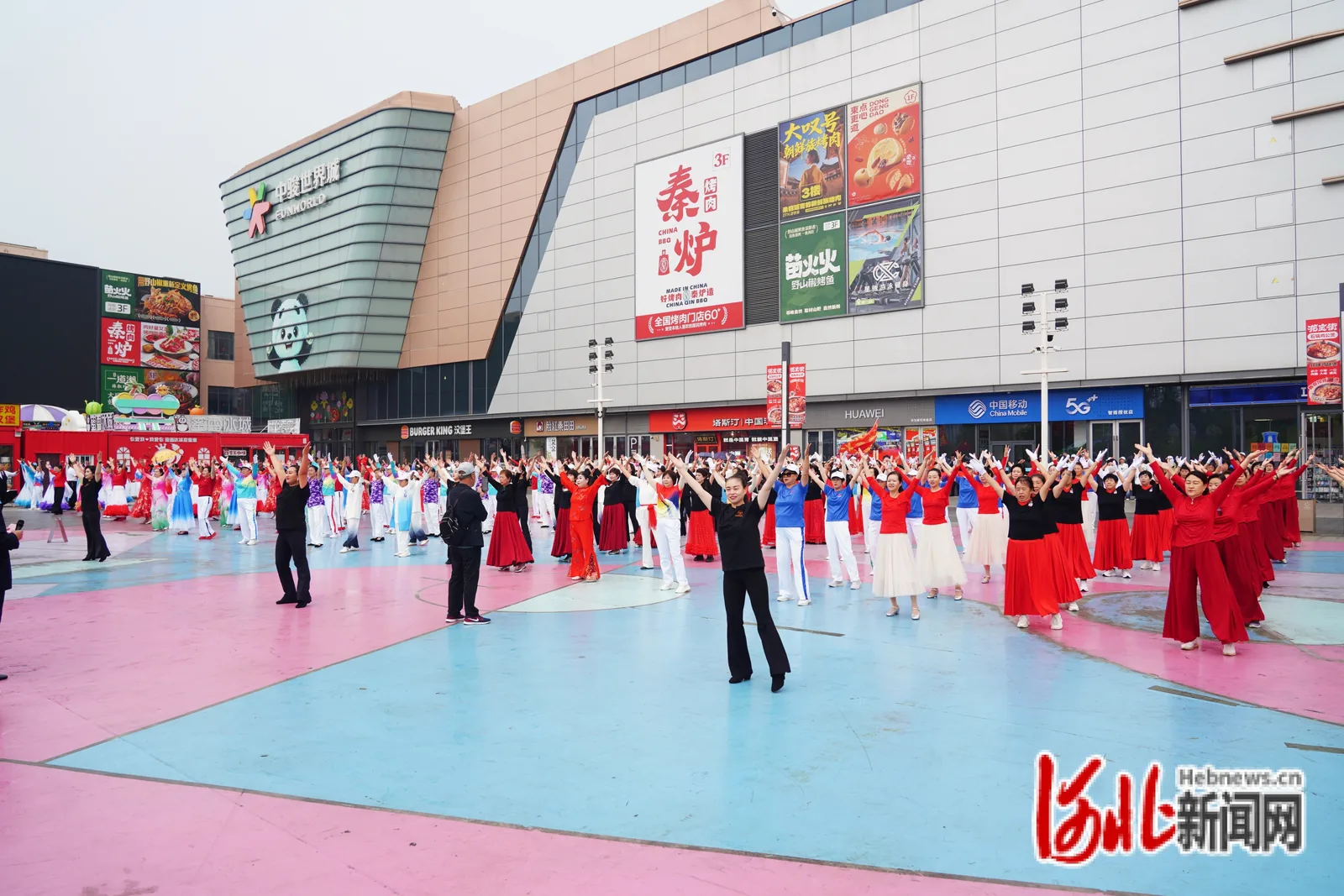
Evening practice under residential towers — the modern public square, after work hours.
By the late 1980s and 1990s, group dancing had become increasingly visible in Chinese urban parks and other open spaces.
Contemporary accounts looking back at the period often trace the development of today’s square dancing to the public discos and group dancing of the 1980s. Beijing Review, for example, described square dancing as emerging from public dancing in that period and becoming increasingly common in city parks by the late 1980s.
Several conditions gradually came together.
Urbanization created more public gathering places
China’s cities expanded rapidly.
New residential developments, parks, plazas and open public spaces provided places where large numbers of people could gather — the public-space question this later created is tracked under Culture.
Portable audio changed the economics of dancing
A dance group no longer needed a ballroom.
A portable speaker could turn an ordinary open space into a temporary dance floor — the same infrastructure described in Sounds of the Public Square.
Retirement created a new population of potential participants
The women who would later become strongly associated with guangchangwu were entering middle and later adulthood.
Many had spent their lives in workplaces, factories, schools, government organizations or households structured around relatively fixed routines.
Retirement created more discretionary time — the social history detailed in Who practices guangchangwu?.
Community networks provided the social infrastructure
A person did not need to belong to a formal club.
A neighbor could introduce a routine.
An experienced dancer could stand at the front.
A newcomer could simply follow.
This combination was extraordinarily scalable.
5. The 1990s: The Conditions for a Mass Movement Come Together
The modern guangchangwu phenomenon was not created by one organization or one invention.
It emerged from the convergence of several trends.
Public space
China’s expanding cities produced more plazas, parks, residential courtyards and pedestrian spaces.
Aging
A rapidly growing older population created a large potential audience for accessible community exercise.
Leisure time
Retirement allowed many people to establish regular daytime or evening routines.
Popular music
Music became increasingly diverse, inexpensive and portable — later amplified through the song-driven ecosystem.
Grassroots organization
Groups could form without a central authority.
Mass fitness
China’s growing emphasis on 全民健身 — national fitness — gave activities such as community exercise an increasingly legitimate place in everyday life.
These factors help explain why guangchangwu should not be attributed to a single “inventor.”
The practice was assembled socially.
People copied routines.
Dance leaders taught neighbors.
Groups adapted music.
Participants moved between groups.
Successful routines spread from one city to another.
A local activity could become a national phenomenon without ever having a single headquarters.
This grassroots structure remains one of guangchangwu’s defining characteristics today. Research on Chinese square dancing describes the activity as a form of group cultural life in which dance teachers, experienced members and ordinary participants develop layered community relationships — recorded in Sources.
6. The 2000s: Guangchangwu Becomes a Mass Fitness Practice
The 2000s were the period when the modern system became recognizable.
The practice increasingly moved away from the idea of “people dancing in public” toward something more specifically recognizable as square dancing for exercise.
Simple choreography became important.
Participants did not need professional dance training.
A leader could stand at the front.
Everyone else could learn through repetition.
That structure made the activity exceptionally scalable.
A group could have ten people.
Or thirty.
Or more than one hundred.
The dance could last for an hour or more.
And the same routine could be repeated day after day.
This was not professional dance.
It was mass participatory movement.
That distinction is central to understanding guangchangwu.
7. 2008: The Rise of Organized Fitness Dance
One of the important developments of the late 2000s was the emergence of recognizable branded or named routines and dance systems.
The Jiamusi happy dance steps (佳木斯快乐舞步) became particularly influential.
Its choreography emphasized accessible, repetitive movements that could be followed by large groups.
The model demonstrated how a local exercise routine could travel through China’s growing network of community fitness groups.
The broader pattern was already visible:
local routine → popular recording → imitation → community adoption → national visibility.
This would become even more powerful once China’s internet and short-video ecosystems began accelerating.
8. 2012–2015: The Golden Age of Guangchangwu
If the previous decades created the conditions for guangchangwu, the early 2010s turned it into a national cultural phenomenon.
Three things came together:
music + mass participation + mass media.
2012: Popular music enters the square
Songs such as “The Most Dazzling Ethnic Style” (最炫民族风) by Phoenix Legend became closely associated with public dancing.
The distinction between “exercise music” and mainstream popular music became increasingly blurred.
A successful pop song could become a dance routine.
A dance routine could make a song more popular.
The relationship was circular — the same song-to-dance loop described on the music hub.
2014: Little Apple
Then came Little Apple (小苹果) by the Chopstick Brothers.
The song became one of China’s biggest viral music phenomena of the period.
Contemporary reporting cited approximately 579 million online audio plays and 823 million music-video views on major Chinese platforms at the time, while the song’s connection with square dancing helped make it one of the defining soundtracks of the phenomenon.
Its appearance on the international stage at the 2014 American Music Awards further amplified the cultural visibility of a song already strongly associated with Chinese mass entertainment.
2015: Guangchangwu reaches the national stage
The year 2015 marked an important institutional turning point.
The General Administration of Sport of China and the Ministry of Culture and Tourism of China launched a national square fitness dance program and introduced Standardized guangchangwu routines — 12 standardized model routines.
These included routines using popular songs such as “Little Apple” and “The Most Dazzling Ethnic Style.”
The program also trained instructors and promoted the routines across China’s provinces and municipalities.
The same year, the national square-dance competition adopted an internet-plus model, allowing teams to submit videos online and participate through a combination of online voting and judging — the competition culture recorded under Competitions.
This was an important change.
Guangchangwu was no longer simply something that happened locally in a neighborhood square.
It had become:
a mass fitness activity + a media phenomenon + an organized competition culture.
Importantly, the government did not intend the 12 routines to eliminate grassroots creativity. The sports authorities explicitly clarified that the model routines were intended as guidance rather than a compulsory single style — the pushback is documented in Noema’s coverage of standardization resistance.
9. The Conflict Era: When the Square Became a Battleground
The same period that made guangchangwu famous also made its problems impossible to ignore.
The central issue was not dancing itself.
It was public space and sound.
As groups became larger and speakers became louder, residents living near parks and squares began complaining about noise.
In some locations, conflicts became extreme.
Reports from the early 2010s described confrontations involving residents, students and dancers. The incidents included water balloons, thrown waste and, most dramatically, the 2013 Beijing case in which a resident fired a shotgun into the air in protest against dancers.
These incidents attracted enormous domestic and international attention.
The “dancing grannies” became a global media image.
But the controversy revealed something deeper.
Guangchangwu had become a negotiation over:
- who has the right to use public space;
- what counts as acceptable noise;
- how older and younger residents share neighborhoods;
- how much space community activities should occupy;
- and whether public space should prioritize quiet individual use or collective activity.
Academic research subsequently treated square dancing as a useful lens for understanding public space and community life in contemporary China — the long form of that story is Public space and sound.
The controversy therefore became part of guangchangwu’s history, not simply an embarrassing side story.
10. From Conflict to Regulation
The response was not to eliminate guangchangwu.
Instead, China increasingly moved toward regulation, standardization and coexistence.
The 2015 national program was one early example.
The 2017 national competitions went further, establishing formal competition rules and incorporating standardized routines alongside self-selected choreography. The regulations explicitly allowed both men and women and included participants across a broad adult age range.
This represented a remarkable transformation:
an informal neighborhood activity had developed a formal institutional layer.
At the same time, cities experimented with local approaches to noise management, public-space scheduling and registration.
The goal increasingly became not “stop square dancing,” but:
find a way for square dancing and other urban activities to coexist.
That distinction is important.
Guangchangwu’s history is therefore not simply a story of grassroots culture confronting government regulation.
It is also a story of a grassroots activity becoming important enough that institutions began to build systems around it — the same arc traced in Guangchangwu culture and the transition covered in How to start guangchangwu.
11. From National Phenomenon to Cultural Export
Guangchangwu did not remain exclusively inside China.
Chinese communities overseas began organizing similar activities in parks, Chinatowns and community spaces.
New York, London, Paris, Sydney, Toronto and Vancouver have all seen forms of Chinese community square dancing.
Outside China, the meaning can shift again.
For an older immigrant, the activity may provide:
- exercise;
- Chinese-language social interaction;
- cultural memory;
- friendship;
- and a familiar community routine.
For younger participants, it can become a way to encounter Chinese popular culture.
This makes overseas guangchangwu an important part of its history — the documented locations are told in Guangchangwu around the world.
The practice is no longer tied entirely to Chinese urban public space.
It can travel with communities.
12. The Digital Turn: Guangchangwu Enters the Smartphone Era
The next transformation came from smartphones and short-video platforms.
Originally, a dancer had to physically observe another dancer to learn a routine.
Now a person can watch a choreography repeatedly on a phone.
Dance leaders can distribute new routines.
Performances can become viral videos.
Participants can follow instructors from other cities.
And a local routine can reach an audience thousands of miles away.
Platforms such as Douyin, Kuaishou, Xiaohongshu and Bilibili changed the relationship between the physical square and the digital world.
The square remained the place where people danced together.
But the internet became the place where routines circulated.
This also changed the age boundaries of the phenomenon — visible today in how new practitioners join.
13. Guangchangwu Goes Younger
For much of its modern history, guangchangwu was strongly associated with middle-aged and older women.
That image began changing in the 2020s.
University groups and younger urban dancers increasingly adopted the practice, often using contemporary music and choreography.
At Beijing Foreign Studies University, for example, a student-led square-dance group that began in 2021 attracted large numbers of students, including international students.
Other young dancers have incorporated K-pop and contemporary Chinese pop into routines that would be almost unrecognizable to someone who associates guangchangwu exclusively with older women’s evening exercise.
This is an important historical development.
The practice is not simply aging with its original participants.
It is being reinterpreted by new generations.
The meaning changes with them.
14. COVID-19 and the Digital Square
The pandemic temporarily disrupted the physical foundation of guangchangwu.
Public gathering became difficult or impossible during periods of restrictions.
But the activity did not disappear.
Dance moved indoors.
Tutorials moved online.
Live streaming became more important.
People practiced routines in living rooms and shared performances through digital platforms.
This revealed something that had been less obvious before:
the square is a setting, but collective dance does not necessarily require a physical square.
The community could survive through screens and return to public space when conditions allowed.
That flexibility has become increasingly important to the modern form.
15. Guangchangwu in the 2020s: From Controversy to Cultural Institution
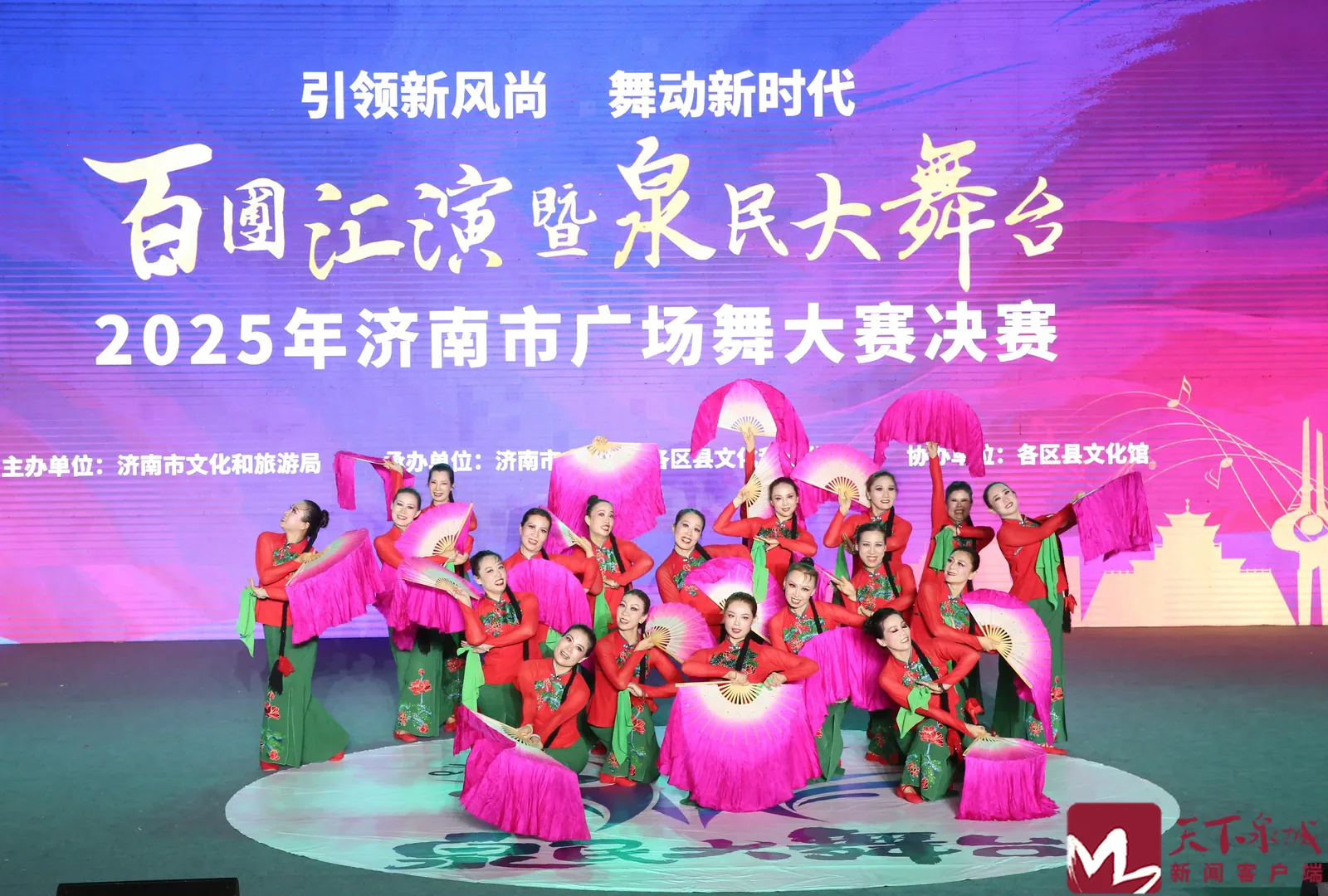
Staged group performance — plaza dancing is now also a stage art form.
By the mid-2020s, guangchangwu occupied a much more complicated position in Chinese society than it had during its explosive rise.
It remains a grassroots activity.
But it also has:
- national competitions;
- standardized routines;
- trained dance leaders;
- dedicated digital platforms;
- commercial clothing and equipment;
- community organizations;
- public-health research;
- university research;
- overseas groups;
- and growing participation from younger people.
The research literature now treats square dancing not simply as exercise but as a form of group cultural life, social connection and public-space interaction.
That represents a significant change in how the activity is understood.
It is no longer enough to ask:
“Why are older Chinese women dancing in public?”
The historical question has become:
“How did collective dancing become one of the ways contemporary Chinese communities organize social life?”
16. What the History of Guangchangwu Really Tells Us
The history can be summarized as a series of transformations:
| Period | Major development | What changed |
|---|---|---|
| Ancient China | Ritual, folk and communal dance traditions | Dance embedded in collective cultural life |
| 1940s | Yan’an New Yangge | Folk dance adapted for mass participation |
| 1950s–1970s | Revolutionary mass dance | Collective movement became politically organized |
| 1979 onward | Ballroom and social dance revival | Public dancing returned after decades of restriction |
| 1980s–1990s | Parks and public dancing | Dance increasingly entered everyday urban space |
| 2000s | Mass fitness routines | Group dance became accessible community exercise |
| 2008 onward | Named routines such as Jiamusi Happy Dance Steps | Local choreography became widely reproducible |
| 2012–2015 | Viral songs and mass media | Guangchangwu became a national cultural phenomenon |
| 2015–2017 | Standardized routines and competitions | Grassroots practice gained an institutional layer |
| 2013–2020s | Noise and public-space conflicts | Cities began developing coexistence and regulation mechanisms |
| 2020s | Smartphones, short video and youth participation | The practice became more digital and demographically diverse |
| 2020s–present | Overseas communities and cultural exchange | Guangchangwu became increasingly global |
The pattern is striking.
Guangchangwu did not emerge from one historical tradition. It emerged from layers.
Ancient Chinese dance demonstrates a long cultural familiarity with collective movement.
Yangge demonstrated the power of simple folk choreography to mobilize ordinary people.
The revolutionary period normalized mass performance and synchronized bodies.
Reform and Opening restored public social dancing.
Urbanization created the spaces.
Mass fitness created the demand.
Portable speakers created the infrastructure.
Popular music created the soundtrack.
The internet created the distribution system.
And millions of ordinary participants created the phenomenon itself.
17. The Future of Guangchangwu
History also helps explain where guangchangwu may be heading.
The practice is unlikely to remain frozen in the image that made it famous internationally.
Its future is already becoming more diverse.
Older women remain central.
But younger dancers are entering.
Men participate.
University students experiment with new choreography.
Digital platforms distribute routines.
Competition creates more formal performance structures.
Overseas Chinese communities adapt the practice to new cities.
And technology is being used to address the most persistent problem in its history: how to share public space without turning music into a source of conflict — the ongoing story under Public space negotiation.
In that sense, guangchangwu’s future may look surprisingly similar to its past.
It will continue to change when people, technology, public space and cultural habits change.
That has always been the secret of its durability.
Frequently Asked Questions
When did guangchangwu begin?
There is no single founding date for modern guangchangwu. Its contemporary form developed gradually, particularly from public dancing in the 1980s and 1990s, followed by the expansion of community fitness dancing in the 2000s.
Is guangchangwu an ancient Chinese dance?
No. Modern guangchangwu should not be described as an ancient dance that survived unchanged. It is a modern public fitness and cultural practice that developed from multiple historical traditions and modern social conditions — see What is Guangchangwu?.
Is yangge the origin of guangchangwu?
Yangge is an important historical influence in the broader history of Chinese mass and folk dance, particularly through the New Yangge movement of the 1940s. But there is no simple one-to-one lineage from traditional yangge to today’s guangchangwu.
What happened to dancing during the Cultural Revolution?
Many forms of social and Western-style dancing were heavily restricted. Revolutionary forms of collective performance became dominant, including dances associated with political campaigns.
When did public dancing return to China?
Public and ballroom dancing began returning with Reform and Opening after 1978. The 1979 ballroom event at the Great Hall of the People became an important symbolic moment in the revival of public social dancing.
When did guangchangwu become popular?
The modern mass phenomenon developed particularly during the 2000s and exploded into national visibility in the early 2010s.
Why was 2015 important for guangchangwu?
In 2015, China’s sports and cultural authorities launched a national square fitness dance program, introduced 12 model routines, trained instructors and organized national competitions.
Why did guangchangwu become controversial?
The main controversy concerned loud music and competition for public space. Conflicts became particularly visible in the early 2010s as large groups occupied spaces near residential neighborhoods — see Public space and sound.
Is guangchangwu still mainly practiced by older women?
Older women remain its traditional core, but the participant population has diversified. Younger adults, university students, men, competition teams and overseas Chinese communities now participate as well — see Who practices guangchangwu?.
Is guangchangwu the same as American square dancing?
No. The two practices have different histories, formations, music and social structures — see Guangchangwu vs. square dance. The English phrase “square dancing” can therefore be misleading when applied to guangchangwu.
Conclusion
The history of guangchangwu is not really the history of a particular dance.
It is the history of Chinese people repeatedly finding new ways to move together in public.
Ancient ritual and folk traditions created a deep cultural history of communal movement.
The New Yangge movement demonstrated how simple choreography could mobilize ordinary people.
The revolutionary period made collective dance part of mass social experience.
Reform and Opening brought public social dancing back.
Urbanization created new public spaces.
Retirement created millions of potential participants.
Popular music and portable speakers turned those spaces into temporary dance floors.
The internet transformed local routines into national trends.
And younger generations are now giving the practice new music, new meanings and new forms.
That is why guangchangwu cannot be reduced to the image of “dancing grannies.”
Its history is much larger.
Guangchangwu is a modern Chinese cultural phenomenon built from old habits of collective movement, twentieth-century social transformation and twenty-first-century technology.
And the story is still being written.
Next steps
- What is Guangchangwu? — the definition
- Who practices guangchangwu? — the people
- Guangchangwu vs. square dance — the distinction
- Chinese plaza dancing — the term in English
- Sources — the evidence behind this page
Sources
- China's Relationship with Song and Dance Is Unselfconscious
- China's elderly seek health and happiness through square dancing
- Wrath of Dancing Grandmothers Forces Chinese Government to Backtrack
- China orders square dancers to walk the line
- Square dancing (China)
- The man who created a new dimension to square dancing
- Little Apple (song)
- Phoenix Legend
- 佳木斯快乐舞步 越简单越流行
- Chinese square dancing competition enhances mass leisure exercise to national level