A dance that began in China’s public squares did not set out to become an international cultural phenomenon. It traveled first in a much quieter way: with Chinese families moving abroad, with people carrying portable speakers into neighborhood parks, and with familiar morning routines recreated far from home.
Then came something very different.
A noise dispute in Brooklyn. A viral photograph supposedly showing Chinese women dancing at the Louvre. Chinese visitors dancing in Moscow. A performance in Times Square. Retired Chinese women appearing on a European theater stage. Nigerian performers learning Chinese dance. Cross-border dance competitions between China and Russia. And, eventually, millions or billions of short-form video views generated by Chinese dance challenges.
These episodes are often treated as unrelated stories.
Taken together, however, they reveal something more interesting:
Guangchangwu has traveled through several different mechanisms, and what travels abroad is not always the same thing as the practice that developed in China’s public spaces.
In this article, Guangchangwu (广场舞) refers primarily to China’s organized group dancing in public spaces: music, repeated choreography, synchronized movement, exercise, and social participation. In English-language media it is often called Chinese square dancing, although that term can create confusion with the very different North American tradition of Western square dance.
Its international history is therefore not simply a story of “Chinese square dance going global.”
It is a story of diaspora, public space, cultural performance, digital circulation, and local adaptation.
The First Journey: When Guangchangwu Traveled in a Suitcase
The earliest international spread of Guangchangwu was probably the least spectacular.
There was no viral video and no international campaign.
Chinese migrants and their parents simply continued doing something they already knew how to do.
By the late 2000s and early 2010s, Chinese community groups in cities such as New York, Los Angeles, Vancouver, Auckland, and elsewhere were organizing outdoor group activities that included dancing, line dancing, waist-drum routines, and other forms of collective exercise.
In this first stage, the most important participants were often members of the Chinese diaspora.
The dance did not initially need to be translated for a foreign audience.
It was a familiar routine transplanted into a new environment.
Sunset Park: A Diaspora Practice Becomes a Public-Space Issue
New York’s Sunset Park became one of the most visible examples.
Chinese residents gathered in the park for morning exercise and dance, using amplified music in a neighborhood shared with other residents. In August 2013, a dispute over noise escalated to police intervention involving a Chinese dance organizer. The episode subsequently became one of the best-known examples of the tension between Chinese public-dance practices and local noise expectations.
The important point is not simply that “Chinese dancers were arrested.”
That framing leaves out the actual issue.
The conflict involved public space, amplified sound, time of day, neighborhood expectations, and different understandings of acceptable outdoor activity.
It was therefore an early example of a problem that would follow Guangchangwu overseas: a practice designed for China’s public-space environment can encounter very different rules and social expectations elsewhere. The same dimension is examined from the inside in Public space and sound.
The Sunset Park story also illustrates why Guangchangwu cannot be understood only as dance.
For the people participating, it could simultaneously be exercise, routine, friendship, cultural continuity, and social life.
For neighbors, the same activity could be experienced primarily as amplified sound in a shared residential environment.
The same square could therefore contain two very different interpretations of what was happening.
From Local Practice to Global Spectacle
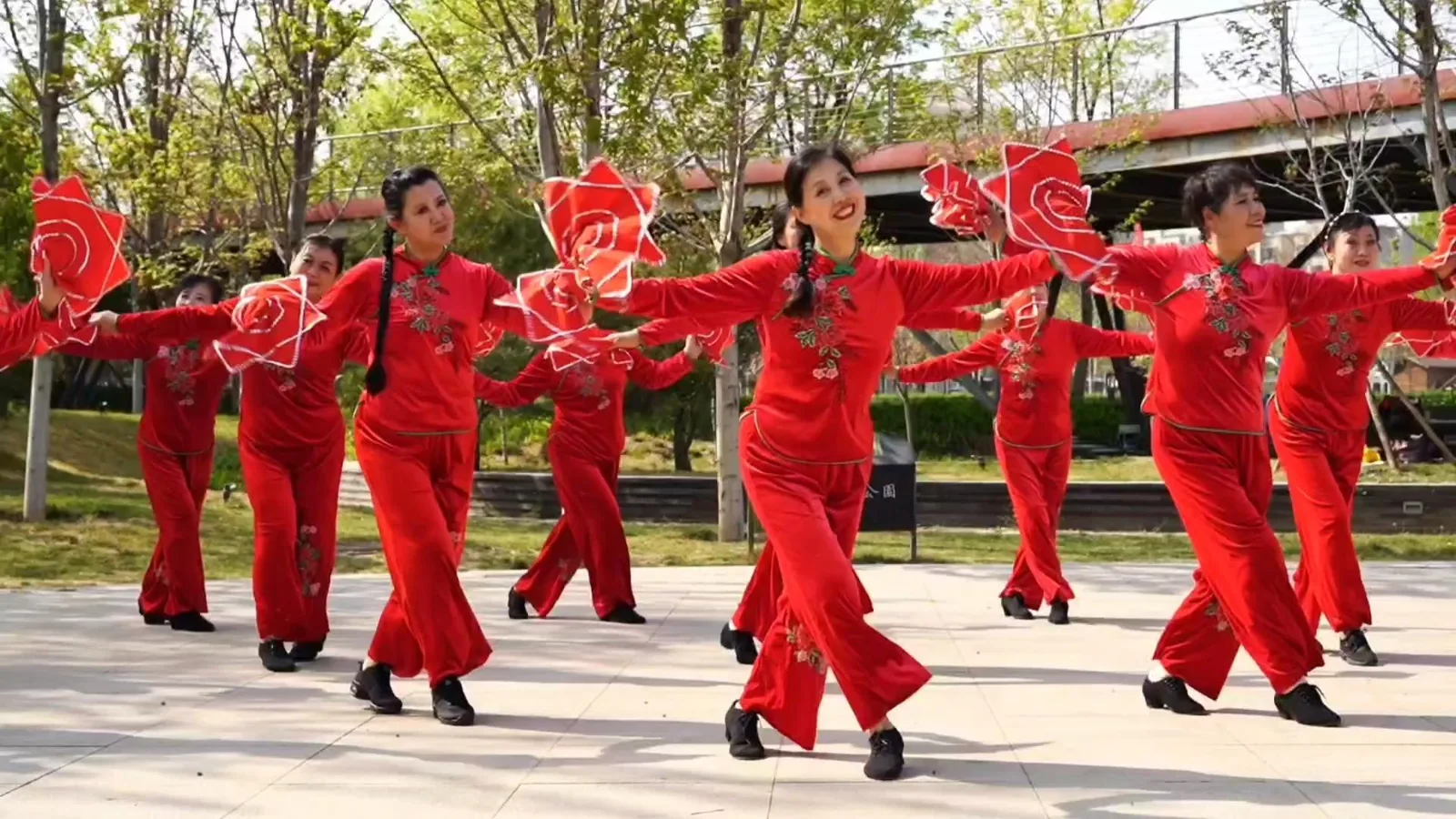
Long-ribbon dancing — the visual language that travels best across borders.
Around 2013–2016, several highly visible incidents transformed Guangchangwu and the figure of the Chinese dama into an international media subject.
Some were genuine dance events.
Some were cultural performances.
Some were tourist episodes.
And some became famous largely because photographs and headlines turned them into symbols.
The Louvre Photograph
In 2014, a photograph circulated widely that purported to show Chinese women dancing at the Louvre in Paris — the overseas appearance documented on this site as a one-off episode at In front of the Louvre (Paris).
The image became part of a much larger Chinese online discussion about dama and public behavior abroad. Chinese-language coverage itself questioned aspects of the image and its presentation, while international audiences encountered it as a striking visual story about Chinese visitors and public dance.
That distinction matters.
The Louvre photograph became historically important because of its circulation, not because it provides reliable evidence that the Louvre was a regular Guangchangwu venue.
For an evidence-based history of the phenomenon, it should therefore be treated as a viral media episode, not as proof of an established Parisian dance community.
That is an important difference between documenting a practice and documenting an image of that practice.
Red Square
A similar pattern appeared in Moscow, where Chinese visitors were reported dancing in Red Square.
Again, the event became part of a growing international narrative about Chinese tourists, public behavior, and dama culture.
By this point, however, something had changed.
Guangchangwu was no longer visible only inside Chinese communities.
It had become recognizable internationally as a shorthand for a particular image of contemporary Chinese public life.
From Spectacle to Performance
At almost the same time, other overseas appearances presented a very different picture.
The New York Chinese Song and Dance Ensemble, founded by Feng Jie, organized Chinese dance performances in New York, including a Times Square flashmob and later participation in the Macy’s Thanksgiving Day Parade.
These were not spontaneous park routines.
They were organized cultural performances.
That distinction is useful because it shows one of the first major transformations in Guangchangwu’s international journey:
the practice could move from everyday exercise to cultural representation.
Another striking example came from Europe.
The production 50/60 Dance Theater with Dama placed six Chinese women with experience in square dancing on an international theater stage. The production reached Bologna’s Vie Festival in 2016 after its Beijing performances. Contemporary accounts described the women as ordinary square-dance participants whose everyday activity had unexpectedly become part of an international theater production.
This was not simply “Chinese square dance abroad.”
It was something more interesting:
an everyday social practice being reinterpreted as contemporary performance.
Three Ways Guangchangwu Travels
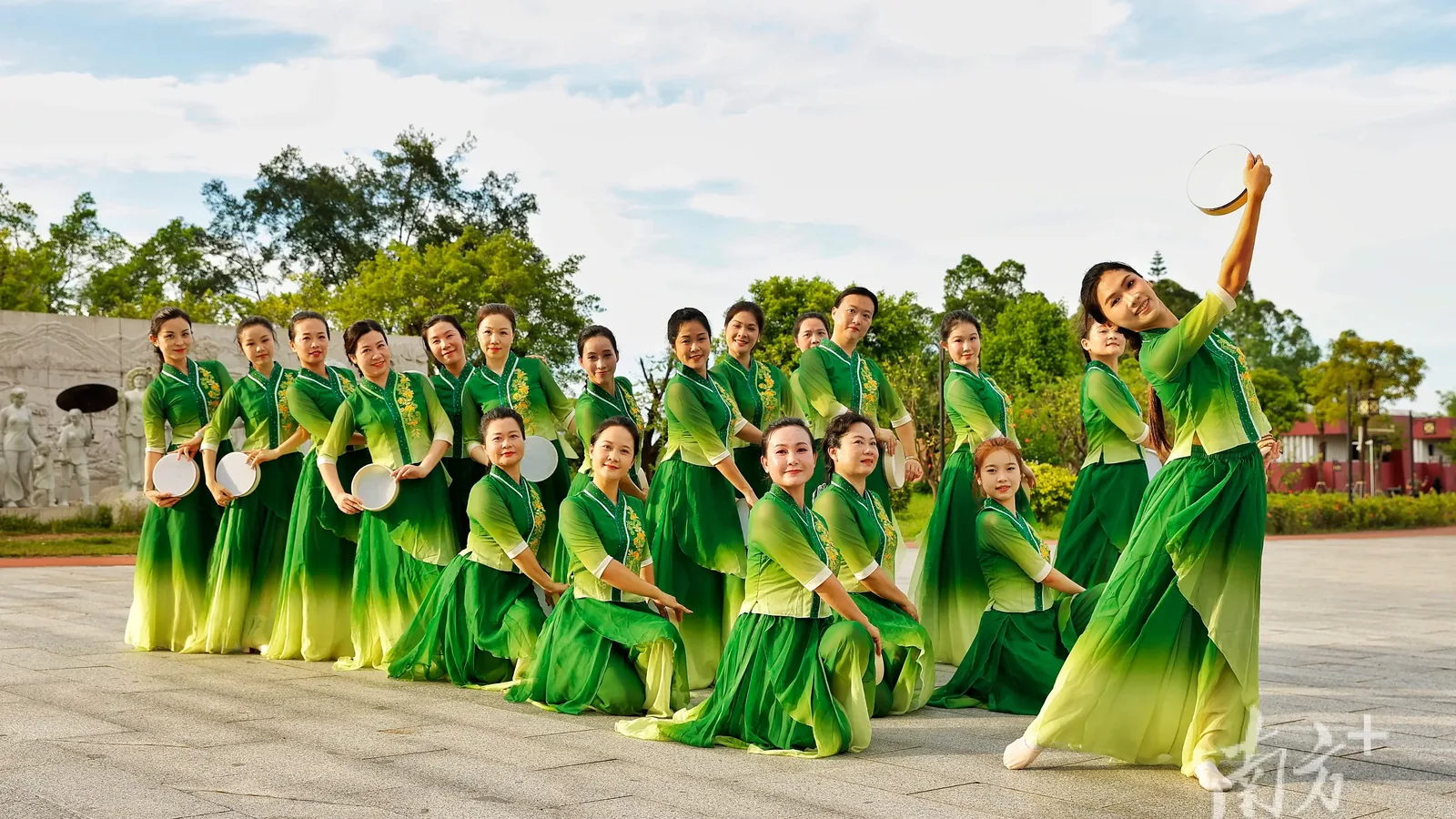
Fans and formations translate across languages — the movement needs no translation.
Looking across documented overseas cases, a useful way to understand the international history of Guangchangwu is to distinguish three recurring forms.
This is an analytical framework rather than an established academic classification.
| Form | Typical settings | Who it is for | What it demonstrates |
|---|---|---|---|
| Diaspora community dance | Parks, schoolyards, community spaces | Participants themselves | Cultural continuity |
| Festival and flashmob dance | Festivals, parades, stages, exchange events | A general audience | Visibility and representation |
| Local adaptation | New local venues and music | Mixed local participants | Long-term adoption — the hardest to document |
1. Diaspora Community Dance
This is the closest overseas equivalent to everyday Guangchangwu in China.
Typical characteristics include:
- Chinese participants
- Chinese-language music
- regular meetings
- familiar choreography
- parks, schoolyards, community spaces, or other public venues
- exercise and social connection
- strong continuity with routines established in China
The activity does not necessarily exist to introduce Chinese culture to foreigners.
It exists because people want to dance.
This is why diaspora Guangchangwu is better understood as cultural continuity than cultural export.
The dancers may be maintaining a routine they already consider ordinary.
For someone who moved from Beijing, Harbin, Shenyang, Guangzhou, or another Chinese city to New York or Auckland, dancing in a foreign park can reproduce a small piece of familiar social geography.
The surroundings change.
The practice does not have to.
2. Festival and Flashmob Dance
The second form is much more visible.
Here, Guangchangwu-related choreography appears at:
- festivals
- parades
- public celebrations
- cultural-exchange events
- tourism sites
- theater productions
- organized competitions
The audience changes.
The dancers may be performing for people who do not participate themselves.
The choreography may also be modified for a stage or event.
This is where Guangchangwu can become part of a broader representation of Chinese culture.
The 2014 Times Square performance, the 2015 Macy’s Parade appearance, and the Bologna theater production belong more naturally to this category than to everyday park dancing.
They demonstrate an important principle:
A cultural practice can travel even when its original social setting does not.
3. Local Adaptation
The third form is the most interesting — and the most difficult to document.
It occurs when people who did not grow up with Guangchangwu begin participating themselves, and when the practice changes as a result.
Music can change.
Participants can change.
Venues can change.
The purpose can change.
The result may no longer look exactly like Guangchangwu in a Chinese residential park.
But the underlying model — collective movement, accessible choreography, repeated group practice, music, and social participation — can survive.
This is where cultural transmission becomes cultural adaptation.
And it is also where claims should be made carefully.
A foreign person appearing in one viral video does not establish a local Guangchangwu community.
A festival performance does not establish long-term adoption.
A TikTok view does not establish participation.
The strongest evidence comes from repeated practice over time.
Where Is Guangchangwu Found Outside China?
There is no reliable global census of overseas Guangchangwu.
The cases below should therefore be understood as documented examples, not a complete map of every place where people practice it.
North America: Diaspora Roots and Public-Space Negotiation
The United States provides some of the clearest examples of diaspora Guangchangwu.
New York has long-standing Chinese community dance activity in places including Sunset Park, Flushing, and Manhattan Chinatown, where published community accounts have documented Chinese dancers sharing park and street space. Southern California also has extensive Chinese-speaking communities where group dance and other communal physical activities occur.
The most important story here is not simply geographic expansion.
It is adaptation to a different public-space system.
A Chinese public park may support large groups using amplified music at times that would be ordinary in China.
An American neighborhood park may have stricter expectations concerning noise, hours, or permitted activity.
As a result, overseas groups may change volume, timing, location, or venue.
This is one reason the international history of Guangchangwu is also a history of negotiating shared space — the same negotiation traced in Public space and sound and in Guangchangwu culture.
Canada provides similar examples through Chinese diaspora communities in cities such as Vancouver and Toronto. Xinhua has documented a Chinese square dance competition in Southwestern Ontario — recorded on this site as Southwestern Ontario Chinese Square Dance Competition near Mississauga — and Canadian event listings now include Guangchangwu programming such as the Culture Days 2026 listing Guangchangwu – Chinese Plaza Dancing at Culture Days.
But again, the evidence is strongest for community continuity — not necessarily large-scale adoption by the wider population.
Europe: From Viral Images to Cultural Exchange
Europe illustrates the full range of Guangchangwu’s international forms.
France became associated with the famous Louvre photograph, but the image should not be confused with evidence of a permanent Guangchangwu community at the Louvre.
Italy offers a very different case.
The 50/60 Dance Theater with Dama production brought experienced Chinese square dancers into an international contemporary-theater context.
The United Kingdom has also produced examples of people outside the Chinese community engaging with Chinese-style group dance, alongside broader public-dance phenomena that share some structural similarities with Guangchangwu.
Russia is particularly interesting because cross-border cultural exchange has produced organized dance events involving Chinese and Russian participants.
These events demonstrate another possible pathway:
Guangchangwu can become a platform for people-to-people exchange rather than simply a diaspora activity.
But organized international competitions should still be distinguished from spontaneous local adoption. A cross-border event demonstrates institutionalized exchange; it does not necessarily prove that Guangchangwu has become an everyday Russian recreational practice.
Japan: When Dance Becomes Cultural Memory
One of the most academically interesting recent cases comes from Osaka.
A 2026 study in Retos examined Guangchangwu and Er’renzhuan among second-generation descendants of Japanese Zanryu Koji who had grown up in northeast China before returning to Japan.
The study surveyed 30 participants and interviewed 10. The researchers found that the “Embodied Cultural Expression” measure had the highest mean score among the measured dimensions, while 83.3% of participants reported a positive shift in cultural identity associated with the practices. The researchers identified themes including embodied cultural memory, identity reaffirmation, community solidarity, and intergenerational transmission.
The study is exploratory, and its small sample limits generalization.
But its importance lies elsewhere.
It demonstrates that Guangchangwu can function as more than exercise.
For some diaspora communities, movement itself can carry cultural memory.
You do not necessarily need to explain a cultural practice intellectually for your body to recognize it.
A familiar rhythm, formation, gesture, or routine can become a way of maintaining connection to a place and a community.
That makes Guangchangwu an unusually interesting subject for research into migration, identity, aging, and embodied culture.
Africa: When Local Participants Become Part of the Practice
Nigeria provides another important case, although it needs to be described accurately.
The Huaxing Arts Troupe Nigeria is a cultural organization involving Nigerian and Chinese performers. It was originally established for the Chinese community and later expanded its cultural-exchange activities into Nigerian schools and communities. Reporting in 2019 described the troupe as mainly composed of young Nigerian performers who had taken Chinese and Nigerian music and dance into schools across Lagos and other states.
More recent Nigerian-China cultural initiatives describe the troupe combining Chinese forms such as lion dance and waist-drum dance with Yoruba, Igbo, and Hausa traditions.
This is important — but it should not be reduced to “Nigerians adopted Guangchangwu.”
The better description is:
Chinese communal and traditional dance practices entered a Nigerian cultural-exchange environment and began interacting with local performance traditions.
That is actually more interesting than a simple globalization story.
The result is not cultural copying.
It is cultural negotiation.
The Digital Journey: When Dance Stopped Needing a Location
The biggest change in the international visibility of Chinese dance did not happen in a park.
It happened on a screen.
Short-form video fundamentally changed how people encounter unfamiliar movement.
A person no longer has to live near a Chinese community to see synchronized Chinese group dancing.
They only need an algorithm.
But this is where precision becomes especially important.
Not Every Viral Chinese Dance Is Guangchangwu
Some of the most successful Chinese dance trends on TikTok and Douyin — including Kemu 3 (科目三) and other highly viral choreography — are better understood as part of a broader ecosystem of Chinese popular dance.
They should not automatically be labeled Guangchangwu.
The same applies to viral folk-song challenges such as Midu Mountain Song.
They may share characteristics with Guangchangwu:
- repetitive choreography
- accessible movements
- group participation
- low barriers to entry
- social-media circulation
But similarity does not make them the same thing.
This distinction is important for anyone trying to understand how Guangchangwu travels.
Digital circulation can spread the movement vocabulary and social logic associated with Chinese communal dance without exporting the entire original Guangchangwu institution.
That is a much more interesting phenomenon than simply counting hashtags.
What TikTok Actually Changed
Before short-form video, international exposure depended heavily on geography.
If you lived in a Chinese neighborhood, you might encounter Guangchangwu.
If you did not, you might never see it.
TikTok changed that relationship.
Dance is particularly well suited to algorithmic distribution because it communicates visually.
A viewer does not need to read Mandarin to understand:
- people moving together
- a recognizable rhythm
- repeated gestures
- an older generation dancing energetically
- strangers joining a group
- a choreography that looks easy enough to imitate
The result is a powerful discovery loop:
surprise → curiosity → imitation → sharing
But views must not be confused with participation.
A billion-view hashtag does not mean a billion people learned the dance.
Even a large number of people attempting a viral routine does not prove that they adopted Guangchangwu as an ongoing social practice.
This distinction separates digital visibility from cultural adoption.
Why Does Guangchangwu Travel So Easily?
Some characteristics of the practice are remarkably portable.
It does not require a partner
Many forms of social dance require a partner.
Guangchangwu generally does not.
A person can arrive alone and follow the group.
The entry barrier is low
Basic movements can often be copied after watching the leader.
That does not mean advanced choreography is easy.
It means the practice has a relatively low entry threshold.
It combines movement and social life
People are not simply completing an exercise routine.
They may also be:
- meeting friends
- talking
- forming groups
- maintaining routines
- participating in community life
- spending time outside the home
That combination can make the practice attractive in societies where loneliness and social isolation are growing concerns.
It is visible
There is something inherently compelling about synchronized movement.
One person dancing can be entertainment.
Fifty people moving together becomes a social phenomenon.
What Does Not Travel So Easily?
The international story is just as interesting when we look at what does not travel.
The loudspeaker
Amplified outdoor music is one of the most recognizable characteristics of Chinese Guangchangwu — and one of its most difficult features to transplant.
Noise regulations and neighborhood expectations differ considerably between countries, and English-language guidance for public dance has long emphasized the same variables: volume, agreed hours, and direct conversation with neighbors. The Sunset Park conflict demonstrates why.
The early-morning schedule
In China, morning public exercise can be deeply normalized.
In another city, a 6 a.m. outdoor dance session may be interpreted primarily as a noise problem.
The Chinese music ecosystem
Guangchangwu is connected to a large repertoire of familiar Chinese popular songs, remixes, folk melodies, and choreography — the repertoire indexed in Guangchangwu music.
Outside Chinese-speaking communities, that musical context may disappear.
Local versions therefore have incentives to use music that participants already know.
The Chinese public-space environment
Guangchangwu developed within a particular urban landscape:
- residential compounds
- neighborhood parks
- open plazas
- public exercise spaces
- large pedestrian areas
The physical environment matters.
The dance is not simply a sequence of movements detached from its surroundings.
It is a spatial practice.
Is Guangchangwu Chinese Soft Power?
This question has no simple answer.
It is tempting to describe every international appearance of Guangchangwu as a form of Chinese cultural soft power.
But that would collapse several different phenomena into one category.
Consider the range:
A grandmother dancing in a New York park is not necessarily conducting cultural diplomacy.
A theater production in Bologna is a cultural export.
A Chinese-Russian competition is an organized form of international exchange.
A Nigerian troupe combining Chinese and Nigerian dance traditions represents transcultural practice.
A TikTok user copying a dance for ten seconds may simply be participating in a meme.
These are different social mechanisms.
The Osaka research makes this distinction especially clear. In that study, Guangchangwu was examined as an embodied cultural practice connected to identity, memory, community, and intergenerational transmission — not as a simple state-directed cultural message.
At the same time, some international dance events are explicitly organized within cultural-exchange frameworks.
So the most useful conclusion is not that Guangchangwu is or is not soft power.
It is that the practice can operate at several levels simultaneously:
everyday recreation → diaspora identity → cultural performance → intercultural exchange → digital entertainment
The meaning depends on who is dancing, where, why, and for whom.
Three Different Meanings of “Going Global”
This distinction may be the most important lesson from Guangchangwu’s international history.
Global visibility
People around the world have seen it.
Social media can achieve this extremely quickly.
Global participation
People outside China actually learn and perform it.
This is more difficult.
Global localization
Local communities modify the practice and incorporate it into their own social and cultural environment.
This is the deepest form of internationalization — and probably the rarest.
A viral video can create global visibility overnight.
It can take years to create a local community.
From Chinese Public Square to Global Practice
The international history of Guangchangwu is therefore not a straight line.
It looks more like this:
China → diaspora communities → public-space encounters → international media → cultural performances → organized exchange → digital circulation → local experimentation
The first travelers carried speakers.
The next generation carried choreography.
The internet carried images.
And local participants began changing what the practice could mean.
That is why “Chinese square dance went global” is both true and incomplete.
What traveled was not one fixed dance style.
Different parts traveled at different speeds:
- the choreography
- the music
- the group format
- the public-space model
- the image of Chinese dama
- the idea of collective aging
- the social experience of belonging
- and, increasingly, the possibility of joining without being Chinese
The Future Question Is Not “Will Guangchangwu Go Global?”
It already has.
The more interesting question is:
What happens when Guangchangwu is no longer practiced only by people who already understand where it came from?
A diaspora group in Brooklyn may preserve the practice almost unchanged.
A theater director in Europe may reinterpret it.
A Nigerian troupe may combine Chinese and African traditions.
A Japanese community may use it to maintain embodied cultural memory.
A social-media user may borrow a few movements for a viral video.
These are not identical forms.
They are different stages of cultural transmission.
And perhaps that is the most revealing thing about Guangchangwu’s journey.
It began as one of the most ordinary forms of everyday life in modern China: people gathering in public space, turning on music, and moving together.
Its international story suggests that ordinary cultural practices may travel farther than carefully packaged cultural products precisely because they are ordinary.
They do not require a theater.
They do not require professional dancers.
They do not necessarily require a shared language.
Sometimes they only require music, a few movements, an open space — and someone willing to join.
Frequently Asked Questions
Is Guangchangwu popular outside China?
There are documented Guangchangwu and related Chinese communal-dance activities in diaspora communities and cultural-exchange settings across North America, Europe, Asia-Pacific, Africa, and elsewhere. However, there is no reliable global census, so the scale of overseas participation should not be exaggerated.
Where can I see Chinese plaza dancing in the United States?
Documented Chinese community dance activity has appeared in places including New York City and Southern California. New York’s Sunset Park and Flushing are particularly well-known examples of Chinese public-space dance communities.
Have Chinese square dancers had conflicts with local residents overseas?
Yes. The most famous example is the Sunset Park dispute in Brooklyn, where amplified music and early-morning dancing generated complaints and police involvement. The case illustrates the challenges of adapting a Chinese public-space practice to different local noise expectations.
Do non-Chinese people participate in Guangchangwu?
Yes, there are documented examples of non-Chinese participants in Chinese communal and cultural dance activities. However, individual participation or a festival performance should not automatically be interpreted as evidence of a permanent local Guangchangwu community.
Is TikTok spreading Guangchangwu?
TikTok and other short-form video platforms have greatly increased global exposure to Chinese dance. But viral Chinese dance is broader than Guangchangwu. Some popular challenges share Guangchangwu’s participatory characteristics without being Guangchangwu itself.
Is Chinese square dance the same as American square dance?
No. “Chinese square dance” is a common English description of Guangchangwu, but it can create confusion with North American square dance, which has a different historical and structural tradition — the distinction worked through in Guangchangwu vs square dance.
Was there really Chinese dancing at the Louvre?
A widely circulated 2014 photograph purported to show Chinese women dancing at the Louvre. The image became an influential media story, but questions were raised about its authenticity and presentation. It should therefore be treated as a viral media episode rather than straightforward evidence of regular Guangchangwu activity at the Louvre.
What is the most interesting example of Guangchangwu abroad?
That depends on what you mean by “interesting.” The Sunset Park story reveals the public-space dimension; the Bologna theater production shows artistic reinterpretation; the Osaka study demonstrates the relationship between dance and embodied identity; and Nigerian cultural-exchange activities illustrate how Chinese and local traditions can interact.
Is Guangchangwu a form of Chinese soft power?
It can participate in cultural-exchange and public-diplomacy settings, but not every Guangchangwu activity should be described as soft power. Diaspora recreation, identity maintenance, commercial entertainment, cultural performance, and state-linked exchange are distinct contexts.
What happens when Guangchangwu is adapted overseas?
The music, participants, venue, choreography, and social purpose can all change. In some cases the result remains recognizably connected to Guangchangwu; in others, it becomes a broader hybrid form of communal dance.
Next steps
- Part 1 — What Is Guangchangwu? — understand the practice itself: who participates, where it happens, how groups organize, and why public space matters.
- Part 2 — The History of Guangchangwu — trace the development of public group dancing in modern China.
- Part 3 — Guangchangwu vs Square Dance — understand why Guangchangwu should not be confused with the North American square-dance tradition.
- Who Practices Guangchangwu? — meet the changing participants behind the practice.
- Sources — every claim on this page traces back to a published source.
The next question is no longer simply what Guangchangwu is.
It is what happens when an ordinary Chinese public-space practice enters places where the people, music, rules, and meaning are different.